
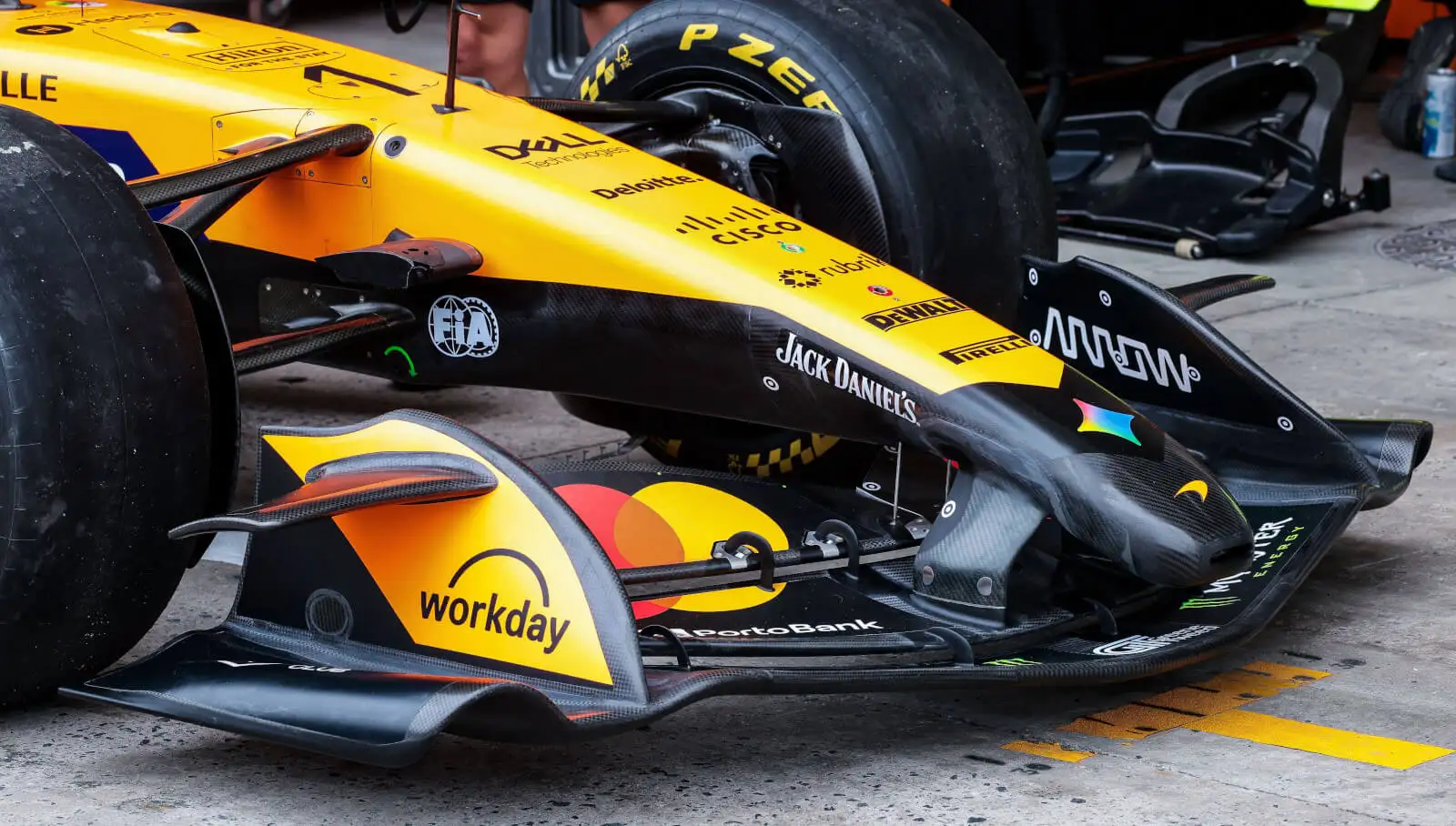
McLaren arrived in Brazil with a brand-new front wing design, offering a sneak peek of the team’s F1 2027 plans after McLaren revealed the concept would “carry over” into next season.
In this detailed breakdown, we explore the core philosophy of the Woking engineers and the direction their development path is taking.
The latest upgrades for the 2026 McLaren
McLaren was the sole team to roll out updates in Brazil; alongside the aforementioned front wing, the team redesigned its rear wing, diffuser, and floor elements.
Intriguingly, McLaren confirmed that this front wing architecture will carry over into the 2027 season, giving us our very first sneak peek at next year’s technical landscape.
Ahead of the weekend, chief technical officer, Aerodynamics, Peter Prodromou, said: “While the learning we take from these upgrades will feed into next year’s development, we also expect to carry over the concept of the new front wing into the launch specification of next year’s car.”
A side-by-side comparison reveals that the shift from the old specification is drastic, completely altering the philosophy of the front wing.
The most striking visual change is on the mainplane, which now flows smoothly into the lower surface of the endplate to form a continuous, unified assembly, eliminating the abrupt junction previously seen between the two elements (highlighted by the green line in the image below). Consequently, the overall curvature of the mainplane is now reduced.
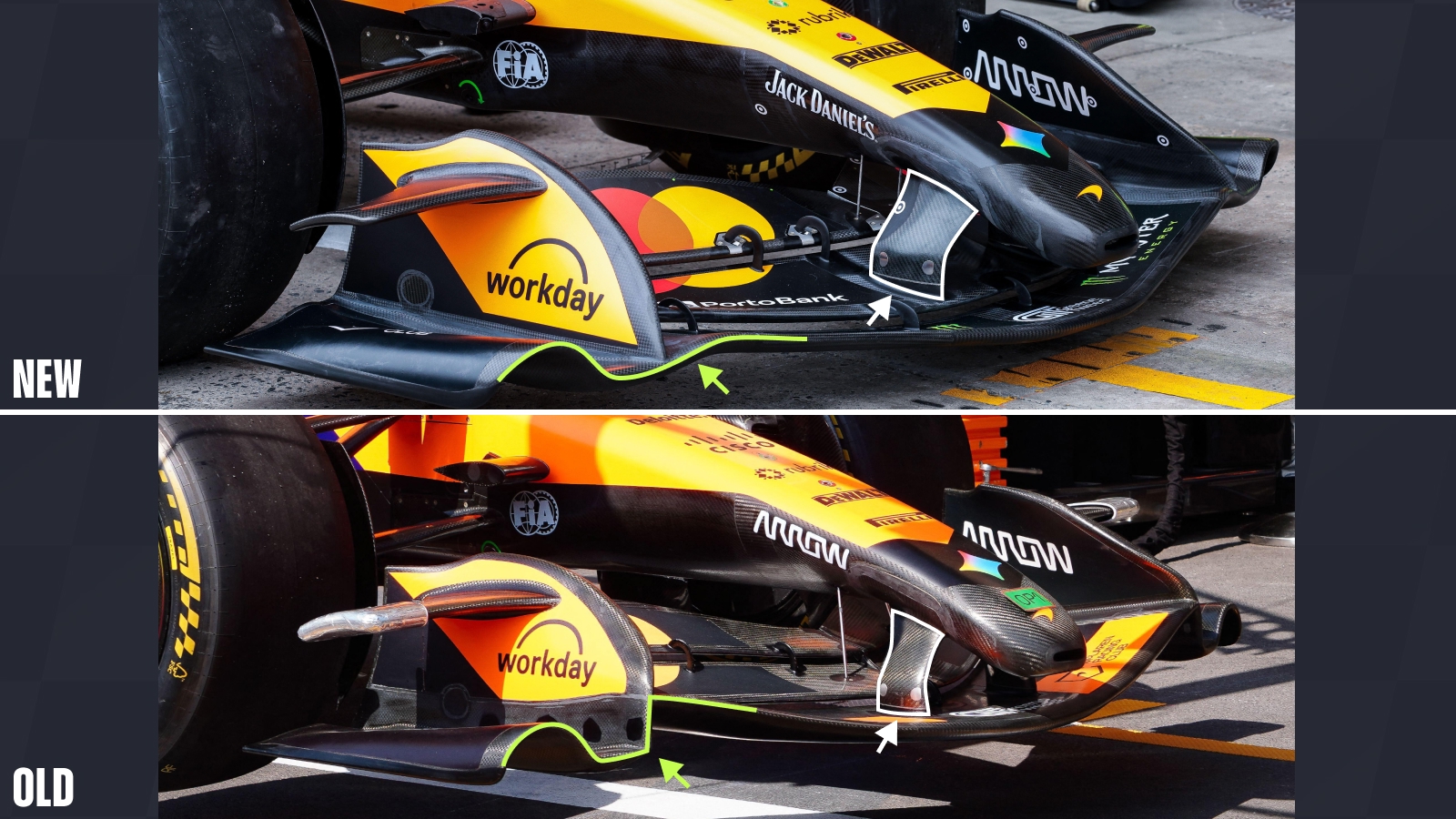
Comparison between new and old McLaren front wing
Perhaps an even more significant modification concerns the nose mounting architecture. In the revised layout evaluated during Friday practice in Brazil, the front wing mounts directly to the second flap element rather than the mainplane. This single change triggers a cascading series of adjustments.
First off, instead of two movable elements, McLaren now utilises only a single active flap element—the uppermost flap—which drops to shed drag along straight-line sections.
“This implies the team has accepted a trade-off that may introduce slightly higher straight-line drag, but the resulting airflow redirection is more beneficial for the overall aerodynamics of the car.
Furthermore, the mounting pillars (white arrow) have been shifted slightly rearward and increased in surface area, offering greater scope for managing airflow in this critical region — an advantage McLaren has undoubtedly exploited.
Beyond that, component dimensions have evolved: the mainplane is noticeably smaller now that it no longer houses the nose pylons, while the third and sole active element is visibly larger, as confirmed by trackside photography.
And if you remember Mercedes’ last major upgrade, you’ll know they did the exact opposite — switching from a single movable element to two. What’s really interesting is that both teams switched philosophies in the exact same way during the second half of the season when it came to sidepod geometry.
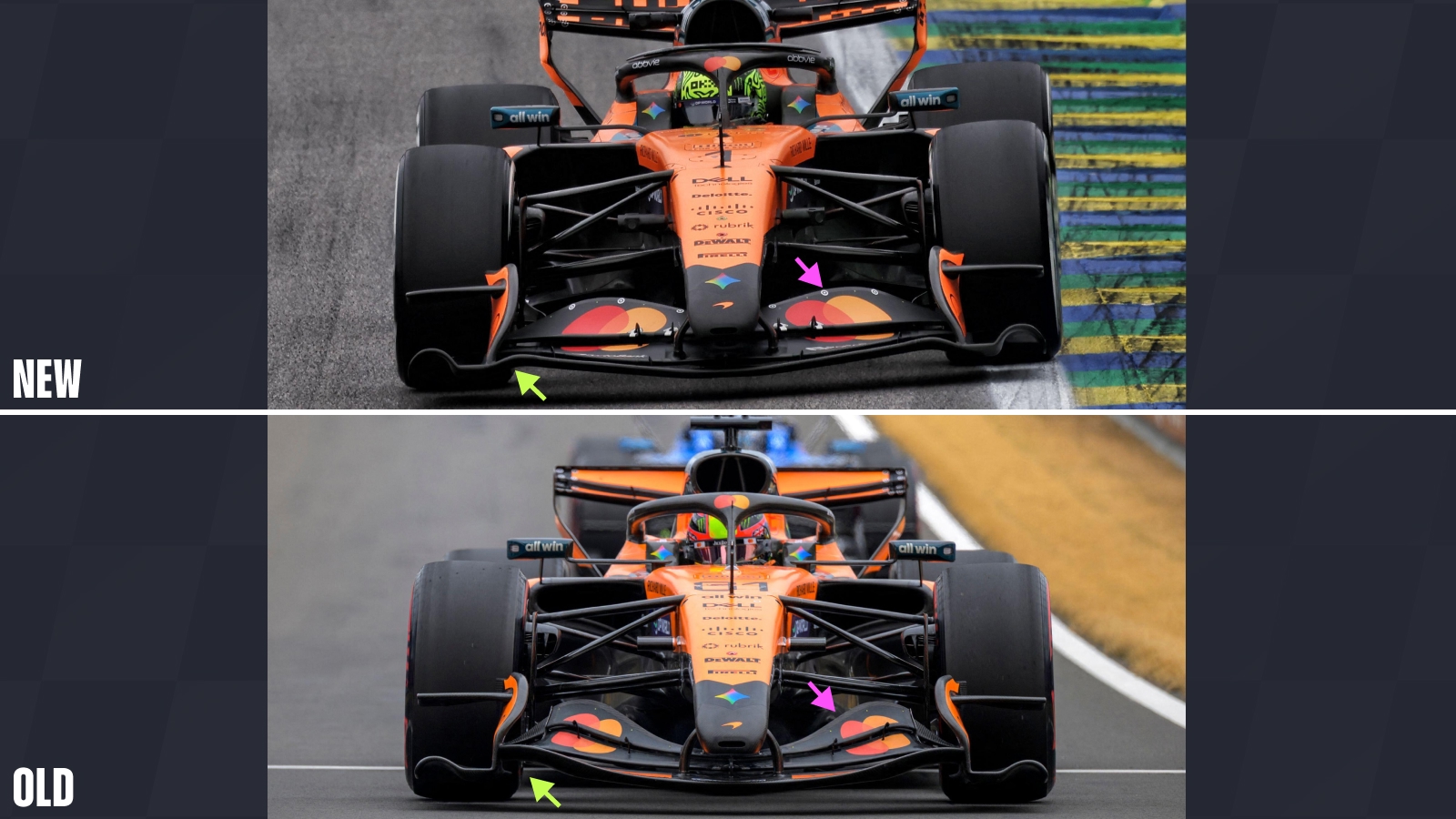
Comparison between new and old McLaren front wing
The primary objective of this new package is to scale up not only the localized downforce generated by the assembly, but also the overall aerodynamic efficiency of the front wing.
Because the front wing is the primary point of contact with clean, undisturbed air, it serves as the ultimate tool for shaping airflow behaviour. While generating downforce is part of its job, engineers design front wings primarily to dictate how airflow is sculpted and fed downstream toward the rest of the car.
During Friday practice sessions, the team applied flow-viz paint to evaluate the new design, allowing engineers to verify that the physical hardware on track performed exactly as predicted by computer simulations and wind tunnel testing. One particularly revealing image highlights the outwash generated by the front wing, which sweeps the turbulent wake of the front tyres away from the bodywork.
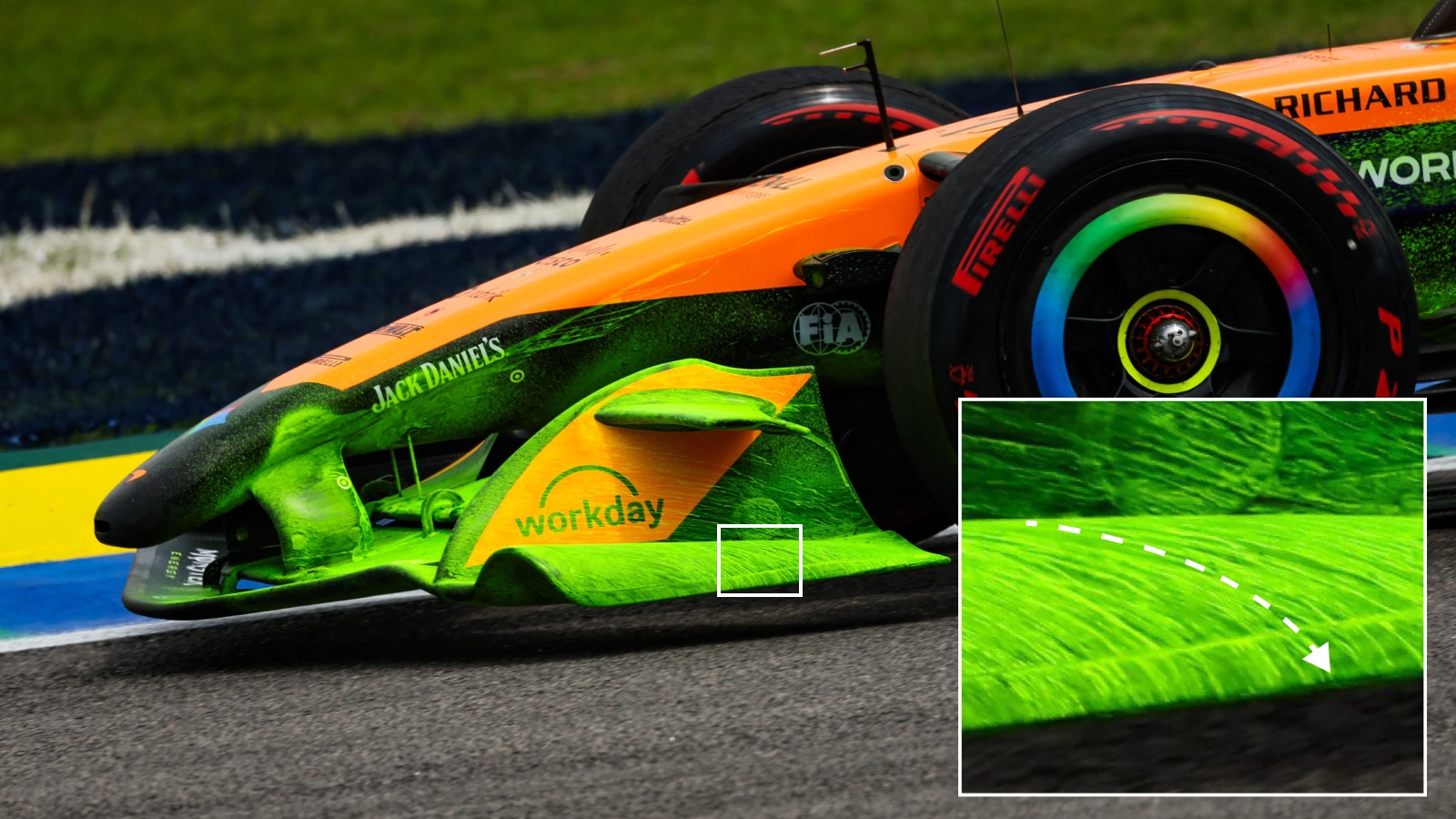
Detail on McLaren’s new front wing
Turning to the other updates, the rear wing also received a comprehensive re-profiling. The second and third active elements were reduced in size, with the mainplane expanding slightly to compensate.
Unlike the front wing, the primary mandate here was almost certainly pure downforce generation. Another intriguing detail is the addition of small hangers on the uppermost element—a solution adopted across much of the grid this season.
Once again, high-resolution flow-viz imagery offers a interesting glimpse into the micro-aerodynamics of a Formula 1 car, illustrating precisely how these tiny supplementary elements optimise rear wing performance.
Examining the upper edge of the top flap in the image below, you can spot a fluorescent green horizontal line of concentrated colour marking the airflow separation (white arrow on picture bellow). Ideally, separation is something aerodynamicists want to avoid entirely on a rear wing, but in reality, it occurs on almost all modern F1 cars due to exceptionally aggressive wing geometries.
Crucially, that boundary line dissipates right around the location of those small elements, offering tangible proof that these auxiliary attachments successfully suppress separation, thereby boosting rear wing efficiency and total downforce output.
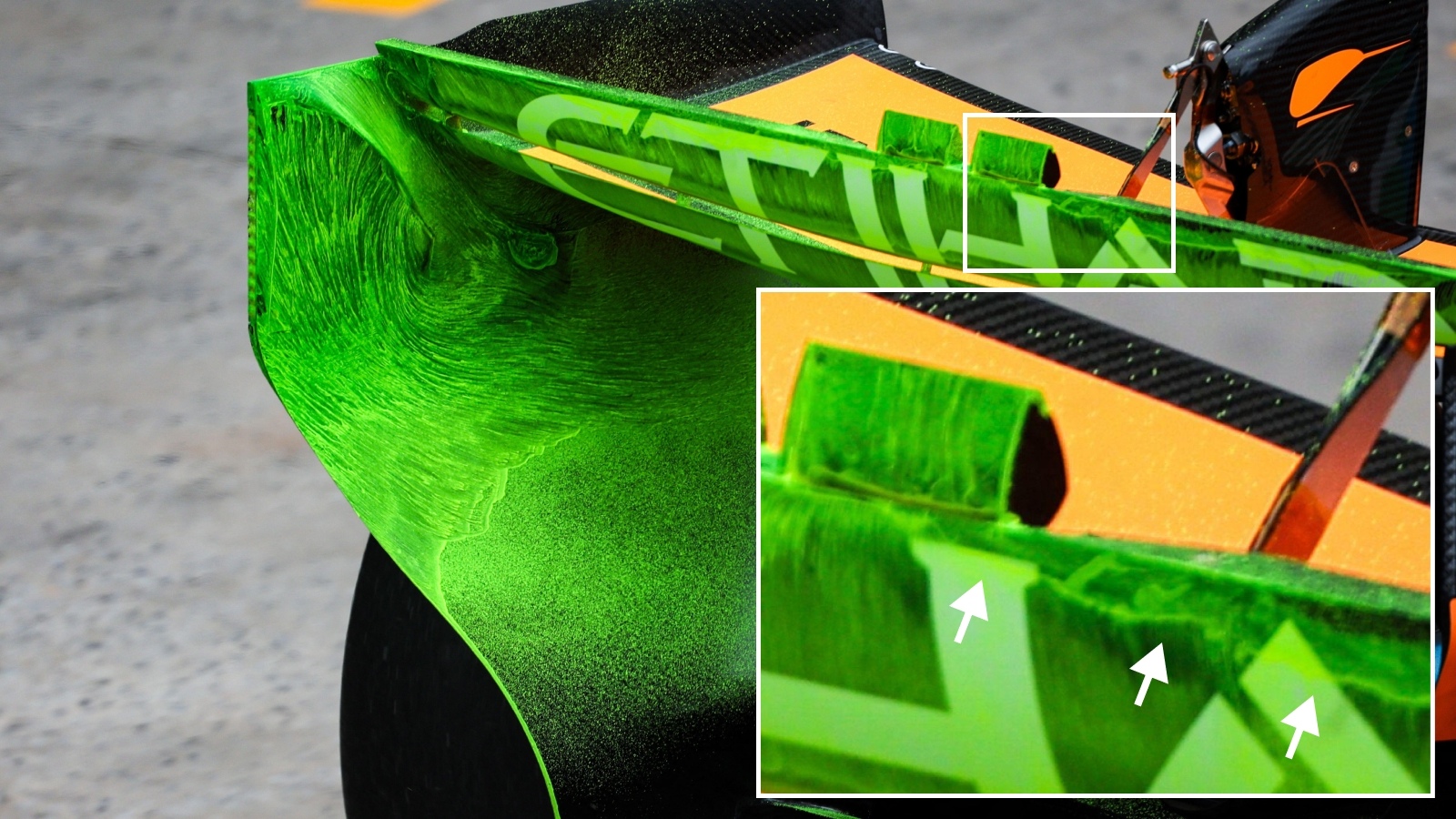
Detail on McLaren’s new rear wing
While it remains challenging to quantify the exact lap time gain delivered by this new package, McLaren looked punchy as Lando Norris turned his pole position into a second Grand Prix win at the Interlagos circuit.
Read next: Brazilian GP conclusions: Hamilton talking his way out, Russell crying out, big Lawson dilemma