
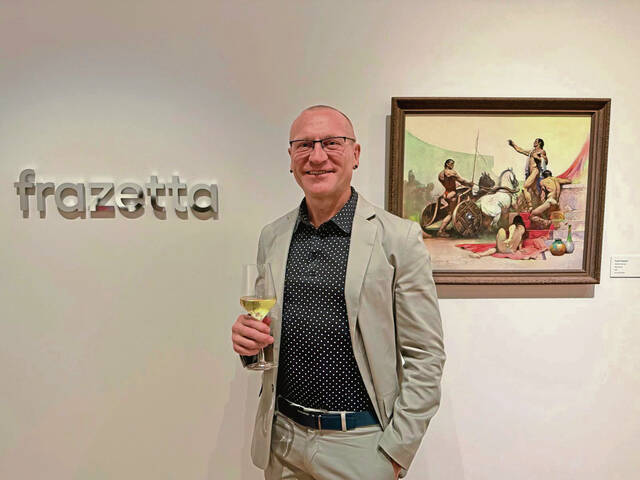
Lance Laspina considers himself living testimony against the adage “never meet your heroes.”
Laspina, who graduated from Penn-Trafford in 1988, was 16 years old when he met the person who inspired his love of art — East Stroudsburg science fiction and fantasy artist Frank Frazetta.
Without that meeting, Laspina isn’t sure he would have produced the documentary that recently debuted at George Lucas’s Museum of Narrative Art in Los Angeles.
In 1987, Laspina, now 56, of Atascadero, Calif., and his parents drove about 4½ hours east to Frazetta’s Fantasy Corner — a museum of Frazetta’s artwork in East Stroudsburg. It was Laspina’s first time seeing Frazetta’s work in person.
Frazetta’s wife, Ellie, told Laspina he could meet his artistic inspiration upon the store’s closing in 15 minutes, when he was scheduled to pick her up from the museum.
“I had my own artwork that I brought with me to show him. He was
very nice and cordial, and it was very encouraging, which is embarrassing for me to think about these days,” Laspina said with a laugh. “But it made an impression on me.
“They tell you ‘Don’t meet your heroes, because you’re going to be disappointed.’ Well, it was just the opposite for me. It made me want to know him even better, and I think that probably played a big part in, several years later, wanting to actually do this documentary.”
Laspina’s “Frazetta: Painting With Fire,” which was released in 2003, will be on display in the Lucas Museum of Narrative Art for five years. Lucas himself selected the documentary for the museum’s Robert Flaherty Theater, Laspina said.
Film interest
A free video camera sparked Laspina’s interest in film making.
His father won the device for reaching a sales threshold in his job at a local lawn and garden shop. Soon, Laspina began asking his teachers at Penn-Trafford High School if he could swap their written essay assignments for video productions.
He attended film school at the University of Southern California. After graduating in 1992, he moved back to Westmoreland County and began working small storyboarding jobs. He took a visual effects job after moving to California with his wife in 1997.
But the job was tiring, Laspina said. Between navigating hectic Los Angeles traffic and early mornings and late nights spent working, the job became a grind.
That’s when Laspina started reflecting on his meeting with Frazetta a decade prior.
“I knew I was going to be turning 30,” he said, “and I always wanted to make a film, so I put that mental pressure on myself. I wanted to start doing this film before I turned 30.”
‘Kind of a mystery figure’
Laspina believed Frazetta would be the perfect subject.
Only one video interview, filmed at East Stroudsburg University, existed at the time.
“He was kind of a mystery figure,” Laspina said. “No one really heard him speak or saw many photographs of him. They all knew his artwork, but not many people knew much at all about Frank — the person or the artist.”
Laspina sensed it wouldn’t be easy to get Frazetta and his family on board with the idea.
“I had a feeling that there was a reason why a documentary had never been made before (about) him,” he said. “I knew it wasn’t because of lack of interest. I knew that other people probably had tried and either failed or got turned down.”
Laspina gathered a group of friends and set out to find artists who were influenced by Frazetta. They recruited artists at San Diego Comic Con in 1999 and 2000, conducting interviews in a quiet room separate from the convention center activity.
He edited the seven interviews into a proof of concept-style video and mailed it to Frazetta’s family in Pennsylvania.
The team got a phone call from the Frazettas about a week later, said Shane Patrick White, the creative consultant for the documentary.
“It was really a love letter,” said White, 56, of Seattle, Wash. “And I think that love came through in the interviews we did with people who admired Frank and who were heavily influenced by him.”
Ellie Frazetta gave Laspina the green light.
“She said, ‘We’ve gotten a lot of videos like this, that people have tried to do something, and we’ve not really liked any of them,’” Laspina said. “She said ‘This is the first one that we all really enjoyed and felt was done well.’”
The documentary came out about 3 ½ years later — seven years before Frazetta’s death.
White described the process as a “fly-by-the-seat-of-your-pants situation.”
“Lance just took on so much work,” he said. “I think it took him a year just to edit the thing and do all the special effects. He’s just one of those guys who, once he envisions something, he won’t let go and he’s got to see it through.”
Documentary on display
More than two decades later, the Lucas Museum of Narrative Art contacted Laspina about featuring the documentary in the new facility, which opened Sept. 22.
Lucas, the creator of the “Star Wars” films, first envisioned the museum in 2011, according to the Associated Press.
The $1 billion institution includes paintings from artists such as Norman Rockwell, activist murals by Judith Baca and Diego Rivera, a portrait of Frida Kahlo and a statue of “Star Wars” character Princess Leia portraying a scene from the 1983 film “Return of the Jedi.”
The museum’s Robert Flaherty Theater plays a series of documentaries nonstop during its open hours, Laspina said. He estimates “Frazetta: Painting With Fire” plays about three or four times per week.
White was proud to know their work would be seen by the museum’s audiences for the next five years.
“Making a film is a miracle, no matter if it’s big or small,” he said. “It’s a series of thousands of miracles coming together to create this thing. And to do it at this level, I think, is one of those high points that was really cool to share with a really good friend.”