
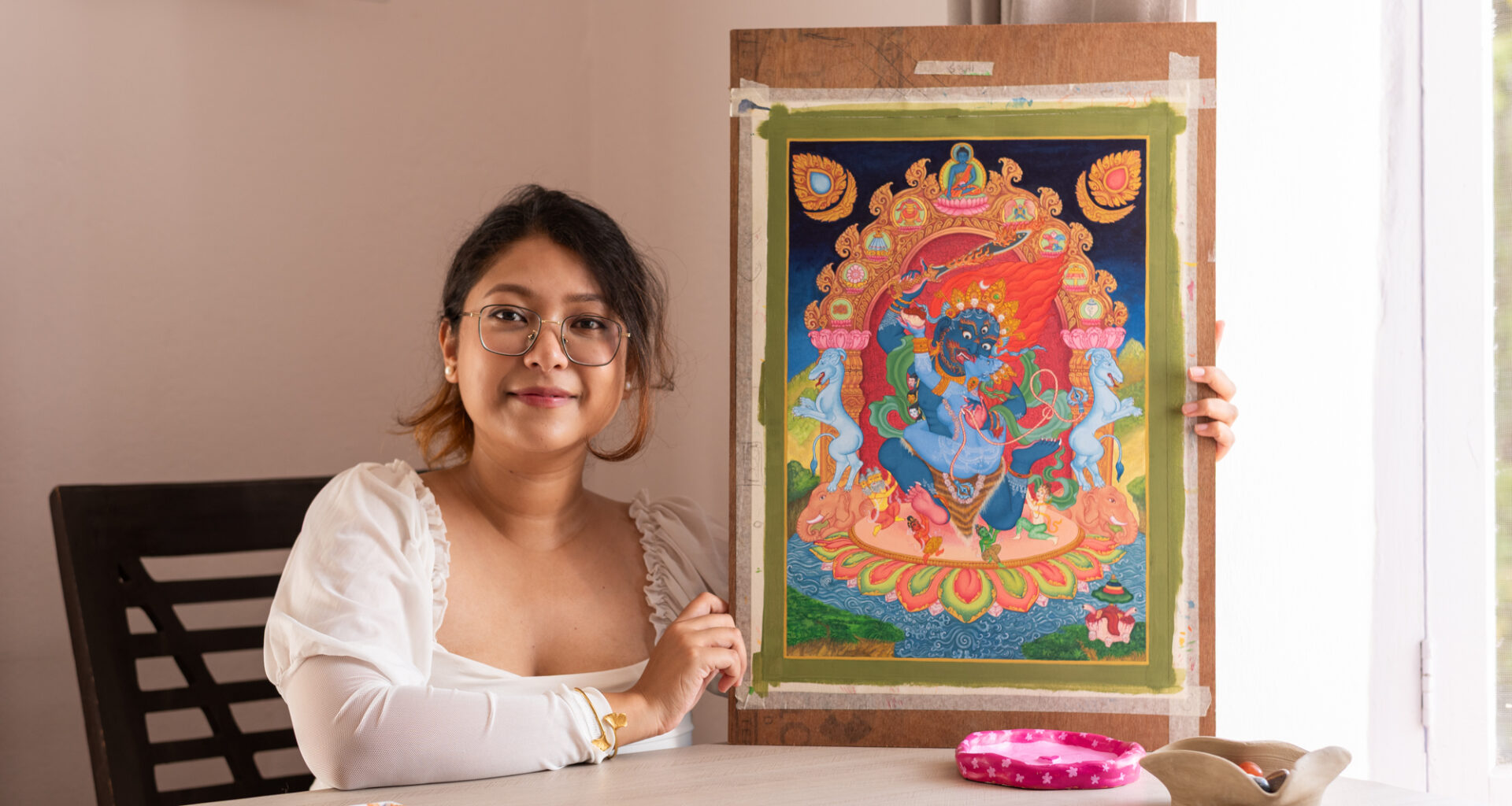
For years, a painting—old, fading and slightly damaged—hung quietly on the wall of her grandfather’s room. Ishuta Shrestha walked past it daily without a second glance.
About a year and a half ago, she enrolled in a class to learn the ancient Newa art of Paubha under master painter Lok Chitrakar. In his studio in Patan, surrounded by images of gods, she found a medium where her philosophical inquiries could take physical form.
One night, while journaling in bed, she thought suddenly of the painting in her grandfather’s room. After days of studying the motifs and patterns of traditional Newa deities in class, she realised what had always been there.
“I saw the patterns,” Shrestha recalls. “I took the frame down. It was around 11pm. I turned on all the lights, used a flashlight, and realised, this is indeed Paubha. I had been seeing this sacred image for years without knowing what it was.”
The figure was Candamahārosana, a wrathful deity in Vajrayana Buddhism. She felt it as a silent, universal calling. This realisation became the foundation for her exhibition.
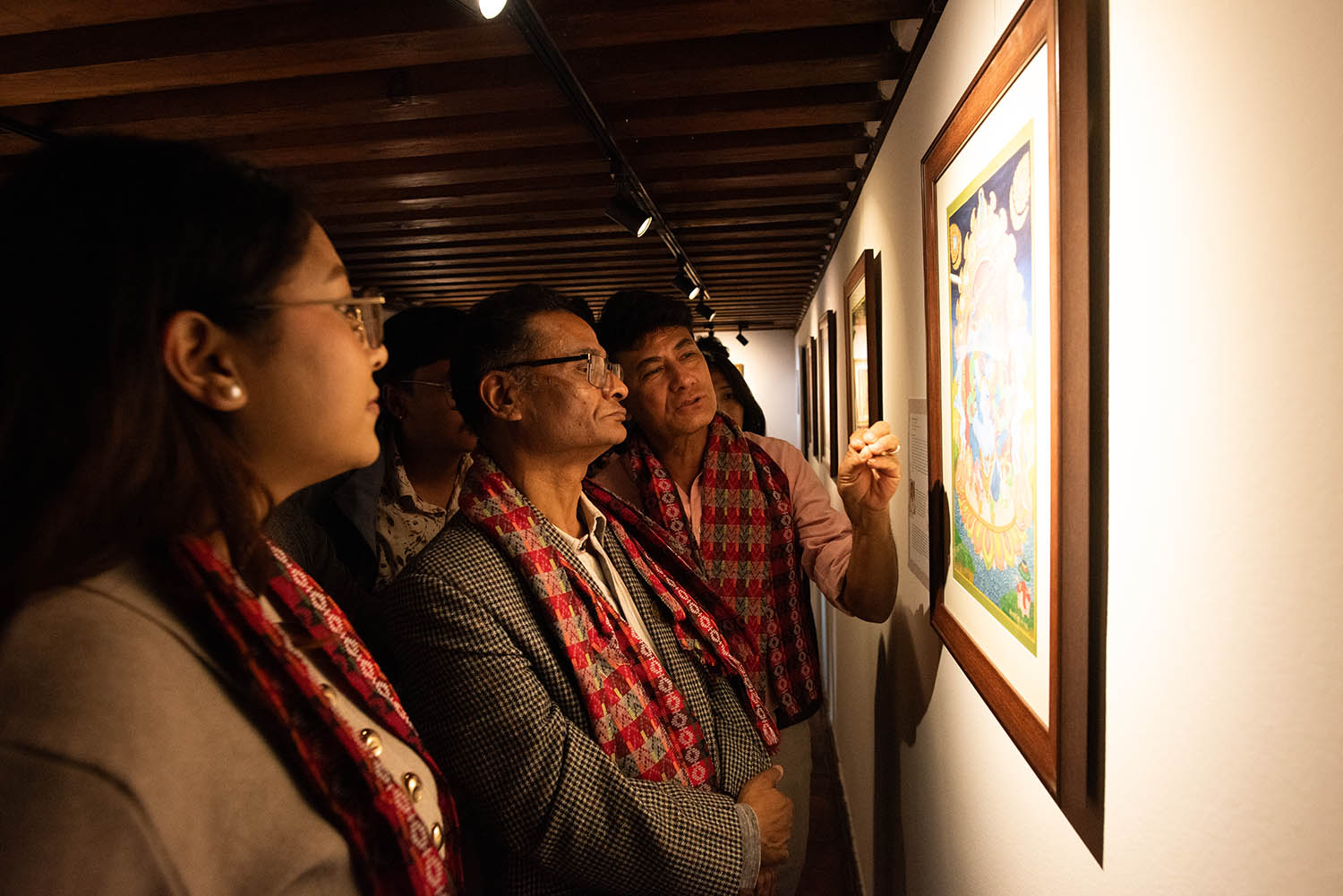
The exhibition—ABHYĀSA: Tradition in Making—opened at the Patan Museum on Saturday and will run until November 20. It features paintings by participants of the Kathmandu-based studio Drawing Room’s advanced Paubha course and its 15-day intensive workshop. The show is Drawing Room’s first dedicated Paubha showcase. It brings together works by 18 participants alongside their mentor Narendra Malla and marks the culmination of the introductory workshops and the newly introduced three-month advanced training.
Shrestha never knew why her grandfather owned that painting. No one in her family came from an art background or had any training in Paubha.
Shrestha grew up sketching freehand and had always enjoyed painting. Before joining the class, she had been overwhelmed by her work. Learning Paubha became an escape, a practice in patience and a more sacred form of art. “I was an atheist until I was about 25,” says Shrestha, who is now 29. “But when life became difficult, I began exploring. I wanted to understand why people believe in God, why they are so spiritual. I began observing and then I wanted to test it.”
That questioning guided everything. Why do we make these offerings? Why do we perform these rituals? Why do certain deities demand our fear? Each question led her deeper, and eventually, to Paubha.
She later joined an advanced Paubha training under Narendra Malla at Drawing Room. There, she began to develop her own style and identify the subject she most wanted to paint: Candamahārosana.
Shrestha is drawn to wrathful deities—figures that are often misunderstood, particularly through a Western lens, as ‘scary’ or ‘evil’. Her exhibition seeks to challenge those misinterpretations. In Paubha, she explains, the fierce expressions of these deities do not signify anger. They represent fierce protection: an intense energy directed at destroying the devotee’s ego and self-sabotaging habits.
Her painting ‘Candamahārosana’ explores the union of compassion and wisdom. The male deity embodies compassion and skillful means (upāya), while his consort represents transcendent wisdom (prajña). The deity is poised just before movement, embodying compassion guided by wisdom. The copper lasso (pāśa) represents the restraining of destructive impulses, and the sword (khaḍga)) represents the power to sever ignorance.
This symbolism is embedded in the iconography of the work. “The sword is to cut through ignorance, while the rope is there to pull us back whenever we begin to harm ourselves through self-sabotaging behaviour,” Shrestha explains. Even the deity’s kneeling posture, which at first glance suggests submission, captures the moment just before a leap: an entity poised to spring upward to help a devotee.
The painting’s purpose, ultimately, is to transform negative emotions into enlightenment through the combined power of compassion and wisdom.
Shrestha says she finds her strength in sketching; her greatest challenge lies in adapting to Paubha’s structured rules. “In the beginning, I found the rules incredibly restrictive,” she says. “I wondered, where is my own identity in this? But as I kept painting, I realised that the discipline itself is the practice. By limiting the elements, you learn to specialise and find depth.”
She adds, “In Paubha, the deity itself is the source of light, like how the flame of a candle does not cast a shadow, the deity itself is the light. Therefore, the background should not have cast shadows. The light emanates from within the subject.”
Sanjeev Maharjan, cofounder of Drawing Room, says that because Paubha is often seen as overwhelming, requiring years of intense study, they designed a 15-day course so that people from non-art and diverse professional backgrounds could participate. Across eight editions, more than 80 people, including doctors, architects, designers, professors and counsellors, have joined the workshops, he adds.
Malla says he began practising Paubha 12 years ago at the age of 19. Becoming a teacher was an unexpected evolution. Encouraged by his own teacher, Lok Chitrakar, and given a platform by Drawing Room, he took on the foundational classes as a challenge, focusing on technical skill while pushing students to research the iconography of their chosen deities.
“Teaching makes you realise that explaining what you know in a simple way is a completely different skill from painting itself,” Malla says. “Initially, I never expected an advanced course to emerge from a 15-day workshop. It happened organically because the participants themselves asked to go deeper.”
Shrestha says that what she loved the most about that fading painting in her grandfather’s room was the image of compassion taking wisdom along and leaping into action. “It made me realise that the male and female principles don’t mean men are compassionate and women are wise,” she says. “We all move along a spectrum of masculine and feminine, and each of us holds both compassion and wisdom. Before we leap, we must carry our wisdom with us and keep our compassion beside it.”