
In this extract from Rooms Volume Two, Douglas Lloyd Jenkins explains why New Zealanders love neutral colours and makes a case for boldly embracing different hues.
Syrie Maugham did not have much to say, nor did she leave much theoretical writing. There are not many clever quotes or philosophical
bon mots, perhaps because her husband, the novelist and playwright Somerset Maugham (they hated each other), had that market sewn up. One of the few things she is on record as saying was, “If you don’t have £10,000 to spend, I don’t want to waste my time.”
Syrie is easy to dismiss as a society decorator working for wealthy clients. Here, in New Zealand, we have never taken professional interior decorators to heart, let alone lauded a wealthy one. Syrie (“The Princess of Pale”) is famous for one thing – in 1927 she invented the monochrome interior in the form of the All-White room, and that reason alone probably justifies her a place on our banknotes.
In 1927 white was the most fashionable colour in the world because only the very richest people could keep it clean. Maugham’s achievement was not that she took a bucket of Cardrona, Black White or Infinity and drenched the room, but that she took the colour of her day and created a sophisticated symphonic effect. Maugham knew that in minimising colour she also needed to maximise the effects of tone by using multiple whites (as any paint-chart connoisseur knows, these are endless), and to work particularly hard with texture and reflection to compensate for the absence of colour. To do this she arranged mirrors, stuffed vases with concoctions of white flowers and used the feathers of white peacocks – she even went as far as dipping her curtains in a cement solution to ensure not only the desired shade of white but also that they hung the way she wanted. All in all, the All-White room was indulgent madness, created at the height of fashion for the pursuit of pale, and for this it should be applauded.
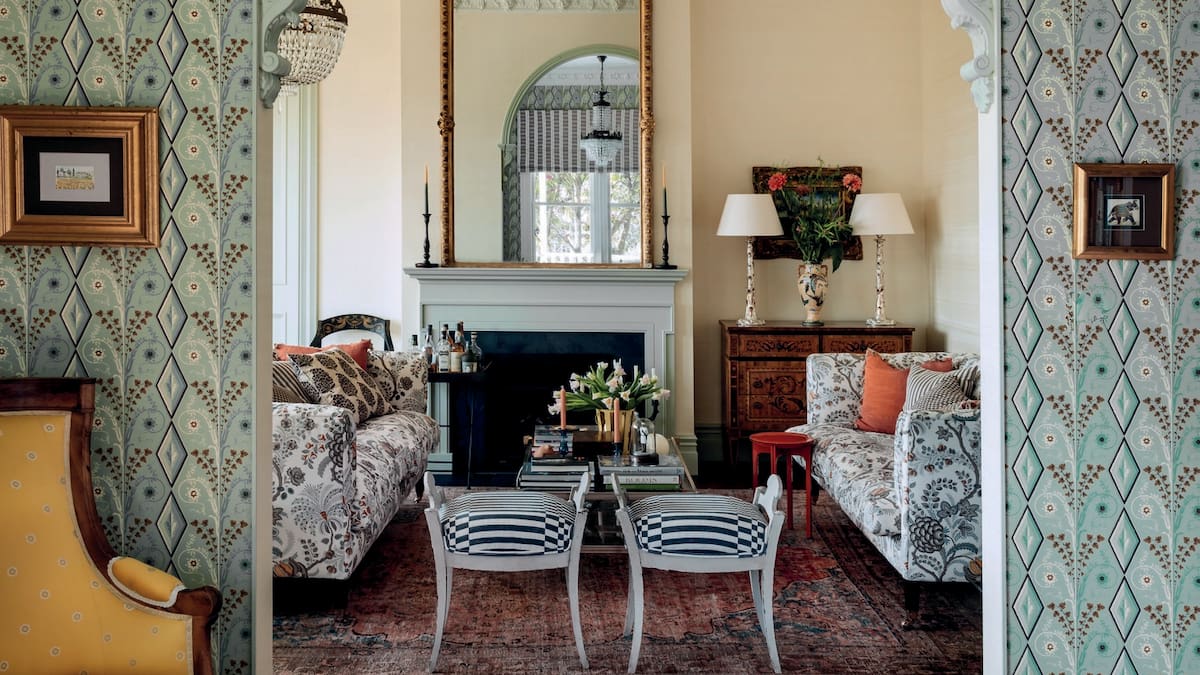
Former ad agency man Daryl Watt and his late wife Judy filled their Greytown home with modern and antique pieces, including works by Bill Hammond, whom Watt went to high school and Ilam art school with. Photo / Jane Ussher
The understanding of colour and its widespread use is a sign of cultural confidence. Think India, Mexico or Sweden, where tradition has ensured the continued presence of colour and where passionate vibrant colour is a national characteristic.
As Marc Chagall expressed it, “colour is all. When colour is right, form is right”.
If this is true, then New Zealand is not yet quite right. Here neutrals have settled in as a marker of national character, perhaps reflecting a decline of confidence.
Many believe neutral stands in for good taste, when in fact it stands for a collective failure of courage. It is hard for an interior to “wear an individual air” or to denote any kind of emotion or passion when denuded of colour.
St Albans House in Christchurch was designed by the owners to replace the original cottage on the site, damaged in the 2011 earthquake. Photo / Jane Ussher
Passions, publicly expressed, are embarrassing – as New Zealanders, we don’t like them. As we have become less confident, less economically secure, more culturally divided and less well educated aesthetically, we have become cautious, less likely to make bold choices, and as a result avoiding colour has almost become a national pastime.
New Zealanders prefer black. We know black. It dominates our sports teams, our casual clothes, our fashion sector and, even if it seldom appears in our interiors, black “coffin-houses” are becoming dominant features in rural landscapes. Black suits us, not only because it offers up the comfort of conformity but also because, as the colour of death, it represents the absence of any perceivable passion. Choosing black won’t embarrass us.
In this St Albans house, the artwork above the stool is by Robyn Kahukiwa, and the framed Christchurch map was designed by C1 Espresso Company. Above the poster hangs a photograph of the 2024 Hīkoi mō Te Tiriti. Photo / Jane Ussher
The creators of the rooms in this book (and its predecessor) are cultural and aesthetic outliers; a small but creative group of New Zealanders who think differently, passionately and seriously about a culminative art and culture and the role they play in our domestic lives.
These are children, women and men who have a clear and individualised vision of how the domestic environment might look and how a home might function. Some are just starting out on their journey, while others have been perfecting these rooms for decades.
Despite appearances, most are richer in imagination than they are financially. They come from diverse backgrounds and various parts of the country. Some live in rambling rural idylls; others live in highly contained spaces within pressured cities. Some are concerned with reflecting and understanding cultural heritage, while others are about actively supporting the contemporary arts. All are, to different extents, challenging received perceptions of what it means to be at home here.
Rooms Volume Two: More portraits of remarkable New Zealand interiors by Jane Ussher and Douglas Lloyd Jenkins, Massey University Press, $90 RRP, out now.
Rooms Volume Two: More portraits of remarkable New Zealand interiors by Jane Ussher and Douglas Lloyd Jenkins, Massey University Press, $90
RRP.
More home & interiors inspiration