
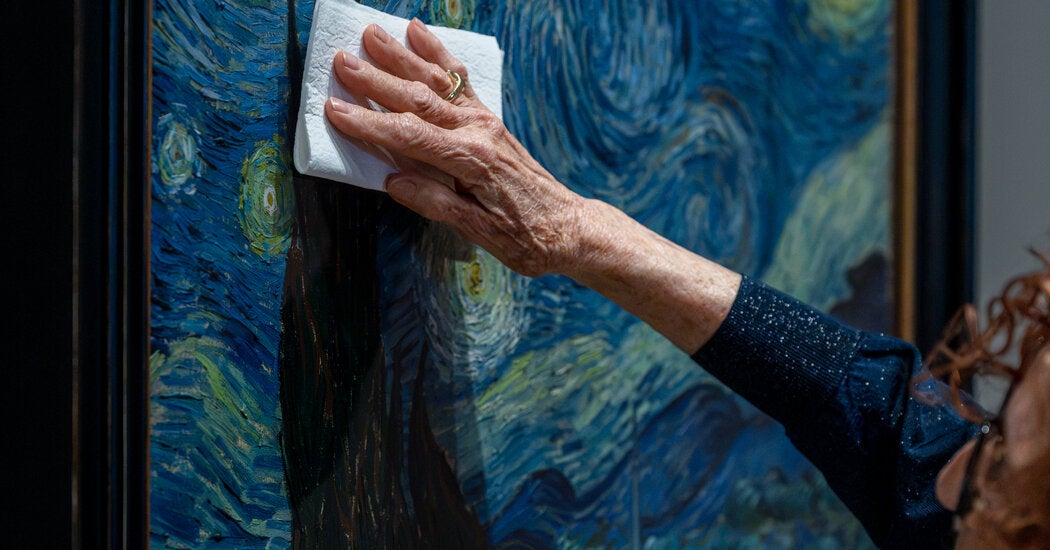
Not all artists in the museum have their names on the walls. The practice of maintaining these masterpieces is itself an art, requiring a patient mind, a gentle hand and a sharp eye. “When you have the opportunity to look at things so close, you get a little bit into the mind of the artist,” said Ms. Aviram.
It’s a dynamic relationship between a conservator and the paintings they care for, one with its own secret language.
Take the monumental Jackson Pollock on view on the fourth floor. Between July 2024 and June 2025, the museum saw nearly three million visitors, many of whom may have paused to glance at the action painting masterwork.
But few would notice the handprints on the edge of the canvas. Ms. Aviram believes they indicate that the artist must’ve touched the paint before it was dry. “You learn what tools they use, how they refine strokes using different things — their fingers, a sharp tool, a soft tool,” she said.
Ms. Aviram, who was born in Mexico City, once had intentions of becoming an artist in the traditional sense. She studied art after high school, but “I wasn’t doing that well,” she said. “I wasn’t going to be a good painter.” So she pursued conservation instead.
In 1986, she traveled with the work, as a courier, to the Kunstmuseum Basel for an exhibition of Monet’s waterlily paintings. He had made hundreds, obsessively, toward the end of his life.
But once she arrived, Ms. Aviram knew something was off. “These other Monet triptychs that they were in the show, they were very matte,” she said. “Monet worked very hard to achieve that matte-ness,” she explained, by using blotting paper to remove some of the oil from his paint. Looking at the other pieces, Ms. Aviram said, “I realized that ours was wrong.”
The erroneous sheen was the result of previous efforts to restore the work, according to Ms. Aviram.
In 1958, before MoMA even had this triptych in their collection, a fire had broken out at the museum, completely destroying another Monet piece. In response, the conservation department formed, and the museum acquired three new Monet paintings, the “Water Lilies” triptych that’s currently on display, to replace the lost work. But the newly acquired Monets were damaged from World War II, which the museum tried to reverse.
“There was a lot of old restoration that didn’t look well,” Ms. Aviram said. A tear on one of the panels was repaired crudely, and the varnish was too shiny. After realizing this, Ms. Aviram and a team of scientists and conservators embarked on a two-year project to fix MoMA’s “Water Lillies.” They sifted through old documents, took samples and analyzed pigments, painstakingly restoring the work to what they hoped was Monet’s original ambition.
To the everyday museum visitor, who might spend mere seconds looking at a painting, all of the work that went into creating it — and saving it — remains largely invisible.
Ms. Aviram gently pressed a sponge against one of the panels. Monet was visually impaired, she noted, suffering from cataracts. Spending time with the paintings and noticing the minute details within them — the thickness of the paint, hidden splotches of red — “you start appreciating, truly, how he achieved this,” she said.
Iconic works of art — Picassos, Kahlos, O’Keeffes and Monets — have a sense of permanence, serving as symbols of our collective humanity. But Ms. Aviram’s work proves that they’re anything but immortal. Just like people, they age, they fade, they wear. Likewise, as one gets older, “the face, the height — everything starts falling apart,” she said.
She slowly stepped down from her ladder, completing her annual ritual for the last time.