
From the ocean floor to the night sky
Before he pointed a camera upward, Simon pointed it down to the sea, first. He was a diving instructor and spent years shooting underwater photographs, a discipline that turned out to be ideal training.
“The theory and the principles behind photography don’t change,” he said. “It’s still to do with your aperture size, your exposure, ISOs.” The only real difference: “Instead of looking down now underwater, I’m looking up at the sky.”
His first purchase was a compact smart telescope, a small, largely automated instrument that pairs a lens with a built-in camera. The modest aperture gathers light slowly, so each picture demands patience. “To be fair, it produces really good images,” he said. “It just takes a lot longer.”
His photo of the Heart Nebula, for example, took 13 hours to make. He shot hundreds of 30-second exposures over several nights and combined them into a single image.
How to photograph something 1,300 light-years away
The process starts with what astrophotographers call polar alignment. In the Northern Hemisphere, the North Star holds steady while the rest of the sky wheels around it, so Simon first points his telescope toward it. The instrument takes three photographs to work out exactly where on Earth it is and how it is oriented.
Then comes plate solving, in which software matches the stars in the frame against a map of the sky.
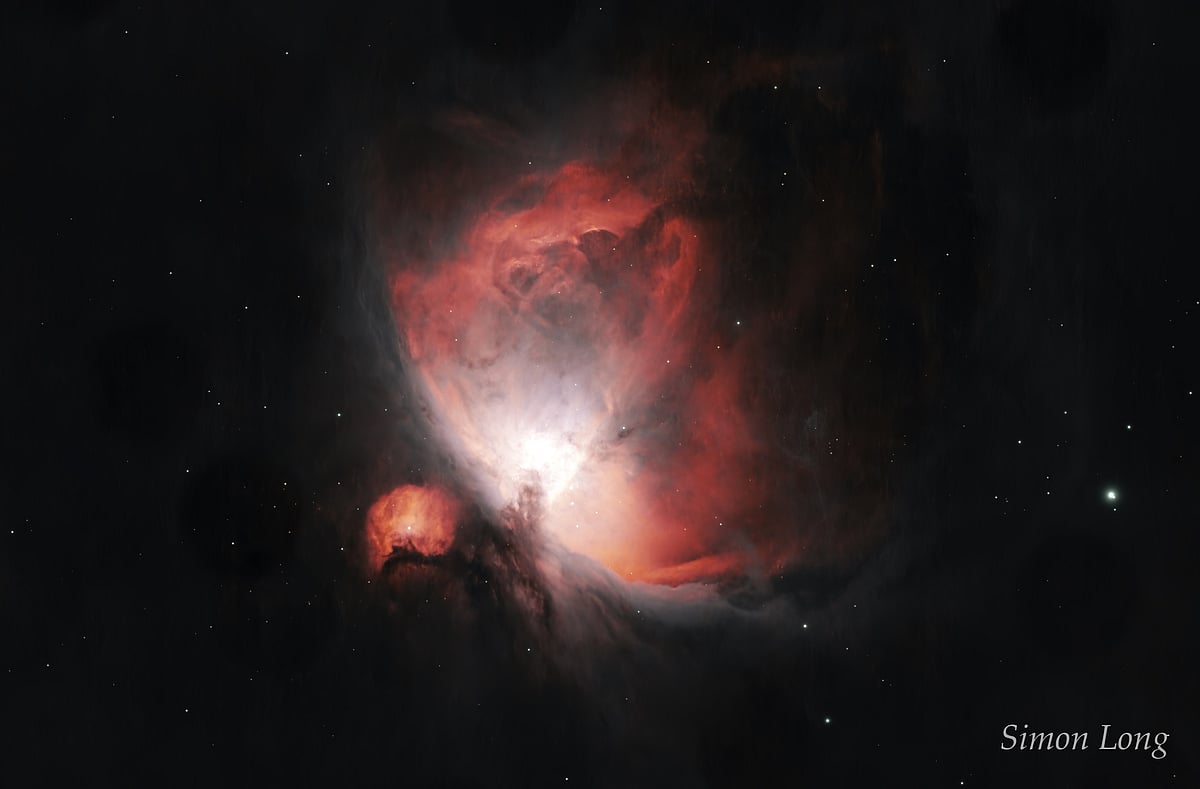
After that, finding a target is almost anticlimactic. Every object has a catalog number. The Orion Nebula, for instance, is Messier 42.
“I just type in M42, enter, and the telescope points and centers on the Orion Nebula,” he said. “I can do that night after night after night for as many times as I want.”
The repeatability is the secret. As the telescope can return to precisely the same patch of sky, he can collect exposures over several nights and stack them, building up faint detail that no single frame could catch. His larger rig, run by a separate controller, follows the same routine.
Orion, California and the Horsehead: A winter menu
The sky is seasonal, and Simon plans around it. The Orion Nebula, a stellar nursery about 1,300 light-years away, has only just climbed back above the horizon after months out of view. It will stay with UAE stargazers until roughly March. The summer Milky Way, which he photographed in the desert, will not return in full until around the same time.
Winter is when the showpieces come out. The California Nebula, a long ribbon of glowing hydrogen in the constellation Perseus, takes its name from its uncanny resemblance to the outline of the American state. It is faint to the eye and rewards exactly the kind of long, patient exposures he favours.
He is especially fond of the Horsehead Nebula, whose dark silhouette rears against a glowing backdrop. “That’s got three different types of nebula in it,” he said: dark, emission and reflection.
A telescope in the carry-on
The small telescope has another virtue: It travels. With a compact tripod, the whole rig fits in his hand luggage. Over Eid, he took it to Zanzibar, where the island’s position near the Equator opened up a slice of sky he cannot see from the Gulf.
“When you go to different places, you see different sections of the sky,” he said. “There’s always going to be something new you can photograph.” That, he added, is half the appeal.
Dipping a toe in: Where UAE beginners can Start
For residents curious to look up, Simon’s first advice is about timing. Winter is the season. It is dark by 7 pm and stays dark until about 5 am, giving roughly 10 hours of night and perhaps seven of true astronomical darkness. In summer, that window can shrink to four.
You do not need a telescope to begin. With good binoculars, he said, you can pick out both Andromeda and the Orion Nebula. To find Orion, locate the three stars of Orion’s Belt, start from the bottom star, then look a little across and down. The nebula sits there.
Lakshana is an entertainment and lifestyle journalist with over a decade of experience. She covers a wide range of stories—from community and health to mental health and inspiring people features.
A passionate K-pop enthusiast, she also enjoys exploring the cultural impact of music and fandoms through her writing.