
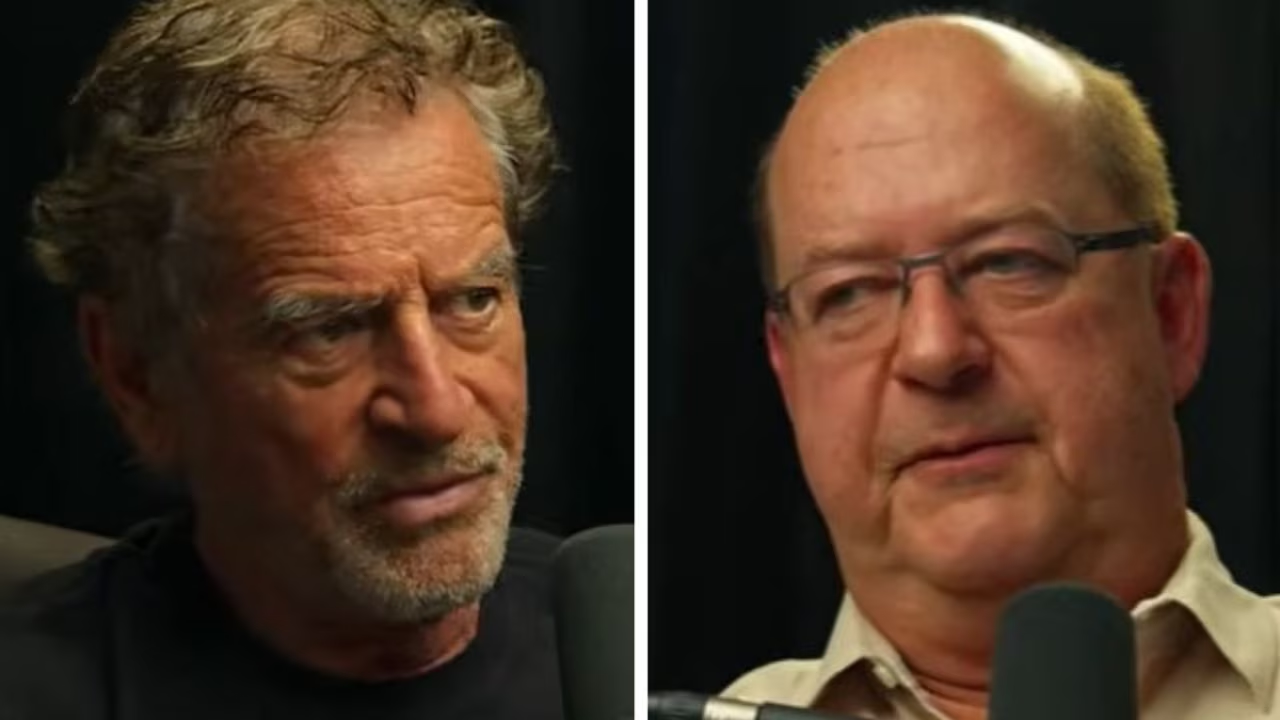
A top economist has issued a brutal reality check for Australian homeowners, warning the golden era of property wealth is officially dead as a painful recession looms.
Speaking on Mark Bouris’ Straight Talk podcast, Judo Bank’s economic forecaster Warren Hogan declared that a downturn is now virtually unavoidable, while delivering a dire prediction for the housing market that will send shivers down the spines of Aussies with mortgages.
Mr Hogan warned the extraordinary wealth generated by bricks and mortar over the past three decades is over, soon to be replaced by an era of stagnant growth and stubbornly high interest rates.
“House prices in Australia will barely outperform inflation for the next 20 years,” Mr Hogan said.
He explained that the property market is already fracturing, predicting a peak-to-trough fall of up to 12 per cent before finding a baseline in autumn next year.
But the real pain lies in the long-term economic forecast.
“Most bubbles are like five years, like the tech bubble in the turn of the century, and then it bursts and it all comes crashing down,” he said. “And that’s the way people think about a bubble bursting. This is a boom that doesn’t continue.”
If you are interested in finance, check out our new podcast, Stress Tested. Subscribe for a new episode landing on Thursday.
MORE:Warned: Shock detail RBA missed in rate hike
Mr Hogan explained that the property explosion was heavily fuelled by artificially cheap money following the Global Financial Crisis (GFC), with real interest rates hovering around zero for a decade and that era of free cash is gone forever.
“Up until the GFC it was all about our productivity and we were a richer nation and we could not only afford the higher debts because we had a better income,” he said.
“Then it all changed after the GFC because of the big crisis overseas… and the RBA was forced to bring our rates down and we had our real interest rate around zero for most of the 10 years before the pandemic when it probably needed to be more like one-and-a-half or two.
“That reality meant you got cheap funding for housing here and that’s where we probably overcooked it.”
Economic reckoning is looming
Mr Hogan did not mince his words about the broader economy, declaring a downturn is already knocking at the door.
“I think we’re going to get a recession,” he said bluntly. “It’s just what type of recession.”
He warned that if the Reserve Bank of Australia is forced to push interest rates even higher to combat sticky cost-of-living pressures, it could trigger a disaster.
Mr Hogan suggested a nightmare scenario where the cash rate is forced up to 6.5 per cent, a massive jump from the current 4.35 per cent.
“You know what a 6.5 per cent cash rate will do to this place? It will trigger a financial crisis,” he warned. “Particularly to the 40 per cent who have got mortgages and all their small and medium enterprises.”
He slammed the Reserve Bank’s recent handling of the economy, describing their reluctance to hike rates harder and earlier as a failed experiment.
“It was an experiment around unemployment and inflation and interest rates,” he said, noting the central bank mistakenly believed they could keep unemployment at historic lows without fuelling inflation.
“Their experiment really ignored all that and said, you know, we’ve got this unusually low unemployment rate and we’ve had this low inflation for the last 15 years… let’s just try and not overreact with interest rates.”
MORE:‘Until 2028’: Bad news for Aus homeowners
Instead, he argued the central bank should have followed the “go hard, go early” philosophy to stamp out inflation before it embedded itself in the system.
“I think we’re now looking back, and this may well be the accepted wisdom over the next decade, you actually jump on it. You actually raise rates harder and quicker and get on top of the inflation.”
‘Worst culprits’: Hogan points finger
However, Mr Hogan reserved his most scathing criticism for the government, blaming out-of-control spending for pouring petrol on the inflation fire.
He noted that the economy has a structural speed limit of about 2 per cent growth, but governments are currently spending at a rate of 3 per cent.
“The absolute source of all the unstable or unsustainable macroeconomy in Australia right now is that we need to grow at one-and-a-half per cent for a couple of years,” he said.
“And the governments of Australia, and not just the feds, the states as well, but the feds are probably the worst culprits, are growing at three.”
He said this reckless spending leaves the Reserve Bank with no choice but to punish the private sector and mortgage holders with higher interest rates.
“If we don’t wake up each day and hit F9 on our spreadsheet and say, ‘Oh, I can’t go to lunch because that’ll be inflationary’ … if we go about our business, if we’re out there spending as consumers or businesses investing and hiring, but that’s too high, then the RBA is left to enforce restraint on the private sector through higher rates,” he said.
Mr Hogan argued that federal government recurrent spending needs to be slashed drastically to bring the economy back from the brink.
“Federal government recurrent spending right now is 11.3 per cent of the economy or GDP. For 50 years, from the early seventies all the way through to about 10 years ago, it was 7.5 per cent on average,” he said.
“We have to cut the size of government, federal government recurrent, not investment. And you know there’s a whole range of different elements of it. The care economy, the size of the public service, but it needs to be cut by between 10 and 20 per cent.”
Silver lining for younger Aussies
While the picture looks grim for property investors and retirees relying on asset wealth, Mr Hogan said there is a massive silver lining for younger generations.
He predicted a historic intergenerational wealth transfer driven by chronic labour shortages as the baby boomer generation exits the workforce.
With fewer workers available, wages will skyrocket, meaning young people will finally hold the financial power.
“In the next 20 years I don’t think asset prices are going to do as well as they have in the last 30, but of course wages is because there’s labour shortage and incomes are going to do well,” he said.
“So you’re going to see the intergenerational transfer through strong wages and incomes and poor asset performance.”
He painted a vivid picture of how this wealth transfer will play out in everyday Australian suburbs.
“The way to think about it is, you know, your upper middle class person in Sydney or Melbourne, you’re say 70, you’ve got $10 million worth of assets … and at the moment you’re paying $1500 to have your hedges done every six months,” he said.
“Well, in five years’ time, you’ve got $8 million worth of assets and your hedges cost 10 grand. That’s how the young ones get the money. The people getting the money, the people doing the hedges are the young ones. So they’re making more money.”
But getting to that point will require surviving the current economic storm, which Mr Hogan warned is unlike anything the nation has faced in modern history.
He said everyday Australians are rightfully angry because they have suffered through an unprecedented five consecutive years of declining living standards.
“Australians have never experienced anything like this. I mean, we are used to getting 1 to 2 per cent improvement in our living standard every year,” he said.
“We have maybe the odd year out of every five where nothing happens. But we’ve had five years in a row. I mean, this might have happened in World War II, but guess what? There was a pretty good reason for it in World War II.
“It’s a failure. It’s a failure of what I call the modern Australian economy.”
You can watch the full episode on YouTube.