

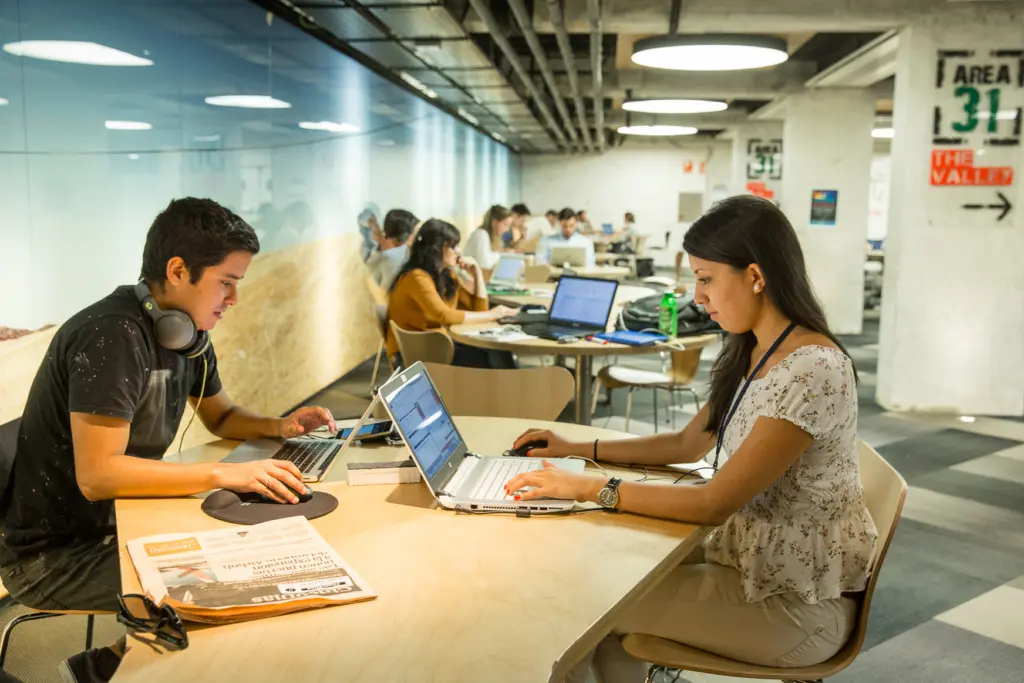
Students working at Area 31, IE University’s flagship startup incubator.
INSIDE IE BUSINESS SCHOOL’S WINNING FORMULA
The challenge for IE MBAs Sarfaraz Singh Wahad and Siddharth Raiyani was detecting potential infrastructure failures before they caused costly disruptions.
Their solution? Antervid, a sensor-based technology developed to detect early warning signs.
Wahad’s and Raiyani’s path from concept to first customer reads almost like a map of IE’s expansive entrepreneurial ecosystem.
The founders first took their idea to IE’s Tech Venture Bootcamp where it was recognized as one of the camp’s most promising projects. Antervid was then invited into IE’s Venture Lab in spring 2026 where the founders worked on the business strategy and market validation. They refined their approach with support from the International MBA’s Startup Lab, and found their first paying customer, Indian Railways.
The startup also gained provisional acceptance of a €30,000 bid through the Tata Innoverse Challenge and an opportunity to attend Web Summit in Lisbon.
“We believe entrepreneurship goes beyond launching a startup,” José Lejarraga, Director of IE’s Entrepreneurship Area, tells Poets&Quants. “Our ambition is to develop ‘value builders,’ people who can use entrepreneurial thinking to launch ventures, pursue acquisitions, invest in businesses, or create value within established organizations.”
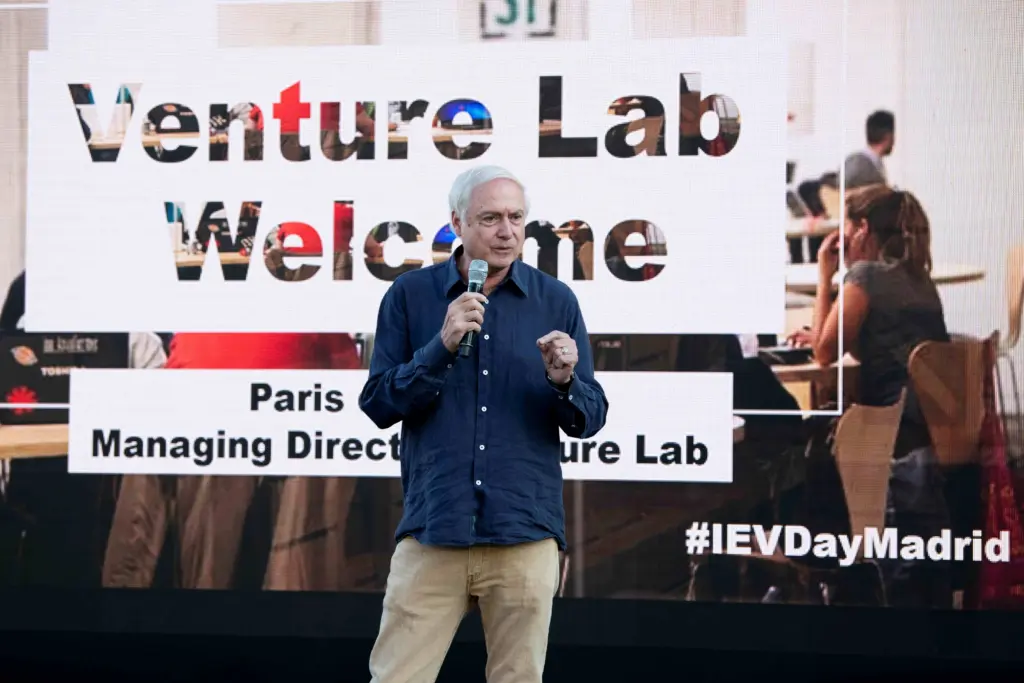
Paris de l’Etraz, Managing Director of IE University’s Venture Lab, speaking at IE Venture Day.
MORE THAN ONE WAY TO BUILD A BUSINESS
Entrepreneurship is embedded throughout IE’s MBA curriculum. Over the past several years, the school has expanded its entrepreneurial offerings through specialized labs, serving more than 1,000 students across IE’s academic programs per year. The school hopes to grow 2,000 over the next year.
This number includes more than 300 MBAs from the latest cohort participating in its M&A Lab, gaining experience evaluating and structuring transactions. About 50 joined the Search Fund Lab, which prepares aspiring entrepreneurs to acquire and operate existing businesses. Six MBA teams participated in the Private Equity & VC Lab.
The school also plans to launch new entrepreneurship labs focused on real estate and deep technology.
The International MBA has students from more than 60 countries, bringing diversity in both perspective and potential opportunities. Entrepreneurship fundamentals are taught early in required courses, and students have the chance to enter Startup Lab by month seven or eight to develop their ideas.
From there, MBAs may advance through Venture Lab which supported 252 student teams in its most recent cohort. There they are connected with mentors and potential investors. Team-building sessions help founders recruit co-founders and students without ideas find teams to join.
Mentors in the eight-week program guide teams through ideation, validation and product-market fit. Students test ideas with real users, build products in dedicated sessions and receive help securing their first customers. An incubator track is available to students who have not yet developed a minimum viable product while an accelerator track supports teams that do.
For Manuel Toledo Cabellero, Alberto Martín Hernández and Pablo Fandiño Carnero, IE’s entrepreneurship labs became the foundation for Graddus, an AI-powered platform connecting students with educational programs and career paths. The trio met during IE’s January 2022 International MBA intake, participated in Startup Lab that June, and entered Venture Lab later that year.
Graddus launched in 2023. Today, it reports more than 250,000 registered users and relationships with more than 20 educational institutions, including IE itself. The company has also raised seed funding from private investors and participated in Spanish public funding programs.
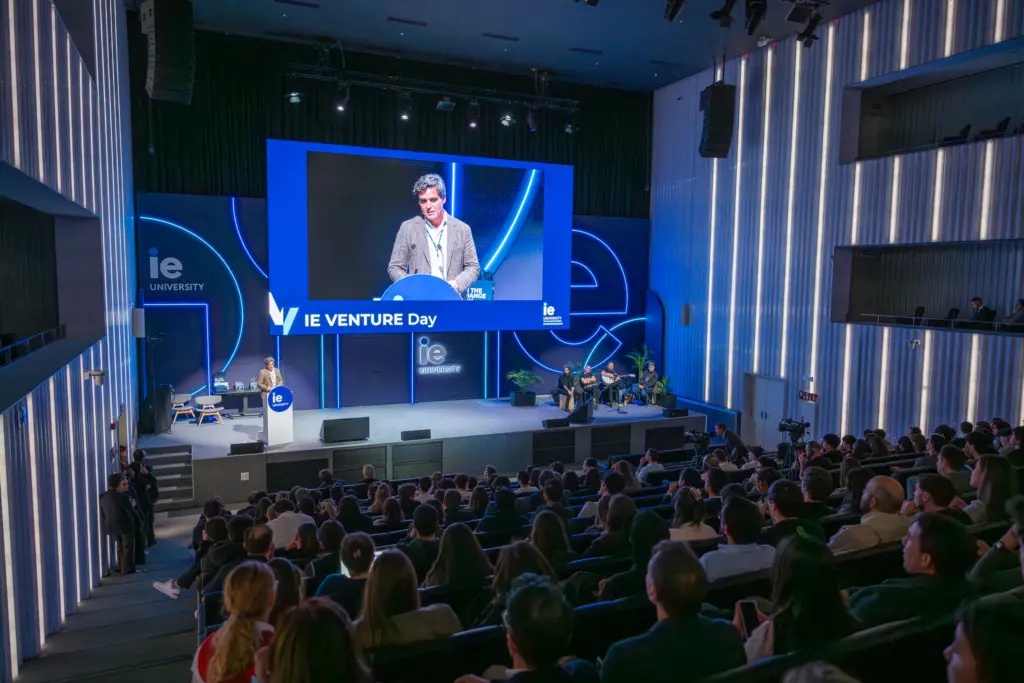
Juan José Güemes, Senior Vice President of Strategy and Corporate Growth and Chairman of IE University’s Entrepreneurship & Innovation Center, speaking at IE Venture Day at IE Tower in Madrid.
WHEN BUILDING GETS EASIER, FINDING CUSTOMERS GETS HARDER
As artificial intelligence makes it faster and cheaper to build working prototypes, IE and other business schools are putting greater emphasis on customer discovery and market validation.
The school’s introductory MBA course, Shaping Futures with AI, now incorporates AI-assisted coding and increasingly sophisticated AI agents that make it easier to run new ventures.
Finding paying customers is a different story.
“Building can be cheap; evidence for real demand is harder to obtain,” Lejarraga says.
Assignments may now prompt students to identify their riskiest business assumptions and test them with actual customers. In one project, an MBA team developed a WhatsApp assistant to help handymen in Mexico City evaluate incoming job requests, then tested it with 32 businesses.
IE is also developing coursework around building businesses with AI, including the possibility of “one-person companies” that use automation to operate with relatively few employees.
For IE, AI’s greatest promise isn’t simply making startups faster or cheaper to launch. It’s helping students build businesses that customers actually need. While most IE MBAs won’t become founders, or even aspire to become founders, those skills will help them create value wherever they end up after graduation.
“Our goal is to help students use AI to automate processes that should be automated while strengthening their own agency: exercising judgment, identifying opportunities, and developing the value-building skills that AI cannot replace,” says Juan José Güemes, President of the IE University Center for Entrepreneurship & Innovation.
NEXT PAGE: 2027’s Ranking of the World’s Best MBA Programs for Entrepreneurship
© Copyright 2026 Poets&Quants. All rights reserved. This article may not be republished, rewritten or otherwise distributed without written permission. To reprint or license this article or any content from Poets&Quants, please submit your request HERE.