
Cronkite News offers an audio version of this story using an automated voice created by AI. Errors in pronunciation, pacing and intonation may occur. If you notice an error please contact cronkitenews@asu.edu.
PHOENIX — The modern NBA is more skillful than ever, with different positions requiring players to do things players from other eras would never have imagined.
Centers such as Denver’s Nikola Jokic are initiating offenses, forwards are becoming primary ball handlers and shooting guards have a lot more on their plate when it comes to creating, both for themselves and others.
Traditional positions are getting rarer, while versatility and fluidity are the new normal.
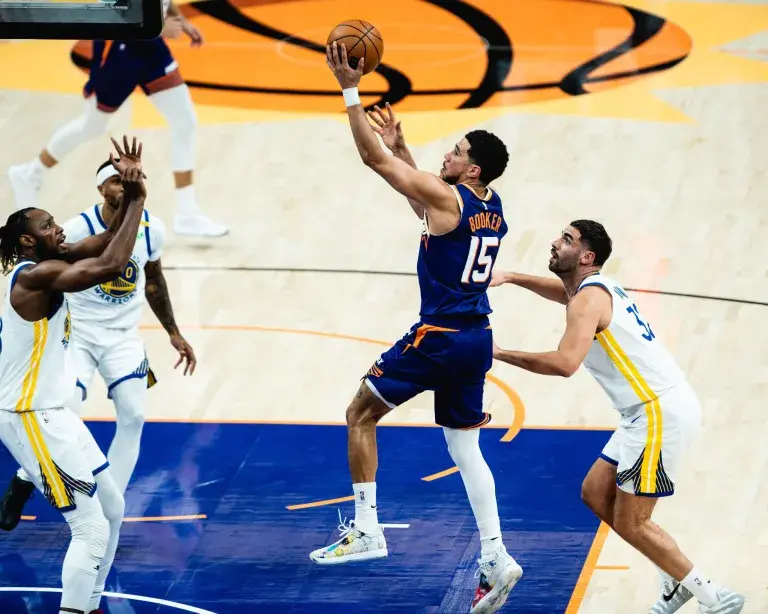
Phoenix Suns star Devin Booker has served as an example of that versatility throughout his career. He began his stint with the Suns in 2015 playing off ball before turning into one of the best players in the NBA alongside true playmaking point guard Chris Paul from 2020–21 to 2022–23.
Booker’s journey now requires him to shoulder more playmaking than ever before as he becomes a more-than-capable point guard.
But the Suns’ current backcourt construction of two natural shooting guards in Booker and Jalen Green raises a question: Just because Booker has shown the ability to be a good point guard, is that the role in which he thrives the most?
Just as important: Are the Suns best served by placing Booker in the role of facilitator?
Booker understands the importance of versatility, especially in the backcourt, and he has never shied away from using his.
“I don’t think there’s many traditional guards left in the league,” Booker said. “If you look around, maybe (Indiana Pacers’ Tyrese) Haliburton, maybe (Chicago Bulls’ Josh) Giddey or something. But I think everybody has the ability to score at the position. You have to do a little bit of everything. We all have to play off each other, you all have to be a threat. I think that’s the way the game’s moving to me.”
The evolution of the position has increased Booker’s value. Between his ability to score at all three levels, to creating open shots for his teammates, Booker’s legacy with the Suns is difficult to contest.
However, Booker’s most successful years in the NBA came when he played alongside Paul, one of the best true point guards of all time.
Paul’s tenure with the Suns lasted three seasons. During that span, when Phoenix went 160–77 in the regular season, reached the 2021 NBA Finals and had the league’s best regular-season record in 2021-22, Booker set career highs in both points per game (27.8) and field goal percentage (49.4).
Now Booker’s backcourt partner is Green, who – like Booker – was a score-first guard earlier in his career, but is now tasked with more playmaking responsibilities. Like Booker, Green played alongside passing point guards, including Fred VanVleet and Kevin Porter Jr., during his time with the Houston Rockets.
“It’s been different,” Green said of his transition to becoming a facilitator. “When I came to the league I was set up to score. I’ve always had the ball in my hands, but now it’s about slowing the game down.”
The evolution of both players as they learn how to effectively break down defenses with playmaking is important for them to coexist. Suns coach Jordan Ott praised Booker’s ability to thrive in different lineups, saying, “It’s what superstars do.”
Ott noted that during Booker’s career, he has seen every coverage, helping him adapt to circumstances quickly, along with relaying his vision to his teammates.
“Every night is different,” Ott said. “He’s the one that’s figuring out those things on the fly a lot of times, who to attack. He’s seen so many different scenarios in his career. That’s why we rely on him so much, because he’s been through it all.”
Hall of Fame coach Mike D’Antoni, best remembered as the architect behind the Seven Seconds or Less Suns and the James Harden-led Rockets, also agreed that having versatility between positions is simply keeping with the sport’s trends.
He was a pioneer of positionless basketball.
“Players are becoming multifaceted,” D’Antoni said. “Centers now can shoot 3s and run and put the ball on the floor, and they can run a pick-and-roll. I think players have evolved where you can kind of do everything.”
During D’Antoni’s first couple of seasons coaching the Suns, he had one of the best true point guards of all time in Steve Nash. However, he still gave Joe Johnson, the starting shooting guard, opportunities to initiate the offense, giving Nash a much needed break.
D’Antoni believes that in an ideal system, every player on the court needs to be comfortable initiating offense when needed.
“To me, the ideal team would be where everybody’s a point guard,” D’Antoni said. “Because when you really think about it, regardless of who brings it up, on that first pass the guy who has the ball is the point guard at that point, because he’s got to make a play, or he’s got to move it to another guy who becomes the point guard.”
During D’Antoni’s time in Houston, he was tasked with coaching a backcourt of Paul and Harden, who at the time were two of the NBA’s most ball-dominant players. For them to coexist, it wasn’t necessarily about forcing them to do things out of their comfort zone, but finding a balance to maximize their talents.
D’Antoni said Paul was willing to defer to Harden, prioritizing winning over individual ego. Their minutes also allowed each player to lead the offense, meaning that for all four quarters, the Rockets had elite point guard play. The pairing, however, only lasted two seasons, partially due to some frustrations on Paul’s side about Harden’s lack of involvement on offense when the ball wasn’t in his hands.
The Rockets example can still be applied to the Suns’ current backcourt, however. Neither Booker nor Green have to be traditional point guards to coexist, but they do have to find ways to elevate each other within the offense.
Based on the sport’s latest trends, the Suns don’t necessarily need to find a traditional point guard for Booker to thrive. In fact, so far this season, Booker is having his most efficient season since 2023-24. Through the team’s first 16 games, as the Suns went 9-7, he averaged 24.5 points and 5.4 assists per game on 47% shooting from the field, 33.7% shooting from 3-point range and a career-high 92.2% from the free throw line.
Booker has proven he can handle point guard responsibilities and still be a top player. The challenge is finding that balance within the roster so that even though he can, he isn’t always forced to do so.
This article first appeared on Cronkite News and is republished here under a Creative Commons Attribution-NoDerivatives 4.0 International License. 
Canonical Tag:
Copy Tag
Article Content:
Does Devin Booker need a traditional point guard to thrive with the Suns?
by Ethan Kinney, Cronkite News
November 24, 2026
Cronkite News offers an audio version of this story using an automated voice created by AI. Errors in pronunciation, pacing and intonation may occur. If you notice an error please contact cronkitenews@asu.edu.PHOENIX — The modern NBA is more skillful than ever, with different positions requiring players to do things players from other eras would never have imagined.
Centers such as Denver’s Nikola Jokic are initiating offenses, forwards are becoming primary ball handlers and shooting guards have a lot more on their plate when it comes to creating, both for themselves and others.
Traditional positions are getting rarer, while versatility and fluidity are the new normal.
Phoenix Suns star Devin Booker has served as an example of that versatility throughout his career. He began his stint with the Suns in 2015 playing off ball before turning into one of the best players in the NBA alongside true playmaking point guard Chris Paul from 2020–21 to 2022–23.
Booker’s journey now requires him to shoulder more playmaking than ever before as he becomes a more-than-capable point guard.
But the Suns’ current backcourt construction of two natural shooting guards in Booker and Jalen Green raises a question: Just because Booker has shown the ability to be a good point guard, is that the role in which he thrives the most?
Just as important: Are the Suns best served by placing Booker in the role of facilitator?
Booker understands the importance of versatility, especially in the backcourt, and he has never shied away from using his.
“I don’t think there’s many traditional guards left in the league,” Booker said. “If you look around, maybe (Indiana Pacers’ Tyrese) Haliburton, maybe (Chicago Bulls’ Josh) Giddey or something. But I think everybody has the ability to score at the position. You have to do a little bit of everything. We all have to play off each other, you all have to be a threat. I think that’s the way the game’s moving to me.”
The evolution of the position has increased Booker’s value. Between his ability to score at all three levels, to creating open shots for his teammates, Booker’s legacy with the Suns is difficult to contest.
However, Booker’s most successful years in the NBA came when he played alongside Paul, one of the best true point guards of all time.
Paul’s tenure with the Suns lasted three seasons. During that span, when Phoenix went 160–77 in the regular season, reached the 2021 NBA Finals and had the league’s best regular-season record in 2021-22, Booker set career highs in both points per game (27.8) and field goal percentage (49.4).
Now Booker’s backcourt partner is Green, who – like Booker – was a score-first guard earlier in his career, but is now tasked with more playmaking responsibilities. Like Booker, Green played alongside passing point guards, including Fred VanVleet and Kevin Porter Jr., during his time with the Houston Rockets.
“It’s been different,” Green said of his transition to becoming a facilitator. “When I came to the league I was set up to score. I’ve always had the ball in my hands, but now it’s about slowing the game down.”
The evolution of both players as they learn how to effectively break down defenses with playmaking is important for them to coexist. Suns coach Jordan Ott praised Booker’s ability to thrive in different lineups, saying, “It’s what superstars do.”
Ott noted that during Booker’s career, he has seen every coverage, helping him adapt to circumstances quickly, along with relaying his vision to his teammates.
“Every night is different,” Ott said. “He’s the one that’s figuring out those things on the fly a lot of times, who to attack. He’s seen so many different scenarios in his career. That’s why we rely on him so much, because he’s been through it all.”
Hall of Fame coach Mike D’Antoni, best remembered as the architect behind the Seven Seconds or Less Suns and the James Harden-led Rockets, also agreed that having versatility between positions is simply keeping with the sport’s trends.
He was a pioneer of positionless basketball.
“Players are becoming multifaceted,” D’Antoni said. “Centers now can shoot 3s and run and put the ball on the floor, and they can run a pick-and-roll. I think players have evolved where you can kind of do everything.”
During D’Antoni’s first couple of seasons coaching the Suns, he had one of the best true point guards of all time in Steve Nash. However, he still gave Joe Johnson, the starting shooting guard, opportunities to initiate the offense, giving Nash a much needed break.
D’Antoni believes that in an ideal system, every player on the court needs to be comfortable initiating offense when needed.
“To me, the ideal team would be where everybody’s a point guard,” D’Antoni said. “Because when you really think about it, regardless of who brings it up, on that first pass the guy who has the ball is the point guard at that point, because he’s got to make a play, or he’s got to move it to another guy who becomes the point guard.”
During D’Antoni’s time in Houston, he was tasked with coaching a backcourt of Paul and Harden, who at the time were two of the NBA’s most ball-dominant players. For them to coexist, it wasn’t necessarily about forcing them to do things out of their comfort zone, but finding a balance to maximize their talents.
D’Antoni said Paul was willing to defer to Harden, prioritizing winning over individual ego. Their minutes also allowed each player to lead the offense, meaning that for all four quarters, the Rockets had elite point guard play. The pairing, however, only lasted two seasons, partially due to some frustrations on Paul’s side about Harden’s lack of involvement on offense when the ball wasn’t in his hands.
The Rockets example can still be applied to the Suns’ current backcourt, however. Neither Booker nor Green have to be traditional point guards to coexist, but they do have to find ways to elevate each other within the offense.
Based on the sport’s latest trends, the Suns don’t necessarily need to find a traditional point guard for Booker to thrive. In fact, so far this season, Booker is having his most efficient season since 2023-24. Through the team’s first 16 games, as the Suns went 9-7, he averaged 24.5 points and 5.4 assists per game on 47% shooting from the field, 33.7% shooting from 3-point range and a career-high 92.2% from the free throw line.
Booker has proven he can handle point guard responsibilities and still be a top player. The challenge is finding that balance within the roster so that even though he can, he isn’t always forced to do so.
This article first appeared on Cronkite News and is republished here under a Creative Commons Attribution-NoDerivatives 4.0 International License.
Copy Content
Tracking snippet:
Copy Snippet