
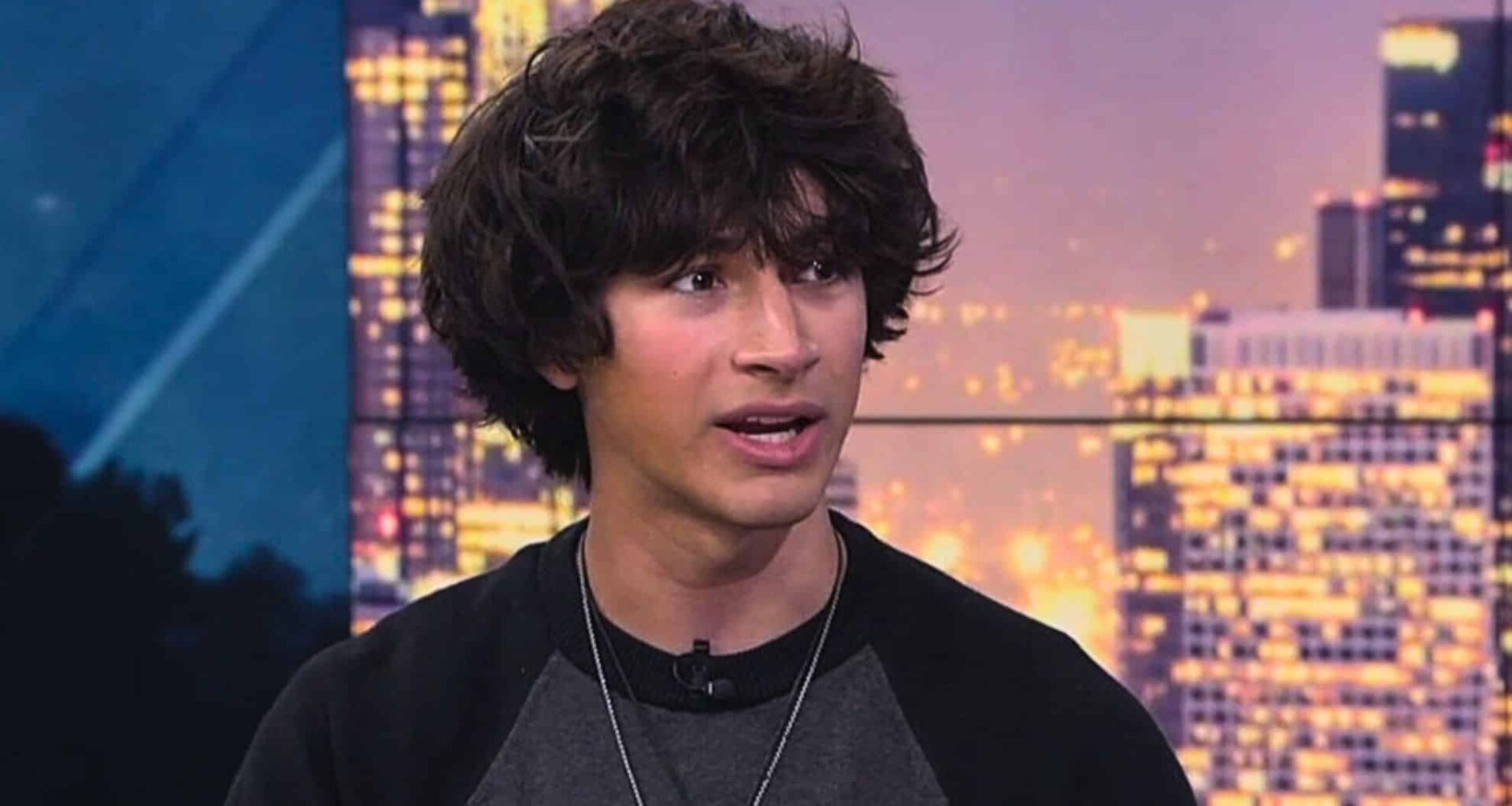
In what may be one of the most unexpected breakthroughs in modern astronomy, a high school student from California has used artificial intelligence to detect over 1.5 million previously unidentified space objects—all from data collected by a retired NASA mission. His work has now been peer-reviewed and published in The Astronomical Journal, giving it firm footing in the scientific community.
An AI Pipeline Built by a Teenager
Matteo Paz, a teenager from Pasadena, joined Caltech’s Planet Finder Academy in the summer of 2022—a research program designed to give high school students exposure to real-world astronomical challenges. Under the guidance of Davy Kirkpatrick, a senior scientist at Caltech’s Infrared Processing and Analysis Center (IPAC), Paz began working with an immense archive of data from NASA’s NEOWISE telescope.
Originally launched in 2009 to detect near-Earth asteroids, NEOWISE ended up collecting far more than that—specifically, over a decade’s worth of full-sky infrared data, capturing not only nearby objects but distant and often overlooked cosmic phenomena.
The challenge was the size: as Kirkpatrick put it, they were “creeping up towards 200 billion rows” of observations. Initially, the team considered analyzing a small portion manually. But Paz had other ideas.
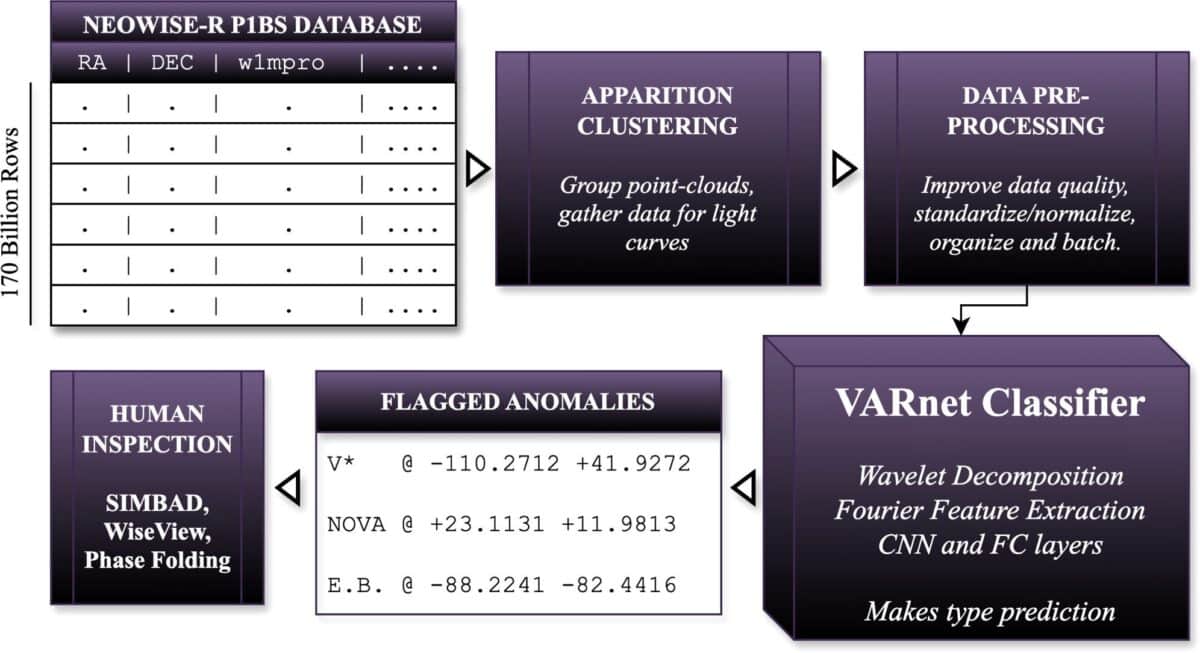 The anomaly extraction pipeline. Credit: The Astronomical Journal.
Armed with a background in theoretical math, programming, and time-domain analysis, he began developing an AI model to automate the entire search. In just six weeks, he built a machine learning pipeline capable of detecting faint, variable light sources—objects that changed brightness over time in ways that human eyes or conventional tools might miss.
“The model began to show some promise almost immediately,” Kirkpatrick told Phys.org. “As Paz refined it, the results kept getting more interesting.”
The breakthrough came in identifying objects that flickered, pulsed, or dimmed—behaviors that often indicate quasars, eclipsing binary stars, or supernovae.
Big Data Meets a Big Sky
The AI model used a combination of Fourier transforms and wavelet analysis, two mathematical techniques well-suited for studying changes in signals over time. These methods enabled the detection of subtle variations in the infrared spectrum, which are difficult to isolate due to the limitations of NEOWISE’s time-sampling.
Some of the variables Paz’s system detected changed so slowly—or so briefly—that they had previously escaped notice entirely. This is especially important for phenomena like slow transients or cataclysmic variables, which don’t follow predictable patterns.
 Matteo Paz with Caltech President Thomas F. Rosenbaum. Credit: California Institute of Technology
Over the summer and the months that followed, Paz collaborated with Caltech researchers including Shoubaneh Hemmati, Daniel Masters, Ashish Mahabal, and Matthew Graham, refining the algorithm to work across the entire sky dataset. What they uncovered wasn’t just one anomaly or two, but a catalogue of more than 1.5 million variable sources, now documented in his published paper in The Astronomical Journal.
The full catalogue is expected to be released in 2025 and could inform follow-up observations by telescopes such as Vera Rubin Observatory or JWST, offering fresh clues about the life cycles of stars, distant galaxies, and other energetic processes across the universe.
From School to Caltech’s Payroll
The story doesn’t end with the discovery. Paz, still finishing high school, is now a paid research assistant at IPAC, continuing to develop the AI pipeline and train new students at the Planet Finder Academy.
What makes this especially compelling is that the skills he used—algorithm development, time-series modeling, computational astrophysics—are typically found at the graduate level. Yet, Paz developed them through Pasadena Unified School District’s Math Academy, a rigorous public program designed to push mathematically gifted students beyond the standard curriculum.
“If I see their potential, I want to make sure they are reaching it,” Kirkpatrick said. “I’ll do whatever I can to help them out.”
Paz himself sees broader possibilities. Because the AI pipeline is built to analyze any kind of temporal data, it could be adapted for fields like finance, pollution monitoring, or even neuroscience, where fluctuations over time often signal critical insights.
His approach shows how tools developed for astronomical discovery can be useful across entirely different domains—something researchers increasingly explore under the umbrella of interdisciplinary machine learning.