
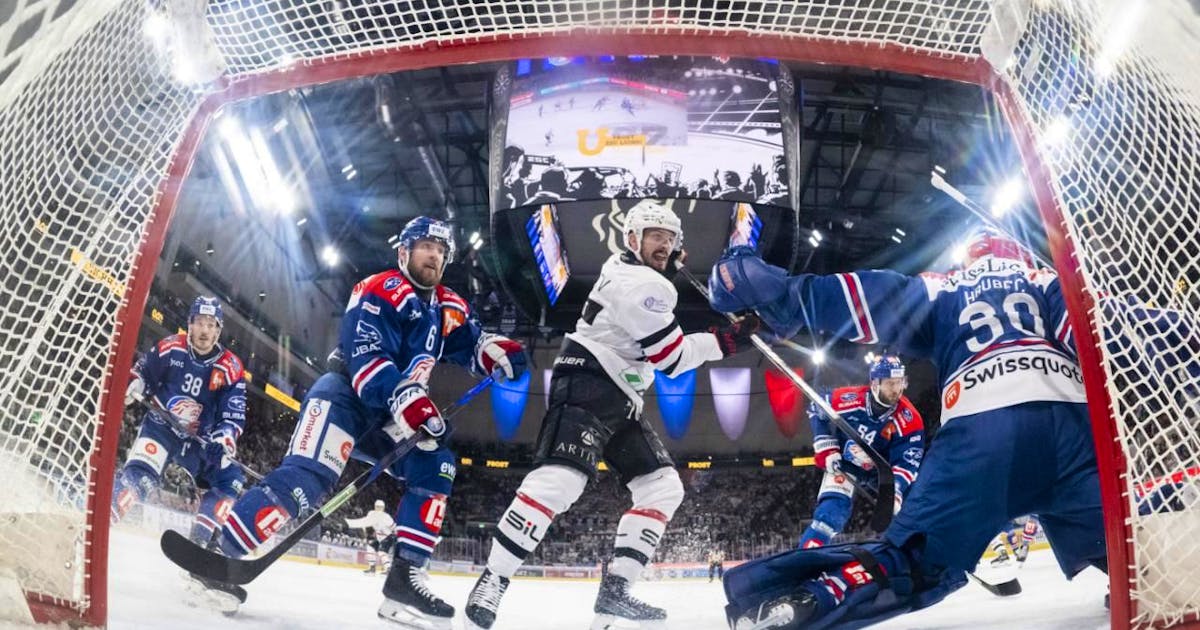
As defending champions, the ZSC Lions are particularly in the spotlight
Keystone
With the 2026 World Championship on the horizon and the Olympic season in sight, the National League gets underway again on Tuesday. New faces fuel the anticipation of an extraordinary season.
Three clubs with new head coaches
In Zug, Fribourg and Lugano, a breath of fresh air is blowing on the sidelines this season. The best-known of the three new head coaches is undoubtedly Roger Rönnberg. The Swede won two championship titles and four Champions Hockey League titles with Frölunda. Now he is to lead Fribourg-Gottéron to their long-awaited first championship title. His predecessor Lars Leuenberger, who took over shortly before Christmas after a turbulent start to the season and led the team first to win the Spengler Cup and then to the play-off semi-finals, will remain with the club as assistant.
There will be an opposite role change in Zug: Michael Liniger will take over from Dan Tangnes. Under the 2021 and 2022 champion coach, EVZ always reached at least the playoff semi-finals in seven years – until the disappointing last season.
In Lugano, those responsible are once again focusing on a fresh start with the signing of Swede Tomas Mitell. Since the last championship title in 2006 under Harold Kreis, 18 coaches have been at the helm of the South Ticino team. Last spring, Lugano was only able to secure league survival in the relegation play-off against Ajoie.
Ajoie and the eternal red lantern
For the fourth time in a row, the National League is starting the season with the same 14 teams. Ajoie hopes to finally shed the red lantern. Since promotion in 2021, the Jura club has consistently finished in last place. Kloten have proven that things can be different. The Zurich lowlanders, who were promoted to the top division one year after Ajoie and completed the increase to 14 clubs, have since finished 9th, 13th and most recently 7th.
Despite this positive development, the team was significantly rebuilt for the new season. In addition to a number of young talents with great potential, five new foreigners have joined the squad. This is only topped by Servette. The Geneva team signed six new import players. They missed the playoffs twice in a row after their 2023 championship premiere.
NHL power in all parts of the country
While ZSC’s championship-winning forwards Juho Lammikko and Vinzenz Rohrer left Switzerland for the NHL, other players took the opposite route. Servette, for example, will be able to count on the services of Czech defenseman Jan Rutta – a two-time Stanley Cup winner. Lugano has also signed American forward Zach Sanford, a former winner of the most coveted team trophy in ice hockey.
Zug landed a real transfer coup with the signing of Tomas Tatar. The 34-year-old Slovakian played almost 1000 games in 14 NHL seasons and collected over 500 scoring points in the process. Lausanne’s signing of Austin Czarnik was probably the most sensational transfer in the league. The top scorer of the last qualifying campaign comes from SC Bern.
Departing legends
With Damien Brunner (Biel), Andres Ambühl and Marc Wieser (both Davos), Joël Genazzi (Lausanne), Arnaud Jacquemet (Servette) and Pascal Berger (SCL Tigers), several influential figures in Swiss ice hockey hung up their skates this spring. Record international Ambühl in particular leaves a big gap at the HCD.
Following the retirement of the 41-year-old Grisons native, Julien Sprunger is now the longest-serving player in the league. The former international, who will turn 40 in January, has never played for a team other than HC Fribourg-Gottéron in his entire career. He has led his colors as captain since 2014 – and was able to lift the first trophy with his beloved club last season by winning the Spengler Cup. Now only one question remains: will Sprunger fulfill his dream of winning his first championship title before the end of his career?
Ongoing spectator boom
In the last qualifying campaign, 2.68 million spectators flocked to the 14 National League stadiums – more than ever before. This time there are 16 full rounds on the calendar, each with seven matches played in parallel.
In addition, 23 games will take place on Sunday afternoons under the motto “Family Games”. The aim is to attract children and families to the stadium. The success of the national team, which has recently reached the World Cup final twice, as well as the upcoming home World Cup could further fuel the spectator boom.