Science Analysis Group
Completed
The Multi-Messenger Astrophysics Science Analysis Group analyzed the potential scientific benefits of multi-messenger observations made possible by NASA observatories in the 2020 decade and beyond, working in conjunction with each other or with other ground and space-based instruments. MMA SAG was completed and final report delivered in 2020.
About MMA SAG
Combining Electromagnetic Radiation, Gravitational Wave Radiation, and Particle Astrophysics
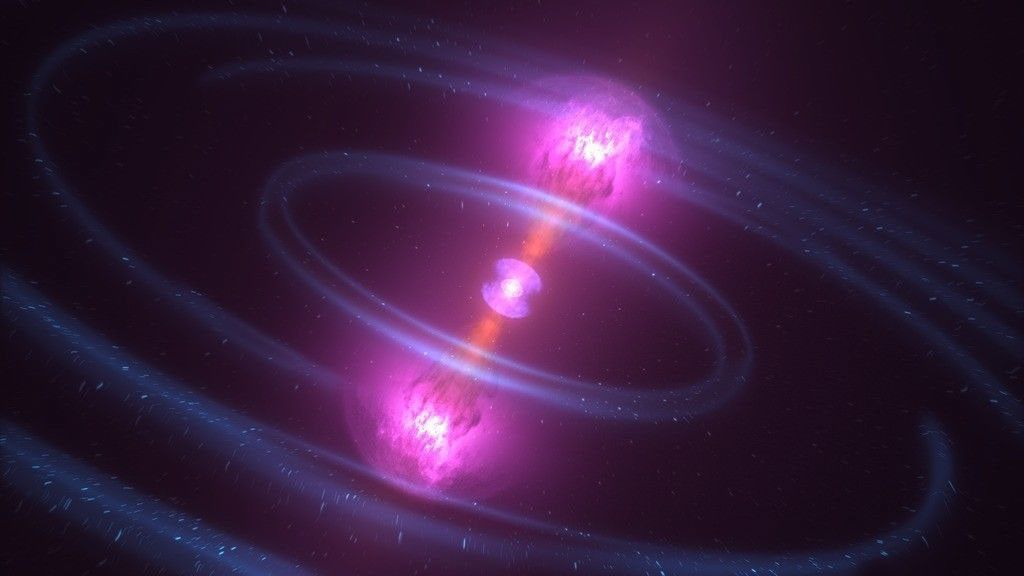
The power of multi-messenger astrophysics was demonstrated in 2017 through the observation of a binary neutron star merger, the first astrophysical event observed in both the gravitational wave and electromagnetic spectra.
Multi-messenger astrophysics will remain an important tool for astronomers in the future as we combine electromagnetic radiation, gravitational wave radiation, and particle astrophysics observations of cosmic events. NASA’s space observatories in the 2020 decade and beyond have an important role to play, including those that continue to operate in the 2020s, such as Hubble, Chandra, Swift, Fermi; those planned, including JWST, WFIRST, Athena, LISA, Explorers; and those considered by the 2020 astrophysics decadal committee.
The Multi-Messenger Astrophysics Science Analysis Group analyzed the potential scientific benefits of multi-messenger observations made possible by NASA observatories in the 2020 decade and beyond, working in conjunction with each other or with other ground and space-based instruments.
MMA SAG Chairs
NameInstitutionJohn ConklinUniversity of FloridaJohn TomsickUniversity of California, BerkeleySuvi GezariUniversity of Maryland
MMA SAG Team Organization
AGN, SMBH Binaries, EMRIsSarah Burke-Spolaor, co-leadBindu Rani, co-leadNS+NS, NS+BH, WD-WD Binaries, GRBsEric Burns, co-leadColleen Wilson-Hodge, co-leadStellar Mass BH-BH BinariesPeter Shawhan, co-leadSaavik Ford, co-leadFRBs, SNe Ia, SN RemnantsGeoff Clayton, lead
MMA SAG Events
Friday, 8 June 2018
Kick-Off Telecon
TimeTopic12:00 NoonIntroduction and SAG GoalsBrief Introduction of Co-ChairsProposed organizational structure
A. Teams organized by MMA source with representation from each of the relevant messengers
B. One lead per team (volunteers needed!)Proposed Interaction Plan
A. Monthly – Full MMA SAG Telecons
B. Weekly – Source Team TeleconsOpen Discussion
Multi-Messenger Astrophysics Science Analysis Group Charter
Multi-Messenger Astrophysics SAG Telecon Notes 8 June 2018
Multi-Messenger Astrophysics SAG Final Report
Decadal Survey White Paper Projects
A Summary of Multi-Messenger Science with Neutron Star Mergers
Opportunities for Multi-Messenger Astronomy in the 2020s
Multi-Physics of AGN Jets in the Multi-Messenger Era
A Unique Messenger to Probe Active Galactic Nuclei: High-Energy Neutrinos
Multi-Messenger Astrophysics With Pulsar Timing Arrays
A Summary of Multi-Messenger Science with Galactic Binaries
Core-Collapse Supernovae and Multi-Messenger Astronomy
Multi-Messenger Astrophysics Opportunities with Stellar-Mass Binary Black Hole Mergers
AGN (and Other) Astrophysics with Gravitational Wave Events
MMA SAG: Thermonuclear Supernovae
News Straight to Your Inbox
Subscribe to your community email news list