
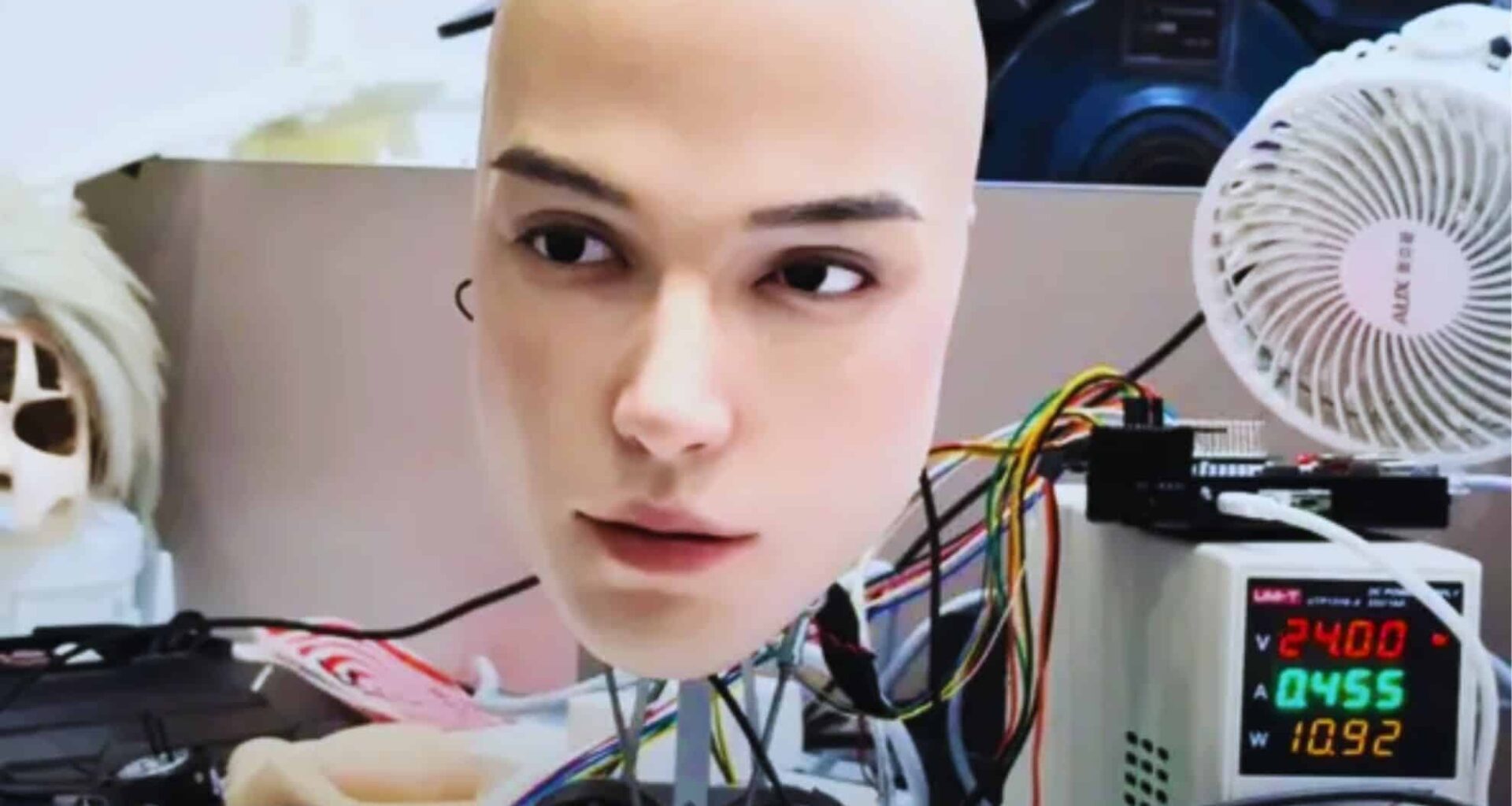
A Chinese robotics company is capturing global attention after showcasing a humanoid robot head with shockingly lifelike facial expressions. The development, created by the startup AheadForm, was recently highlighted through a series of demonstrations and media features—including a widely circulated YouTube video and detailed coverage by Interesting Engineering.
While no peer-reviewed scientific paper has been published on the technology itself, the company has shared detailed technical insights on its official website and social platforms.
A Humanoid Robot That Looks—and Emotes—Like Us
In the now-viral footage, the robot—named Xuan—can be seen blinking slowly, tilting her head gently, and reacting with subtle shifts in gaze and expression that look strikingly human. According to Interesting Engineering, one scene even shows the robot displaying “a quizzical expression and blinks in a way that is eerily lifelike.”
The key to this expressiveness lies in the robot’s core architecture: self-supervised AI algorithms integrated with high-DOF bionic actuation. These technologies allow the system to replicate micro-expressions and adjust facial movement in a way that mirrors real human interaction.
AheadForm explains that this setup helps “empower future AGI to express authentic emotions and lifelike facial expressions,” laying the groundwork for more emotionally attuned machines.
The Elf Series: Where Design Meets Fantasy
Unlike most humanoid robots designed solely for function, Xuan belongs to AheadForm‘s Elf Series—a lineup that blends robotics with fantasy-inspired aesthetics. Xuan herself features elongated ears, sculptural cheekbones, and a presence that feels part Elvish, part futuristic. It’s an intentional artistic decision.
According to the company, she’s “crafted with sculptural precision” and meant to “spark emotional resonance.” In other words, she’s not just a machine, this humanoid robot is also designed to feel like a character.
This visual design, combined with Xuan’s smooth facial motions, creates an experience that’s more immersive than anything previously seen in public humanoid robotics. She features up to 30 degrees of freedom in facial expression, which allows for real-time, fluid reactions—down to the twitch of an eyebrow or a flicker of surprise in her eyes.
Precision Engineering Behind The Subtlety
At the core of Xuan’s lifelike expressions is a specially designed brushless motor built just for facial movement. According to the company—and backed up by tech media—it’s ultra-quiet, super responsive, and small enough to fit neatly inside the robot’s head.
That’s what lets Xuan pull off those subtle, almost unconscious facial movements that make her reactions feel so human. Combined with facial recognition and synced-up speech, the system helps the robot make eye contact that actually feels natural—and respond to what’s happening around her in real time.
emotional realism vs practical application
Some companies, like Shanghai Qingbao Engine Robot, are already rolling out realistic-looking androids in places like stores, hospitals, expos, schools, and even e-commerce livestreams. But their focus isn’t really on deep emotional interaction—it’s more about grabbing attention and engaging with people on a surface level.
Then there are the industrial players, like Tesla, who are building robots that prioritize mobility and function. These bots are being designed to take on physical tasks—whether it’s helping around the house or handling logistics—with a focus on strength, precision, and efficiency, not personality.
AheadForm, on the other hand, is doubling down on making robots feel real. The company’s founder, Hu Yuhang, told SCMP that while making a robot truly indistinguishable from a human is “very difficult,” that’s exactly the direction they’re heading. He thinks that in about ten years, robots could act almost just like us—and in twenty, they might be walking beside us as coworkers, helpers, or maybe even companions.