
A pivotal battle during World War II began on October 23, 1942, with Australian troops playing a key role.
The Battle of El Alamein in North Africa opened with a thunderous artillery barrage by 800 heavy guns.
Soldiers from the Australian 9th Division, under the command of British General Bernard Montgomery, were among the first to advance on the lines of their German and Italian enemies.
 Australian soldiers fought bravely but suffered heavy casualties during the Battle of El Alamein in 1942. (UK Imperial War Museums)
But nearly all were unaware of an elaborate deception ordered by Montgomery to fool his adversary, Nazi General Erwin Rommel, commander of the German Afrika Corps.
Rommel had proved a masterful military commander who had recorded victory after victory over his British-led adversaries.
Montgomery, even though he had amassed a powerful army far outnumbering Rommel’s forces, realised guns and manpower were not enough to defeat his foe.
He devised Operation Bertram – a plan aimed at fooling German commanders that the Allies would launch an attack to the south of El Alamein, instead of the north where a valuable highway was located.
By early October 1942, an entire “ghost army” had been created of wooden tanks, artillery guns and trucks, with the help of filmmakers, illusionists and intelligence experts recruited by Montgomery’s staff.
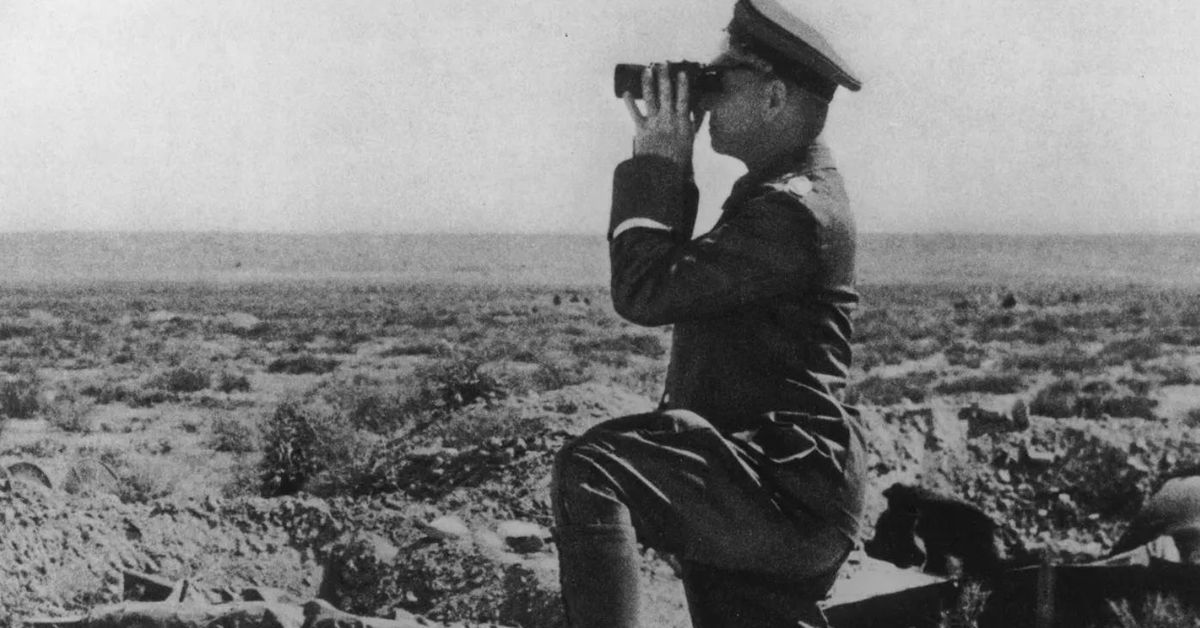
 German World War II General Erwin Rommel in North Africa. (public domain)
German spies and reconnaissance planes convinced Rommel they’d spotted a force of up to 15,000 soldiers, when in reality there was none.
Rommel, who was in Germany receiving dental treatment when the Battle of El Alamein started, was taken by total surprise and rushed back to take control of his stunned armies.
But despite their dogged resistance, the German and Italian troops were steadily pushed back.
The initial Australian attack tied up all of Rommel’s best troops, enabling the British, New Zealanders, Indians, South Africans, French and Poles to make a major breakthrough.
A week of fierce fighting followed, with the Australians grinding their way forward over well-defended enemy positions, taking key positions such as Thompson’s Post, the Fig Orchard, the Blockhouse and the Saucer.
 A fake tank built by British army engineers for the Battle of El Alamein in October 1942. (public domain)
The Battle of El Alamein succeeded in maintaining Allied control of Egypt and the all-important Suez Canal.
But it came at a high cost; more than 1000 Australian troops were killed and some 3600 injured during the fighting.
Although there was more than two years of hard fighting to go until Nazi Germany was defeated, the seeds of Allied success were sown in the North African battle.
British wartime leader and prime minister, Winston Churchill, described El Alamein and the North Africa campaign as the “end of the beginning” in World War II.