
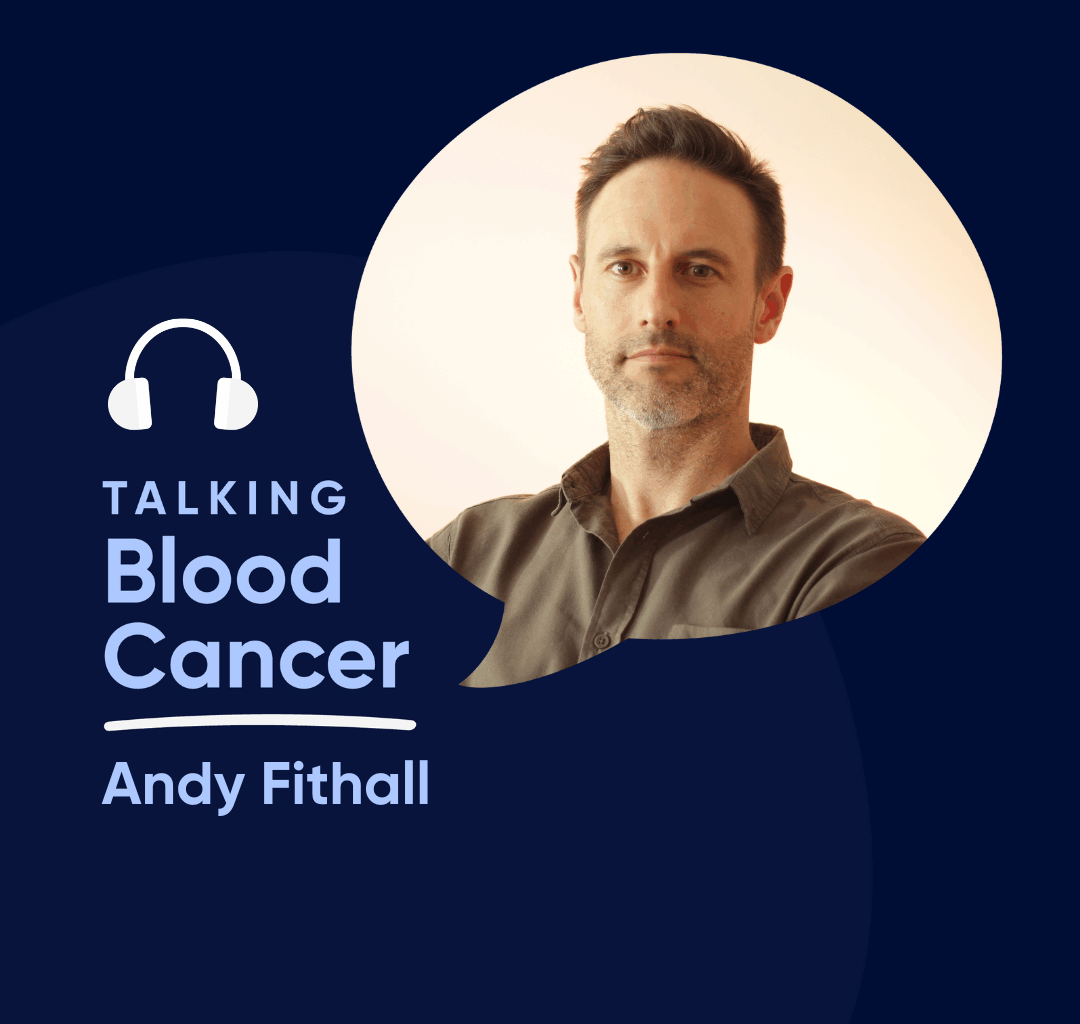
[00:02:37] Kate: Hello and welcome to the Talking Blood Cancer Podcast. I’m your host, Kate Arkadieff. Today I’m sharing a conversation that really resonates with me, one that I had with Andy Fithall, whose experience highlights something that we don’t always talk about enough. What it is like to live with a blood cancer diagnosis when you’re not actively receiving treatment.
[00:02:58] Kate: At 40 years old, Andy received an unexpected diagnosis of chronic lymphoblastic leukemia, or also known as CLL. During what was meant to be a routine screening for something completely different, like so many blood cancer diagnosis, it came out of the blue and it turned his world upside down. What makes Andy’s story particularly compelling is that it all unfolded during the COVID pandemic, adding another layer of complexities to an already challenging situation.
[00:03:28] Kate: Andy found himself in what’s called the ‘watch-and-wait’. A period where his cancer is being monitored closely, but treatment isn’t needed yet. While this might sound reassuring, Andy openly shares how isolating and anxiety provoking this experience can actually be. In our conversation, Andy takes us through the initial shock of diagnosis, the difficult conversation with his wife and children, and the ongoing emotional challenge of living with uncertainty.
[00:03:59] Kate: He is remarkably honest about the psychological impact and how he looks perfectly healthy on the outside, but carries the weight of his diagnosis every day. What I find so valuable about Andy’s perspective is his emphasis on the importance of being open about these feelings and reaching out for support.
[00:04:33] Kate: His insights will resonate with anyone who has faced that limbo of watch-and-wait, or the complex emotions that come with a blood cancer diagnosis. So let’s dive into my conversation with Andy Fit Hall.
[00:02:37] Kate: So, hi everyone. My name is Kate Arkadieff and I’m your host of Talking Blood Cancer. Today I am very blessed to have a guest on, by the name of Andy, but I will let him formally introduce himself and just kind of open up his story a touch, I hope that you enjoy today’s episode. So, welcome, Andy. Thank you for coming.
[00:04:52] Andy: Thank you so much for having me on your podcast. My name is Andy Fithall. I live in Melbourne, in Victoria. I’m 44 years of age. I was diagnosed with CLL four years ago, so just in time for my 40th birthday.
[00:05:10] Kate: What a 40th birthday present.
[00:05:12] Andy: Yes, wasn’t it?
[00:05:12] Kate: Yeah. And I think my maths, honestly, it’s not; if people have listened before, they will know it’s not strong. Would that take me back to 2021 or 2020?
[00:05:21] Andy: Correct. 2021, yup.
[00:05:23] Kate: Yeah, and you said Melbourne, so let’s think back to COVID? I’m guessing, and around lockdown?
[00:05:29] Andy: Yeah, it couldn’t have come probably at a worse time, I would think, because we’ve just, in Melbourne, we’ve just had our two extended lockdowns and we’ve just come out of those. I was diagnosed on the 11th of February, and on the 13th of February, I believe we went into another snap lockdown. So, brand new diagnosis and then just sort of locked in at home and with the kids and trying to work out what’s going on.
[00:05:53] Kate: Wow. And so you said you have kids. How many children do you have?
[00:05:56] Andy: I have two.
[00:05:57] Kate: Two children?
[00:05:58] Andy: Yeah, two boys, mm.
[00:06:00] Kate: And so then what was kind of happening around, uh, as you said, it was COVID, lockdowns were happening at the drop of a hat. So what else was going on for you that prompted you to go to the doctor?
[00:06:10] Andy: Yeah, well, that’s, do you know what? It’s — it’s a random reason why I was diagnosed. So in my family, we have haemochromatosis, and so I was going to the doctor to get a screening for haemochromatosis because, just to find out whether or not I was carrying the gene. And I also just had tonsillitis. And I’ve had tonsillitis a thousand times. So I had been to the doctor, I’ve got tonsillitis, but I hadn’t gotten over it. And so I was going to the doctor to say: look, I’ve got this feeling in my throat; tonsillitis medication, you know, that hasn’t worked. And also, can I get a blood screening for haemochromatosis?
[00:06:53] Kate: Wow.
[00:06:54] Andy: Yeah, and so I had a phone call the next day from the clinic and they said can you come back in?
[00:07:00] Kate: Mm-hmm.
[00:07:00] Andy: The next day. And, and I said, oh is there a problem? She said, well, you just gotta see the doctor. I said, this — you know, is it bad? She said, oh, if it was real bad, you know, we’d be having you in today. So, you know, she’s probably trying to, you know, ease my anxiety around it a little bit. But, um, I, uh, went to the doctor and then they gave me the diagnosis. Yeah.
[00:07:20] Kate: Wow, and what did they say? Did they deliver the news right then and there, like the full diagnosis of CLL, or did they say, oh, we suspect…
[00:07:30] Andy: No, it’s a little hazy. Can I be honest, that memory?
[00:07:34] Kate: Yeah.
[00:07:34] Andy: It was an absolute whirlwind. I went to the doctors a bit unsure because, you know, they’d called me back. I was expecting for them to say, you have haemochromatosis and, I didn’t really know what that meant anyway, so I thought I would get some sort of information about that. But then as I, sat down and then the second doctor entered the room, the more senior doctor.
[00:07:53] Kate: Right.
[00:07:54] Andy: Because the doctor that I’d seen was a junior. She, uh, appeared to be a junior doctor. So a senior doctor came in the room and they both sat down and they, something. It was just off, you know.
[00:08:04] Kate: Mm-hmm.
[00:08:04] Andy: The situation was just a little bit weird. They said, we’ve got your blood test results back. Very straight, they didn’t mince their words. They said, we’ve detected something called CLL which is, you know, and I’m hearing blah, blah, blah, blah, blah, blah. Leukaemia. And then so I, you know, I knew the word leukaemia,
[00:06:26] Kate: Mm-hmm.
[00:06:26] Andy: But to be honest, I didn’t in that moment, it didn’t register what that meant. So I was sitting there, I got the diagnosis. They said, before I knew it, they were on the phone to a specialist…
[00:08:34] Kate: Wow.
[00:08:34] Andy: Booking an appointment. So in the 10-minute consult, I had received the diagnosis, and then I was already booked in to see a specialist. And so at this point I’m going, what, you know, what the hell’s going on?
[00:08:47] Kate: Mmm.
[00:08:47] Andy: What — and what does this mean? I get sent home with the handout, the printout from the computer, that, you know, what is CLL?
[00:08:53] Kate: Yeah.
[00:08:53] Andy: And took that home, and I drove home. I was just in a daze, I was just going, what just happened?
[00:08:58] Kate: I’m guessing you were by yourself, right?
[00:09:00] Andy: I was, I was, yeah, was by myself, so I wouldn’t normally take my partner just to a doctor’s appointment, you know? So I went home and I, sat down, I think I had a coffee, and then I read the documentation. And it wasn’t until I read the documentation and saw the word cancer that it really hit home like that.
[00:09:19] Kate: Yeah.
[00:09:20] Andy: And then that’s when I went: oh, right. I’ve got cancer. Like, that’s what that means. So that was a bit of a moment I remember being pretty upset and sort of not knowing what to do. And then I had a meeting booked for, so it was a nine o’clock doctor’s and I had a meeting for 10 o’clock. And so I had been to doctors, I got home and then I don’t know what clicked for me. And I’ve had this situation once before, but in that moment, something clicked and I remember I was standing there, I was looking at myself in the mirror and I’m a mess, right? Like…,
[00:09:50] Kate: Yeah.
[00:09:50] Andy: I got, you know, tears and I’m sort of in an anxious state. And I look in the mirror and something come outta me. And I just said to myself: “you’re not gonna die today, so pull yourself together and get to your meeting.”
[00:10:03] Kate: Yeah, wow.
[00:10:04] Andy: But I dunno where it came from, but it did.
[00:10:06] Kate: Yeah
[00:10:06] Andy: And uh, and so I did, I, took a few deep breaths and I dried my tears and I got my skates on, grabbed my stuff, and, and I went to a meeting.
[00:10:14] Kate: Wow. Were you at home by yourself at that point?
[00:10:17] Andy: Yeah.
[00:10:18] Kate: Yeah, yeah, yeah.
[00:10:19] Andy: Which is probably a good thing.
[00:10:21] Kate: It is incredible what the brain does, right? To protect ourselves, like how you heard that news and then you just switched hats ’cause you had a different, you’re like, I don’t have time to process that now. I need to go to work and as you said, I’m not gonna die today.
[00:10:35] Andy: Mmm.
[00:10:35] Kate: So I just need to do the job that’s next in front of me.
[00:10:38] Andy: Yeah, absolutely. So I did, and look, it was 11 days between the, diagnosis and the specialist appointment and the prognosis.
[00:10:46] Kate: That’s a long day— That’s a long lot of days.
[00:10:48] Andy: I would say it’s probably the longest 11 days of my life. And I know, look and we’re gonna talk about this, I guess, but I’m, I’m still watch-and-wait. But sitting with that news that I have cancer and not knowing what it meant…, for 11 days, it was, it was a really, tough time.
[00:11:04] Kate: Yeah. You went to your meeting
[00:11:07] Andy: Mm-hmm.
[00:11:07] Kate: And then did you finish the rest of the day? Did you have meetings after that or could you come home?
[00:11:14] Andy: I had the one booked. I went to that meeting. We had a bit, I, there was a bit going on. I was in a, a fantastic mediocre dad band at the time. And I think we had a gig and so I had to organise some things as well. So I think I sort of just went into get-things-done mode and tried to sort of put it away for a little bit. Because I just didn’t know what it meant. And also I couldn’t deal—there was nothing in that moment I could do. So yeah, I just sort of went about my business, but I did eventually apologise to the people I had the meeting with, ’cause I think I was pretty vague.
[00:11:46] Kate: Look, you were there, but you may not have been completely there.
[00:11:49] Andy: I was definitely not completely there.
[00:11:50] Kate: Yeah. Oh, and so how did you deliver that news to your wife and did you tell your children?
[00:11:58] Andy: I did, I told them all. I told my wife that night. It was horrible sitting with it all day. Not being able to tell anyone, and I had to wait till the kids went to bed and I was grumpy. And I was like, oh, can you just go to bed so I can have this discussion and yeah, it was really hard to even broach. Like, how do you open that conversation? So I sort of had to just tear the bandaid off and tell her that, what had happened. And then I guess we just sat there and tried to make sense of it. It was a big shock for her.
[00:12:27] Kate: Mm-hmm.
[00:12:28] Andy: She didn’t sort of know. She’s a healthcare professional, but not in areas of cancer. So she just..
[00:12:33] Kate: Yeah.
[00:12:34] Andy: You know, we’re sort of just sitting there going not quite sure, what we do next. Yeah, apart from…,
[00:12:38] Kate: Yeah.
[00:12:38] Andy: Wait for the, the specialist appointment and…, So then the next day after school, my kids come home. My wife’s still at work, and I just felt obliged to tell them something because I was off, you know,
[00:12:50] Kate: Yeah.
[00:12:50] Andy: Like I wasn’t myself and I just explained to them I thought they need to know the truth and I gave them a, you know, a less detailed version. But I told them, that this is what had happened and I dunno what it means, but we’ll…
[00:13:04] Kate: Yeah.
[00:13:05] Andy: You know, I’ve got a—I’ll go see the blood doctor in a little while and he’ll tell me what that means. So…,
[00:13:10] Kate: Yeah. And I really commend you for bringing your children along in the journey. You know, research has shown and, I’ve worked in this role now for 14 years, and I have seen the difference in people’s experience with children where if they tell them, you know, of course, honestly to an age appropriate level, to the ones that try desperately to hide it. I mean, kids are so intuitive, right? They, they read body language and energy better than anybody, you know, and they know when your parents are off. So for you to, as you said, you felt obliged just to tell them. And an answer that would be age-appropriate. I really commend you ’cause I think that sets them up too, for being a part of this and not creating their own—I mean, they will anyway, but it allows that space. If they do create any thoughts or worries and concerns, they can bring it to you confidently and have a chat with you about it.
[00:14:06] Andy: Yeah, definitely. Well, they’ve asked questions along the way.
[00:14:08] Kate: Mm-hmm.
[00:14:09] Andy: And they’ve compared what I have to other things that they’ve seen
[00:14:13] Kate: Yeah.
[00:14:14] Andy: Around the place. And then it’s been good because we’ve been able to have this discussion about the differences between…,
[00:14:19] Kate: Mm-hmm.
[00:14:19] Andy: Because for me, like I say, until I read the word cancer, I didn’t sort of, it didn’t register, but. There’s so many varieties and, with all these different varieties, there’s all these different outcomes and treatments and whatnot. So for some people, it’s a blip on the radar. And other people, it’s, you know, it’s life-changing. So
[00:14:36] Kate: Absolutely.
[00:14:37] Andy: I think it’s been good to be able to compare the difference…,
[00:14:40] Kate: Very true.
[00:14:41] Andy: Yeah, and not just like lump them all into one category. Because for all intents and purposes, you know— if you didn’t know, you wouldn’t know.
[00:14:49] Kate: No.
[00:14:49] Andy: Like I, there’s no obvious signs for me that I have it. So…,
[00:14:51] Kate: And had you heard of the word, well, did you hear of the word leukaemia before, or even then CLL, or then even blood cancer before it came into your world?
[00:15:01] Andy: The word leukaemia. Yeah. And I probably just thought of the kids we see on like Ronald McDonald.
[00:15:06] Kate: Yep
[00:15:06] Andy: That was my impression. I probably didn’t know much more about it to be honest. Yeah.
[00:15:12] Kate: Yep. And blood cancer. Was that something that had entered into your world before?
[00:15:18] Andy: I don’t think so. I don’t think that was a phrase I’d ever really… I think I would’ve known roughly what it meant if someone had said it, but I don’t think it was a phrase I’d ever really encountered or, or used. Definitely wouldn’t have used it in the past.
[00:15:30] Kate: Mm.
[00:15:30] Andy: Yeah
[00:15:31] Kate: I can just envision, you know, and I think so many of our listeners could potentially relate when, as you said, you hadn’t made that connection between, oh, I’ve got this diagnosis and oh, that actually means cancer. ‘Cause so many of us in the general population, we really connect a lot of those solid tumors to the word cancer. You know, breast cancer, testicular cancer, prostate, all of those type of things. Where this, it’s so different. And as for you, it sounds like there wasn’t many signs that pinpointed you to go, oh, I think I have cancer, where it sounded like it was tonsillitis and your…,
[00:16:07] Andy: Yeah.
[00:16:07] Kate: Your need for family history investigation.
[00:16:10] Andy: Yeah. Well, there was no signs apart from the markers on my blood test. So…,
[00:16:16] Kate: Wow.
[00:16:16] Andy: And actually probably I’d had it for at least a couple of years because I had a raised…
[00:16:20] Kate: Oh really?
[00:16:21] Andy: Yeah, like a slightly raised level from a blood test a couple of years ago. But it wasn’t high enough that it triggered any action.
[00:16:28] Kate: Detection, yeah.
[00:16:30] Andy: Yeah. Yeah. So it was only slightly, I think an average range is up to four or something.
[00:16:34] Kate: Mm-hmm.
[00:16:34] Andy: And this is 4.4 and they said you might have a virus or something,
[00:16:37] Kate: Right. Yeah. Yeah. Yeah. Yeah.
[00:16:39] Andy: And I was unwell at the time, so that was a likely explanation. So yes a couple of years of not knowing. And then the accidental diagnosis. Yeah. Which is and I, you know, I think statistically I’m very young for this. I was 39, you know,
[00:16:54] Kate: Mm-hmm.
[00:16:54] Andy: That is quite uncommon.
[00:16:56] Kate: Mm-hmm.
[00:16:57] Andy: I think mostly older people.
[00:16:59] Kate: They do. Yeah, you’re right there.
[00:17:01] Andy: Yeah.
[00:17:02] Kate: So you got to that doctor’s appointment, and
[00:17:04] Andy: Mmm.
[00:17:05] Kate: I envision maybe through those 11 days, did you go on Google? Did you think, oh my gosh, I’m gonna need treatment? Or, things of that nature.
[00:17:13] Andy: Yeah. You know, I got the booklet, it’s actually one of your booklets here.
[00:17:17] Kate: Well I hope it was helpful.
[00:17:18] Andy: Well do you know, the thing is at the start, and I reckon a lot of people would do this, I decided I wanted to know a lot. So I started looking into it. But, I have to admit that I guess in that first 11 days, it was all a bit overwhelming and I hadn’t retained a lot of the information from the initial diagnosis. So I made sure that I brought my wife along to the consultation, the first one. Because she’s good at detail.
[00:17:45] Kate: Yeah. Usually women are. Men, not, not so much.
[00:17:47] Andy: Well and I just thought, look, I’m, I just need to sort of be there in the moment and not be trying to retain everything. And
[00:17:54] Kate: Yeah.
[00:17:54] Andy: Because it was a very anxious and emotional time.
[00:17:56] Kate: Absolutely.
[00:17:57] Andy: So, I want to share something which I understand now in that, 11 days of waiting, my perspective shift. I noticed a huge shift in how I viewed, just my world—not knowing what was gonna happen. And of course, it’s embarrassing now that, you know, I’m four years down the track, I’m still watch-and-wait. But in that moment, I’m going, okay, if I’ve got six months to live, what does that mean? What do we have to do financially if I’ve got nine months to live? You know, like I was really thinking about these scenarios, but the thing was, it was with such clarity.
[00:18:29]Kate: Yeah.
[00:18:29] Andy: And I wasn’t afraid of that clarity. I was actually, in the moment, I was sort of quite accepting of well, if this is the scenario, you can’t leave them high and dry, your family. What are you gonna do? What do we need to do to set them up so that they’re fine after, you know…,
[00:18:44] Kate: Yeah.
[00:18:44] Andy: After I’m gone. So it was an incredible experience.
[00:18:48] Kate: Mm-hmm. It sounds like you went into like caretaking and protector mode. Right. I’m gonna set them up.
[00:18:53] Andy: Mmm.
[00:18:54] Kate: I’m gonna set my home up. Well, if X, Y, Z unfolds.
[00:18:58] Andy: Yeah. That’s definitely where my mind was at. But then as time goes, I guess, and this is probably unique to the watch and wait people out there when you have your regular appointments and your regular blood tests and things, and you’ve got all this, so I guess this medical part of your life now but then the, doctor says, well, your numbers have increased, but we’re not worried yet. There’s no reason to start the treatment just yet, unless you’ve got some symptoms and stuff. So we are just gonna—I’ll see you next time. And like, it’s this thing that’s lingering, but there’s no action.
[00:19:33] Kate: Yeah.
[00:19:33] Andy: So you can’t control it.
[00:19:35] Kate: Mm-hmm.
[00:19:36] Andy: It’s part of your world, but there’s also no solution at that point. There’s, you’re just sitting with it. And so that probably makes me…, initially I was really keen to know what it was all about. It makes you a bit less inclined to keep looking at the stuff.
[00:19:49] Kate: Mm-hmm
[00:19:49] Andy: Because you know, you’re not feeling sick.
[00:19:52] Kate: Mm-hmm
[00:19:53] Andy: So, why do I need to be bombarding myself with all this information that feels so negative? When I don’t… feel like I don’t need it right now?
[00:20:01] Kate: Yeah. Absolutely. And it is, I hear, and I’ve had lots of conversations with people and they talk about how when they hear the word that they’ve got something and it is in that watch and wait phase, and they go, I’ve just received the news that you never want to hear, you know, the cancer, the C word. And then it’s almost like the doctor goes, okay, see you later off you go, go live. But it’s like. Well, how do you do that? How do you do that well, and without having that fear and that anxiety sitting on your shoulder every day?
[00:20:34] Andy: Yeah. And initially it comes up a lot. I was surprised at how often you are having more tests and things, but how often you declare it, medically. That was interesting, just how often you have to declare it. And also, I noticed that I didn’t like how it was becoming my identity, and like, given that I wasn’t entering into a treatment phase…,
[00:20:56] Kate: Mm-hmm.
[00:20:56] Andy: Or anything, I was just…, had to go and keep on keeping on.
[00:20:59] Kate: Yeah. Just have your blood tests and things.
[00:21:02] Andy: Yeah, yeah, yeah. And you know, like that’s a pretty anxious period. You go get your blood taken. You come up to your appointment, you get your blood taken, and I try to tackle it with a little bit of humour.
[00:21:12] Kate: Tell me how you do that.
[00:21:13] Andy: Well, my favourite joke when I go to my blood test is when the lady that’s there often, she’s taking the blood out. Every single time I say to her as it’s coming out, I go, well, how’s it look? And. She gives me nothing every time and I’m so happy with the joke, but she gives me nothing. And…
[00:21:31] Kate: Like, do you know what I’ve had to do to get to that joke? Like, c’mon.
[00:21:34] Andy: Yeah, yeah, that’s, that’s me sort of being on the front foot. But you know, where I can, I try and inject a bit of humour, but it’s also, I dunno, there’s, it’s just sort of this process that you go through that doesn’t sort of lead anywhere.
[00:21:47] Kate: Yeah. Do you find, ’cause people talk about scan anxiety and even blood tests as well.
[00:21:53] Andy: Yeah.
[00:21:54] Kate: That you feel that coming when you are leading up to those points? Like how often are you in your blood checkup schedule at the moment?
[00:22:02] Andy: Yeah. So right now I’m back to well, I’ve got one in August, but right now I’m on yearly again.
[00:22:08] Kate: Yeah.
[00:22:09] Andy: And I was… Three monthly into six monthly. But now I’m at yearly and so I should be celebrating. Right. And I should be going. Well, that’s great. That’s just a regular checkup and seeing how it’s going and whatever. But it’s still there.
[00:22:22] Kate: It’s 365 days between when you will get confirmation that things are okay.
[00:22:28] Andy: Correct. It’s a long wait. I almost wanted the six monthly, you know…,
[00:22:32] Kate: Mm-hmm.
[00:22:32] Andy: Just to, to be a bit more on top of it, but at the same time, it’s nice to just put it away.
[00:22:36] Kate: Yeah.
[00:22:37] Andy: As much as possible. Yeah.
[00:22:39] Kate: Yeah. And cause I know so many people as well, they talk about, you know, when they do feel and whether they’re in watch and wait or they’ve been in an intense treatment and treatment ceases and they come into a very similar pattern that you are in. How did you deal with that? To go, okay, you’ve got that anxiety or that stress as you wish to be able to have that yearly appointment, but as things are getting taken away, you know, those constant checks, how did you kind of sit with that of being okay sitting in the okayness of it?
[00:23:11] Andy: I don’t have any specific strategies other than just trying to accept…, I mean a lot, you know, we don’t have to be happy. Is one of the lessons in life. You know, there are happy days and sad days and that’s all, all of that is okay. I think it’s making sure that I’m not trying to bottle up too many emotions as well, you know, now the kids know. So if I have a moment. Leading into those times. And that, and I say I’ll just, you know, I just try to be honest.
[00:23:37 Kate: Yeah.
[00:23:37] Andy: And say I’m anxious. I think it’s better to just share it off the cuff. I’m anxious about this coming up and um,
[00:23:43] Kate: There is such power in it, isn’t it? Actually saying it out loud than, as you said, bottling it up.
[00:23:49] Andy: Hmm, definitely.
[00:23:51] Kate: Have you found that during your experience of all of, I mean life and then walking alongside this diagnosis of CLL.
[00:23:58] Andy: So I guess with my family, definitely it’s worth acknowledging those emotions day to day. But it’s difficult because, I’ve said this is, one of the first times I’ve actually told people outside of my sort of inner circle about this,
[00:24:11] Kate: Mm-hmm.
[00:24:12] Andy: And it’s mostly because I feel it’s confusing for people. I feel like the standard trajectory for someone when they tell you, I have a cancer diagnosis. I think in our heads we expect to see a short time later, them going through treatment. You know, we’re talking hair loss and all of the obvious signs. And then after that, either a declaration of remission…,
[00:24:34] Kate: Mm-hmm.
[00:24:35] Andy: And celebration or it’s ongoing or it, you know…,
[00:24:38] Kate: Yeah.
[00:24:39] Andy: I’m back, I’m going back in, or whatever it is, and these people are going through hell.
[00:24:42] Kate: Mm-hmm.
[00:24:42] Andy: But that’s sort of, I think, what people sort of expect to see when they use the word cancer. But for all intents and purposes from the outside in, I don’t look any different.
[00:24:52] Kate: No, yep. Mm-hmm.
[00:24:53] Andy: So it’s sort of, I feel a bit embarrassed sometimes, you know, even feeling like a bit of a souk about it because you go, why am I upset about this? When in theory it sort of hasn’t affected me?
[00:25:04] Kate: Yeah.
[00:25:05] Andy: Although it has emotionally, you know.
[00:25:07] Kate: Yeah!
[00:25:07] Andy: But it’s not affecting me in theory. It’s not affecting me physically.
[00:25:10] Kate: Mm-hmm.
[00:25:11] Andy: From how I look as well function. So it’s interesting space…,
[00:25:17] Kate: Yeah
[00:25:17] Andy: The watch and wait space, and that’s probably why I haven’t really shared it, because I’m not looking for the sympathy vote. There’s a lot more worse off people than me in the world, so it’s just not something I’ve really shared.
[00:25:29] Kate: Yeah. You and I had had that discussion before and I think I had said to you, it’s so powerful to show the different perspective. ‘Cause as you said, although physically you know, you’re looking great, and you are still able to do a number of the things that you once did before a diagnosis landed on your lap. But you are very right. It is the mental weight that it brings and…, although, as you said, you can put it behind you and you can carry on at some points in life, but it is there. It is always there at the back of your mind, you know, and you always, as you say, you have to declare it. You can’t pretend that it’s not something.
[00:26:04] Andy: Yeah. Correct. You know, philosophically, I do question what would my life have been like if I didn’t know?
[00:26:11] Kate: Yeah.
[00:26:11] Andy: What would’ve happened if I hadn’t found out that day? Would I be in a different place to where I am now? Now, of course I cannot change it. But I did, have it for a couple of years and not know.
[00:26:21] Kate: Mm-hmm.
[00:26:21] Andy: And those years were without those appointments and without those thoughts.
[00:26:26] Kate: Mm-hmm.
[00:26:27] Andy: So it does cross my mind occasionally, you know, would I be better off knowing just in time to find out I need some treatment?
[00:26:33] Kate: Yeah.
[00:26:34] Andy: I don’t know.
[00:26:35] Kate: And it’s so right. And then you go, you know, it gives you the opportunity to have those conversations because once a diagnosis does enter your life, if you wanna tend to ignore it or not, either way, mortality is facing you. You can’t, you…
[00:26:49] Andy: You can’t unhear it.
[00:26:51] Kate: You can’t unhear it, and then you can’t pretend that we’re no longer invincible and I guess the beauty of it is it gives you those moments to have those conversations with your family and think about things as you said, with that really clear perspective that you potentially may not have had beforehand as well.
[00:27:12] Andy: Although I think that, like I say that the watch and wait trajectory is mundane, you know, there’s no sort of, ‘not yet’ in my journey, there’s no real climax. So you’re just there with it. And…
[00:27:26] Kate: Yeah.
[00:27:26] Andy: That’s not exciting. I’ve got a few good friends who will occasionally just say, you know, how’s your bloods? How ‘ya going? It’s a pretty boring answer. It’s like, well, this, have my regular appointment. And that’s it. Really. And then they sort of, we put it away for a while and because of the inactivity with it.
[00:27:42] Kate: Mm-hmm.
[00:27:42] Andy: It’s, I don’t know. It’s a really strange space, and I guess for anyone who’s listening to this, who’s sitting there with it, feeling the same thing. Like it’s a strange experience to know that I’ve got something that I, I do wonder, you know, every time I lie in bed and I have something that resembles a sweat, and I go, oh, is this it? Is this time? You know, I have that, these things and it isn’t. So you, have sort of false alarms and things like that.
[00:28:07] Kate: Yeah.
[00:28:07] Andy: You know, am I a ticking time bomb? I don’t know. You know what’s around the corner? Dunno. And then you have your appointment and they go, well, you’re not too bad at the moment. And we’ll see you next time.
[00:28:17] Kate: ‘Cause did you lose trust in your body after you heard the diagnosis?
[00:28:21] Andy: Oh, that’s it. What, how do you mean?
[00:28:23] Kate: Like, I’ve heard the conversation with people and they go, oh, I was going along so well. I had done everything that I, I’m meant to in life as a perfect human, you know, didn’t smoke, drink, or whatever. But then my body’s let me down, and then how do I know it’s not gonna do it again? Or how do I know it’s building that safety back in your body when you never question it potentially before, and then you go, oh, it’s not doing what it’s meant to do.
[00:28:49] Andy: Yeah, well, I think there’s the mortality thing and you know, I’ve read a lot of books and things, and I’ve read some great ones on DNA and, you know, it’s, wonder about, my DNA’s breaking down as I age and all those sort of things. And I think probably one thing that is on my mind is, if I have this, then what’s next, as well?
[00:29:07] Kate: Mm-hmm.
[00:29:07] Andy: You know, like, there’s no direct correlation, I’ve been told between CLL and any other cancers except for potentially skin cancers.
[00:29:14] Kate: Mm-hmm.
[00:29:15] Andy: I think, but it does make you wonder, is the next thing I’m gonna have a lot worse, and am I more likely to get something because this one has already happened, you know?
[00:29:25] Kate: Yeah. I have heard a saying that I need to think of a word that’s not swearing, but that your bad luck card is never full. Like, you’re never exempt. Oh, you’ve had one bad thing come along, and that’s it. You know, we are not just; we don’t ever just get one bad thing in this lifetime and then that’s it. So you do, you do wonder, oh, when’s the next thing gonna pop up…,
[00:29:46] Andy: Mmm.
[00:29:46] Kate: and raise its head?
[00:29:48]Andy: And I think it makes you a little bit hypervigilant of your…,
[00:29:51] Kate: Your body?
[00:29:52] Andy: Of, well, yeah, an awareness of… in your body when you feel different things going on.
[00:29:56] Kate: Mm-hmm.
[00:29:56] Andy: And you go, ooh, ooh, what’s that? Like, is that a thing? Whereas before, you may not have taken, given it a second thought,
[00:30:02] Kate: Do you bank time for it? Like as in, I’m saying sometimes people go, oh, I’ve just sat on this worry of a night’s sweat for days, and I need to reel my anxiety back in. Like, does it ever…, your anxiety peak and then. How do you, well, I’m gonna ask, and do you get to then bring it back down?
[00:30:23] Andy: Yeah, I’ve certainly gone through patches where anxiety has been probably the worst thing. Because you lie there and you know, it’s a sort of a snowball. You sort of feel something…,
[00:30:34] Kate: Mm-hmm.
[00:30:34] Andy: And then you’re aware of it. And I think in your sort of fight and flight modes, when you got the…, you know, and adrenalines and all sorts of stuff going through your body when you’re in that moment going, oh, is this the thing? And then that leads to the anxiety, and then that can last. Or it can build and then you can start thinking about it too much, and then two nights in a row maybe there’s something that you, worry about and then you, yeah. So certainly I reckon the anxiety is probably one of the worst parts. Yeah, definitely.
[00:30:59] Kate: Because you can’t leave it like some people may have flight, you know, flying anxiety or you know, driving a car or something. Yours potentially is connected to your body you can’t leave your body. You can’t…
[00:31:11] Andy: No, that’s right. Well, I don’t have, you know, I hate that I don’t have control.
[00:31:15] Kate: Yeah.
[00:31:15] Andy: I don’t have control over it. It’s doing its own thing at its own pace. So, like, if I had high cholesterol or doctor told me I was overweight, I needed to lose weight, I can control that. I can go and change my diet, exercise, whatever I’ve gotta do. This is, I have no control over it.
[00:31:32] Kate: None.
[00:31:33] Andy: And so, it’s going to, I even asked, you know, the haematologist, the stress levels, you know, change it, whatever. And he seemed to think no. Like there’s, there’s…,
[00:31:541 Kate: Yeah.
[00:31:41] Andy: You don’t have an influence over it. So if I don’t have an influence over it, and I’m not sure when it’s ever gonna, I dunno what it’s gonna do. Is it gonna plateau? Is it gonna grow? It’s, yeah, that’s, that lack of control is really unsettling. And I just feel like you’re left in limbo. Like you’re just in limbo the whole time. What’s gonna happen next? Nobody knows.
[00:31:59] Kate: Mm-hmm.
[00:32:00] Andy: Just, take every day as it comes sort of idea, which is, you know, in some ways is terrible. You want to, I’m only 40. I’m only 44. I should be building…,
[00:32:08] Kate: Yeah.
[00:32:09] Andy: You know, a life for my family and those sort of things. Yeah.
[00:32:14] Kate: Mm. I think, you know, you and I were talking before about how we usually ask the guests about the golden nuggets, and I would almost say that’s potentially one of your golden nuggets. It’s, it’s so right about the lack of control that we have and we can view it as the negative and going, I mean, I love control and I couldn’t envision even being in that space of having to live where you are, but… To go: That’s it. You don’t have control over it. So no matter what you do, no matter how much stress you place into it, how much energy you place into it, there’s nothing that you can do to change the path that’s gonna unfold.
[00:32:50] Andy: Mmm.
[00:32:50] Kate: So, is it with that thought that you go, well then I just need to live how I wanna live or conduct my days as how I want to and can to the quality of life that I can.
[00:33:02] Andy: Yeah. So my career path at the moment is as a social entrepreneur and I have been able to use, I guess, some of that energy into putting into the projects that I work on because they are all about helping other people, so it does feel good to help others. And I think if you are feeling a bit down, maybe you can try going and helping someone else. I think that, that is a good way to lift your spirits and just inject some of the better chemicals back into your body…
[00:33:31] Kate: Yup.
[00:33:31] Andy: All your dopamines and the stuff that makes you feel good.
[00:33:34] Kate: Absolutely.
[00:33:34] Andy: Go and help someone else, has always made me feel better.
[00:33:38] Kate: There’s so much research in that, isn’t it like it—as in if you are feeling like you don’t wanna help yourself, ’cause it is a big step to wanna help yourself and put energy into you. But sometimes it’s a lot easier to project more positive energy and assistance into others that there is this psychological back fold that comes onto you and you will benefit from that.
[00:34:00] Andy: Oh, you’ll definitely benefit even if, even if you’re not sick you’ll feel pretty good when you go and help other people. Yeah.
[00:34:06] Kate: Absolutely. So what is it that you do to help others?
[00:34:10] Andy: So the cancer diagnosis, when I say couldn’t have come at about a worse time, it was also coming a year after I had experienced like a lot of people, I was laid off twice. The first one was from the bush fires in 2020. At the end of that, the company I was working for got obliterated by the lack income coming in as a result of the bushfires and I got a new job and I was there three weeks before they let me go because of COVID. So on the 20th of March in 2020, I was unemployed. And that’s about when they were saying that schools were gonna be closing early for the term, which was the start of the first lockdown. In effect, that was the beginning of everything. So I had been at home with the kids for the whole year beforehand. Now we chose to use our time by creating a good news broadcast. It was called “In Other Good News”, and we went on, on the 22nd of March. So when we talk about that, there was that moment in time where I said, you know, “I’m not gonna die today”. So the other time I’d had one of those moments was the day I was laid off. I said, well, if I’m feeling like this, then so is a lot of other people
[00:35:19] Kate: Mm-hmm.
[00:35:19] Andy: Gonna be feeling down in the COVID lockdown. So, so I pitched the idea of a good news show to my kids and we put one on on Facebook. So we started telling, yeah, every night at seven o’clock abouts we would put on a good news show and we’d tell local good news stories and just try and give people something else to watch other than doom and gloom.
[00:35:37] Kate: Mm-hmm.
[00:35:38] Andy: In the world. ‘Cause that’s all that was on the news at the time was COVID stats. So we did that through the first lockdown. And at the end of that we decided to raise some money for the food bank, the charity, through a live telethon. We broadcast a live telethon and that night raised, you know, $6000 in a one-hour show. And so that was all pretty good.
[00:35:56] Kate: How amazing.
[00:35:57] Andy: Yeah, so we, we were doing these things in the second wave. We put our show back on air because, you know, we thought people needed it. We started selling coffee beans to raise money for food bank ongoing. With 60,000 meals created—generated, from sales of coffee beans and other activities. So we’ve been doing these things for the whole of 2020 and giving that energy back to the community helped me counter the lockdown feelings, you know, those situations. So I think when it came around the next February, that I received this, a few of those same instincts kicked in. But it was just also, it felt like another kick in the guts.
[00:36:33] Kate: Yeah. Absolutely.
[00:36:35] Andy: I was unemployed, locked down at home, and then also now I’ve got this. So it was certainly a very interesting time, but I guess the good thing that’s come out of it, and I guess this is also partly why I wanna share the story today, is that, you know, that we’ve used that energy to go and create meals for food bank. I’ve got a podcast called The Good People Podcast. We’re amplifying the stories of people doing good in the world. That’s quite uplifting as well. When you get to lift those good people up and…,
[00:37:01] Kate: Yeah.
[00:37:01] Andy: See what they’re doing and share that with the world. So I guess hopefully using that energy has got us to a place that…, is pretty good as well.
[00:37:08] Kate: Mm-hmm. So you really breathe and live that motto of like, as you were saying before, that… If you can’t change your own energy, give it to somebody else and do something positive for someone else, like you were in some pretty dark times, although as pre-diagnosis you turned that into a good. Although I’m guessing at the beginning it didn’t feel great, like you yourself were low, but then you got the feedback and as you said, the dopamine and the—a sense of purpose as well.
[00:37:36] Andy: Oh, a hundred percent. That’s exactly what it was. It was how to have a purpose so you had a reason to do anything at all.
[00:37:42] Kate: Mm-hmm, yeah.
[00:37:43] Andy: Yeah. ’cause I could have curled up in a ball and turned into a couch potato and whatever after all of these events, you know.
[00:37:49] Kate: Yeah, absolutely.
[00:37:51] Andy: And I think, so that’s why when I say, when I looked at myself in the mirror and said, clean yourself up and get to your meeting.
[00:37:57] Kate: Mm-hmm.
[00:37:57] Andy: That was the same,
[00:37:59] Kate: Mm-hmm.
[00:37:59] Andy: the same impulse. The same instinct, I think.
[00:38:01] Kate: Yeah, yeah, absolutely. And I, you’re so right you can have those moments of where you, you do, you need to sit on the couch for those days because of—you do need to feel the emotions that you are feeling, but it is going: okay, what’s my purpose? What’s my passion? And how can I move forward with this and go from there?
[00:38:20] Andy: Mmm. Yeah. Yeah. A hundred percent. If you don’t have that direction and that purpose, then what are you…,
[00:38:27] Kate: Yeah.
[00:38:27] Andy: You’re just cruising through life, and I’m finding, and especially after having kids, how quickly that time disappears.
[00:38:33] Kate: Oh, so fast.
[00:38:34]Andy: Yeah. So look, I think, if you can find that purpose, and again, anyone who’s sitting out there listening, that’s a bit like me in the watch-and-wait space, like, you know, if you find that purpose and you find that reason for doing what you do on your day-to-day.
[00:38:49] Kate: Mmm.
[00:38:49] Andy: I think… just, you’re just gonna be in a much better space for tackling things when it comes, if it comes.
[00:38:54] Kate: Yeah. It builds resilience.
[00:38:56] Andy: Mm.
[00:38:57] Kate: And it’s the one thing you can control.
[00:39:00] Andy: Mm.
[00:39:01] Kate: As we’ve talked about before, how much lack of control you have over your medical state, but actually, your purpose and your passion is the one thing you can control. Although, when, sometimes for people, when a diagnosis walks into your life, it can look very different. And your purpose and your, maybe your passion has to adjust to your ability, but it’s being very clever and working out, well how can they still coincide with one another.
[00:39:26] Andy: Yeah, if you can adjust your mindset to say, well, and I think, you know, this is what happened to me in those 11 days? It was, if I’ve only got this much time…,
[00:39:36] Kate: Mm-hmm?
[00:39:36] Andy: How can I use it? And how can I use it to the best benefit of my family and, you know, the legacy I can leave in this short amount of time? It was an incredible moment of clarity. I don’t think…, I may not have another one of those ever, and you know, I wish I could maintain that clarity every day. You know, it’d be good to be able to hold onto that… Hold on to that feeling.
[00:39:58] Kate: But it’s a reflection piece for you, clearly.
[00:40:00] Andy: Yeah.
[00:40:00] Kate: Like you still reflect, it’s sounding like you still reflect on it, even obviously today. But in every other day of life.
[00:40:07] Andy: Hmm.
[00:40:08] Kate: Mm.
[00:40:09] Andy: Yeah. Well, hopefully, yeah, that’s right.
[00:40:10] Kate: Yeah. And so what kind of now is ahead of you? You said you are now on yearly appointments. Is that correct?
[00:40:18] Andy: Yeah, yearly appointments. Yeah. So look, I dunno. I’ve heard that where I’m at, sometimes people sit there and linger there for the rest of their life.
[00:40:25] Kate: Yeah.
[00:40:25] Andy: And so that’s quite possible. And it’s also quite possible that it will need treatment at some point.
[00:40:31] Kate: Yeah.
[00:40:32] Andy: Yeah, I really dunno. I’ve…,
[00:40:33] Kate: Yeah, absolutely.
[00:40:35] Andy: That’s, that’s where we’re at, yeah.
[00:40:36] Kate: And I was thinking as you were speaking and wondering, you know, you, you mentioned before about you don’t know what’s ahead of you and then you also then have, when you tell people, oh look, I do have cancer. But you know, you are, looking well and… How do you think now that we had that conversation before, that you had a bit of anxiety about putting your voice to this and putting it out there?
[00:41:02] Andy: Mmm.
[00:41:03] Kate: Do you see the positive impact that that will make? Because that is, it’s another variety and variation of cancer and a diagnosis that sometimes doesn’t have the voice because people, like you say, don’t feel like they’re as worse off as somebody else.
[00:41:18] Andy: Yeah, well, you do have like, it’s not imposter syndrome, but it’s close, because…,
[00:41:24] Kate: Yeah, I get it.
[00:41:25] Andy: For all intents and purposes, anyone looking at you couldn’t tell any different. And…,
[00:41:29] Kate: Yeah.
[00:41:29] Andy: I also don’t want it to be my identity and I’ve said that before. I don’t want that to be who I am. That was my reservation, I guess. I don’t want people to pity me because I’m, you know, because of this because I can still do everything just fine. And that was probably my biggest reservation from, sharing…,
[00:41:49] Kate: Mmm.
[00:41:50] Andy: Sharing this. Yeah.
[00:41:51] Kate: So many people who even are in intense treatment say a very similar thing as well, is that they don’t want the pity from people they don’t want even to be viewed differently or seen to be different or less than, than they were before. And I wonder, I always struggle with it to think, you know, the person who is the most vulnerable or, or is ill or in grief, like it’s very common in grief. That you almost have to be that leader and that projection for all the people around you. Or how are we gonna look after Andy? Or how do we respond to Andy? Whereas I feel as the community, we need to do better to lead like to be able to visually see the person and go, okay, well yeah, we can talk about it, but that’s not who all they are. Or let’s not ignore it. And let’s not always have to ask, or how—hey Andy, how should we do this or whatnot because it’s already a lot that that person’s going through as well.
[00:42:46] Andy: Mmm. Yeah well, like I say, ’cause there’s a lot of mundane…,
[00:42:50] Kate: Mmm.
[00:42:50] Andy: And I guess, like I say, the regular trajectory that is in people’s minds is not seeing someone look the same all the time.
[00:42:57] Kate: Yeah.
[00:42:58] Andy: So, I think there’s a great quote that someone said to me once, which is: you never know who you’re standing in front of.
[00:43:05] Kate: Mm-hmm.
[00:43:06] Andy: Which can take, you know, many forms, which is, you know, they might be an important person, but also you, you don’t know what’s going on with that person. And we are hearing more and more about things like hidden disability and hidden illness, chronic illness. You just don’t know what’s happening in people’s lives. So in general, if you’re just being kind to everyone and then, if you dug deep enough, you’d find that a lot of the people you’re talking to have got something sitting there…
[00:43:29] Kate: Yeah.
[00:43:30] Andy: And they probably don’t wanna bring it up because they don’t need the attention to it. Makes it feel bad about talking about it or they get embarrassed about talking about it, or…, so I guess it’s probably just a be kind, kind of attitude.
[00:43:43] Kate: Absolutely, totally. Kindness goes a long way. Like, you can do acts of kindness, but then there’s also that silent kindness.
[00:43:51] Andy: Mmm.
[00:43:52] Kate: As well that you can hold for people and look after them in their vulnerability as well.
[00:43:57] Andy: Yeah. Yeah, I think so.
[00:43:58] Kate: Mmm.
[00:43:59] Andy: Absolutely
[00:44:00] Kate: Well, I am very aware that we are nearing almost the 50-minute mark and I really do thank you for being so honest with your conversation with me today. Because, it is, as you say, I’m just gonna use the word imposter syndrome. So many people do feel in that watch and wait space, somewhat imposter syndrome or just confusion as to I have this, but how do I live forward? Or I’ve got this. And as you said, you don’t wanna feel sorry for yourself. So I think you’ve really spoken to it quite beautifully as to how one can receive a diagnosis like that and how I mean, you are living and breathing that motto that you had of giving back to others and it feeds back to you. And I think that’s been a beautiful message, if anything, for people to be able to receive as to how to live forward with a diagnosis that of watch and wait.
[00:44:50] Andy: Yeah. like, I feel better. I feel better for, talking about it. Yeah.
[00:44:54] Kate: Yeah.
[00:44:55] Andy: So you know, keep talking and keep sharing and it’s very lonely. It can be very lonely. So, you know, make sure that you are talking to someone.
[00:45:03] Kate: Absolutely. You know, and it’s things I’m sure people have heard in classrooms and meetings or, that workplaces, or even in just in life, they go, if you are thinking something, ask the question or speak up because somebody likely have got that thought too.
[00:45:17] Andy: Mmm.
[00:45:18] Kate: So as you say, your voice is powerful and your voice is the one thing that you can control and, let’s look at the studies. I don’t think that there’s ever been many positive things that have come out with withholding emotion in. And there’s a lot more positive research and outcomes for continuing to speak and have a voice and reaching out to people and connecting ’cause we’re connecting beings.
[00:45:41] Andy: Mm, absolutely we are.
[00:45:42] Kate: Yeah. As I said to you before, we do always ask our guests, is there any golden nuggets that you would leave our listeners? You have beautifully woven some throughout this episode, but is there anything now that we’ve had a conversation that you would go, oh that’s something I would leave, or you think you did it before?
[00:46:03] Andy: I think do you know, the biggest one for me is that, it is lonely. That is for me, that is, make sure that you’re sharing. That, and it’s okay to feel weird. It’s okay to feel weird about the fact that you’re on this watch-and-wait space
[00:46:16] Kate: Yeah.
[00:46:16] Andy: Because it’s a weird, strange space to be filled with all negative emotions and I dunno, it’s hard. So it’s okay if you’re feeling like it’s hard, ’cause it is hard.
[00:46:28] Kate: Yeah. Couldn’t have ended the episode better myself. So thank you so much for sitting with me today, sharing your story with not only myself, but our listeners and our community here at the Leukaemia Foundation. So thank you so much.
[00:46:41] Andy: You’re welcome. Thank for having me on.