
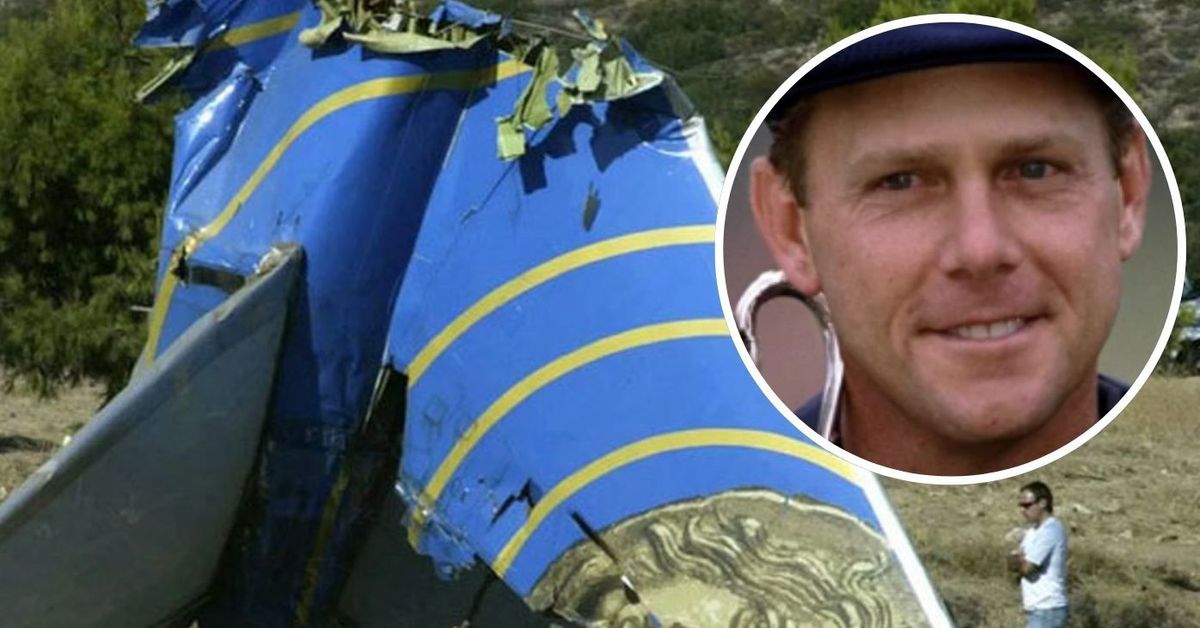
Superstar golfer Payne Stewart was among six people who died in a bizarre plane crash on October 25, 1999.
The 42-year-old was one of the passengers flying from Orlando to Dallas on the Learjet when communication with the pilot was lost shortly after it departed that morning.
The words “three nine zero bravo alpha” was the last transmission recorded by air traffic controllers.
 Superstar American golfer Payne Stewart died in a bizarre plane crash on October 25, 1999. (AP)
Military fighter jets were dispatched to tail the executive jet as frantic attempts to contact its pilot failed.
They reported the jet’s windows fogged over or frozen, and no sign of life.
After its occupants apparently died, the plane began an aimless ghost flight, played out on national television.
Millions of people watched as the aircraft flew aimlessly across 2400km for almost four hours until it ran out of fuel, hit the ground and exploded in South Dakota.
Known for his flamboyant plus-four trousers and flat caps, Stewart was one of the most distinctive golf stars of the late 1980s and 1990s.
He won three of golf’s major championships among his haul of tournament victories.
 A file photo of the Learjet Payne Stewart and five others were flying in before the fatal crash on October 25, 1999. (Public domain)
Cruelly, at the time of his death Stewart had rediscovered his talent on the golf course.
He won the US Open in June 1999 – a title he would never get a chance to defend – and was a member of the American Ryder Cup team that beat Europe just a few weeks before his death.
Also aboard the doomed flight was Stewart’s agent and close friend Rob Fraley, a former college football star.
In the aftermath of the tragedy, there was speculation the US Air Force was planning to shoot down the plane as it flew aimlessly across the country’s Mid West.
But officials have consistently denied the reports.
 A statue of golfer Payne Stewart stands at the Pinehurst course in North Carolina, the scene of his famous US Open victory in 1999, just months before his death. (Getty images)
The flight voice recorder – recovered from the wreckage – revealed the sounds of a low pressure alarm which pointed to a disastrous loss of cabin pressure.
An investigation by the US National Transportation Safety Board found the disaster was probably caused by loss of cabin pressure “for undetermined reasons”.