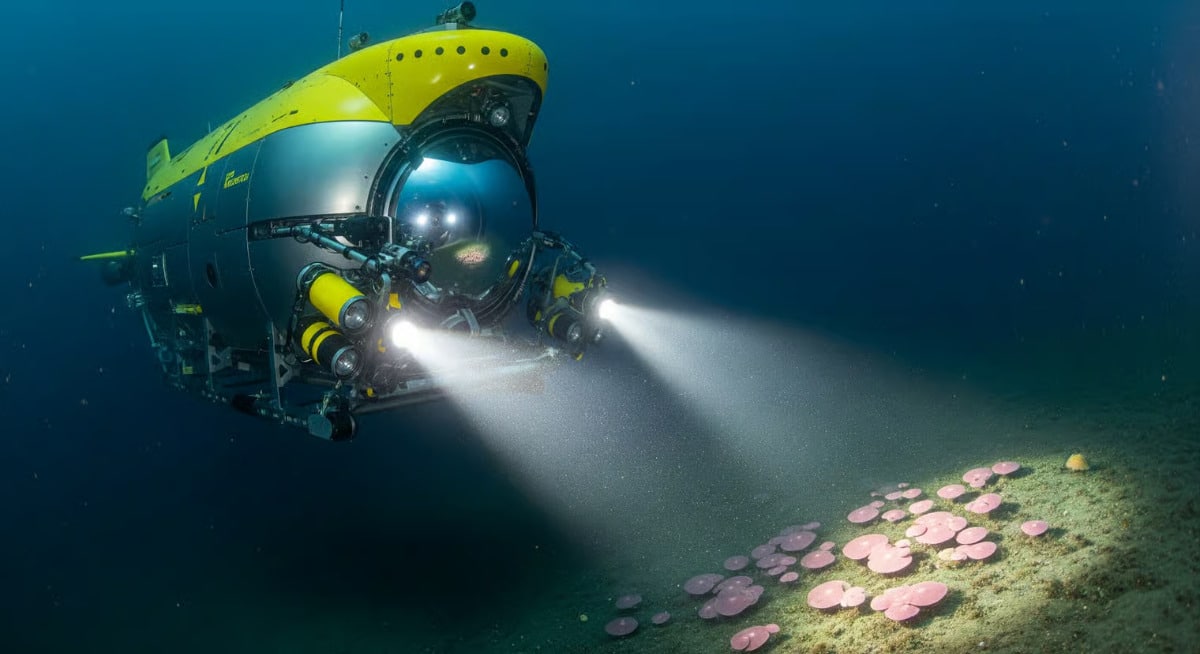
At a depth of 10,000 meters—where light never reaches and pressure could crush a submarine—a Chinese team has made an astonishing discovery: entire colonies of life thriving in conditions once thought utterly impossible.
The hadal zone, found more than 6,000 meters below the ocean’s surface, remains one of Earth’s most remote and mysterious frontiers. Until now, scientists believed life in these crushing depths was limited to microbes and other microscopic organisms. But that assumption has just been shattered.
The Kuril-Kamchatka Trench—one of the deepest known places on the planet at 10,542 meters—has revealed one of its best-kept secrets.
An unseen world at the ocean’s bottom
In 2024, a team of Chinese researchers ventured to the bottom of this deep Pacific trench. Inside a manned submersible, they descended into the abyss—and what they found defied expectations.
Instead of a barren, lifeless seafloor, they encountered a rich ecosystem: thousands of tube worms (some over a foot long), alongside mollusks, crustaceans, and even sea cucumbers.
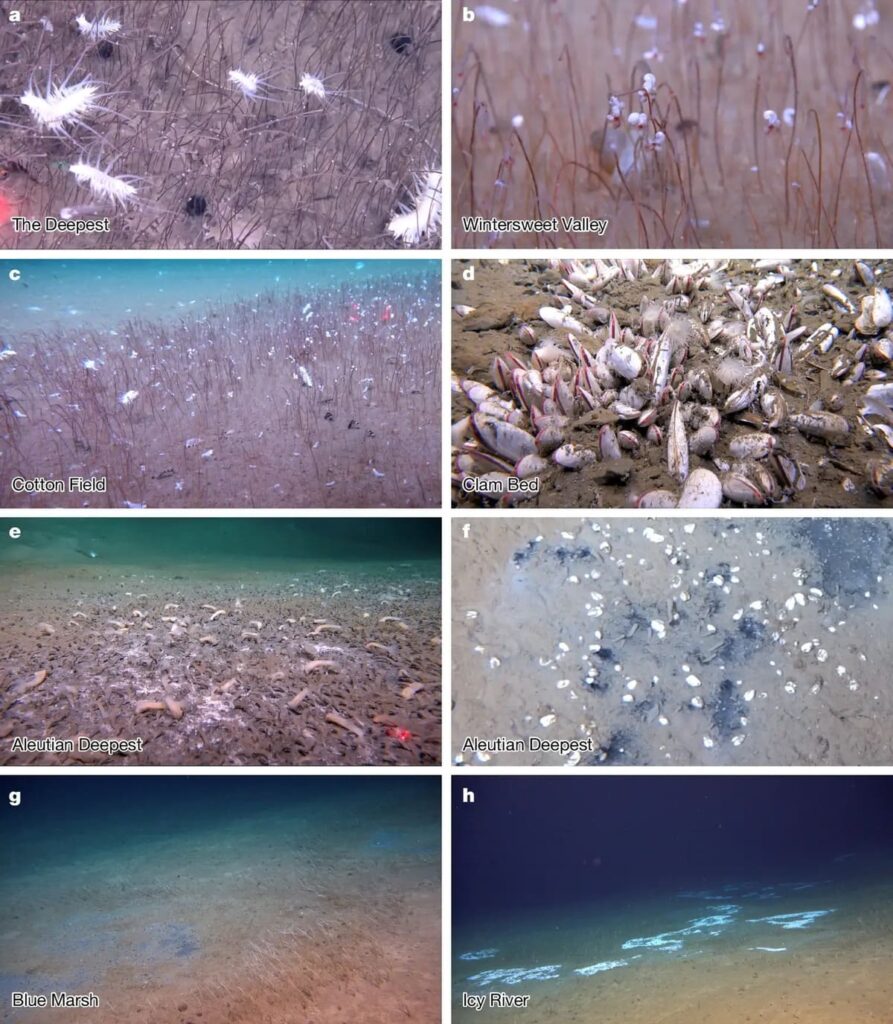
Although scientists knew that microbes could thrive at these depths, they struggled to imagine that larger species could survive there. © Peng et al., Nature, 2025
Living on the edge—without sunlight
How do these creatures survive in such an alien environment? The secret lies in a process known as chemosynthesis.
Unlike most organisms on Earth, which rely on sunlight for photosynthesis, these deep-sea inhabitants get their energy from chemicals like methane and carbon leaking through cracks in the ocean floor. It’s a harsh but sustainable system—built on chemistry, not sunlight.
he researchers discovered several types of areas that are home to different types of organisms. © NPG Press, Institute of Deep-sea Science and Engineering, CAS
Published in the journal Nature, this discovery suggests that similar communities may be hiding in other deep ocean trenches, far beyond where we once thought life could exist.
The future of the seafloor—at risk?
These findings also come with a warning.
As nations like China and the U.S. look to mine the ocean floor for rare minerals, scientists are urging caution. Such activity could irreparably damage fragile ecosystems that we’re only just beginning to understand.
The race for deep-sea resources is heating up—but so is the call to protect these ancient, fragile worlds. Because sometimes, what we stand to lose is far more valuable than what we hope to gain.

Angèle Ingrand
Science journalist
Fascinated by nature and zoology since childhood, this journalist chose to share her passion through journalism after completing her biology studies. Now in her third year at the journalism school in Cannes, she works at Futura, where she is dedicated to making science accessible and raising public awareness of environmental issues.