
Don’t miss out — a bright comet is visible with the naked eye already, and the best is yet to come! Plan a nature trip this weekend, October 25–26, and see this once-in-a-millennium comet for yourself. This guide will help you pick the best time and get ready to take photos. Want to start now? Find Comet Lemmon tonight with the free Star Walk 2 app.
ContentsComet Lemmon 2025 Explained: Key Facts and Visibility Guide
Comet Lemmon showed up in January and suddenly became the candidate for the best comet of 2025. There are likely no other comets reaching that brightness this year.
Don’t lose precious time — the period for viewing Comet Lemmon from the Northern Hemisphere **started in mid-October and will last until mid-November **. During this period, C/2025 A6 will be near Earth and can become visible to the naked eye under dark, moonless skies away from city lights.
Peak brightness is expected around October 27. But peak brightness isn’t always the best time to look. Visibility also depends on the comet’s height above your horizon and the phase of the Moon. In the next section, you’ll find the best dates for selected locations. Or use the free Star Walk 2 app to check exactly where the comet will be in your sky.
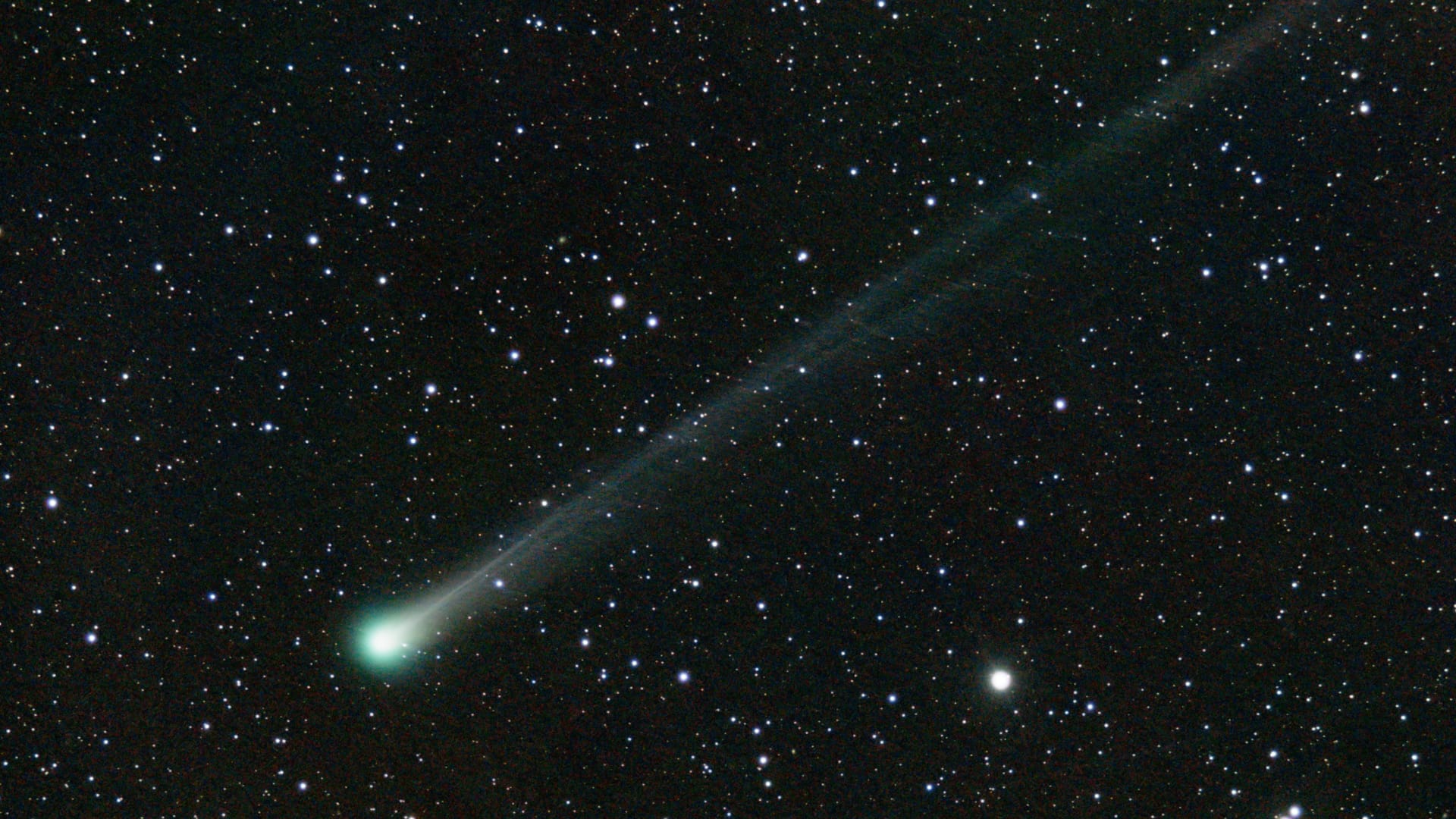 Comet C/2025 A6 (Lemmon) captured on September 24, 2025, by Dimitrios Katevainis.
In photos, Comet Lemmon looks like a bright green streak with a long tail. To your eyes, expect a fuzzy, faint “star.” With binoculars, you’ll see a hazy dot with a brighter core and a short tail pointing away from the Sun. Want to photograph it? Check the section below — you can do it even with a smartphone!
Another reason not to wait and start comet hunting now is that this is truly a once-in-a-lifetime event. C/2025 A6 (Lemmon) returns only about once every 1,000 years, so no one alive today will see it again. If you can’t spot it with the naked eye, at least take a photo — it’ll last forever and be something to show your grandkids!
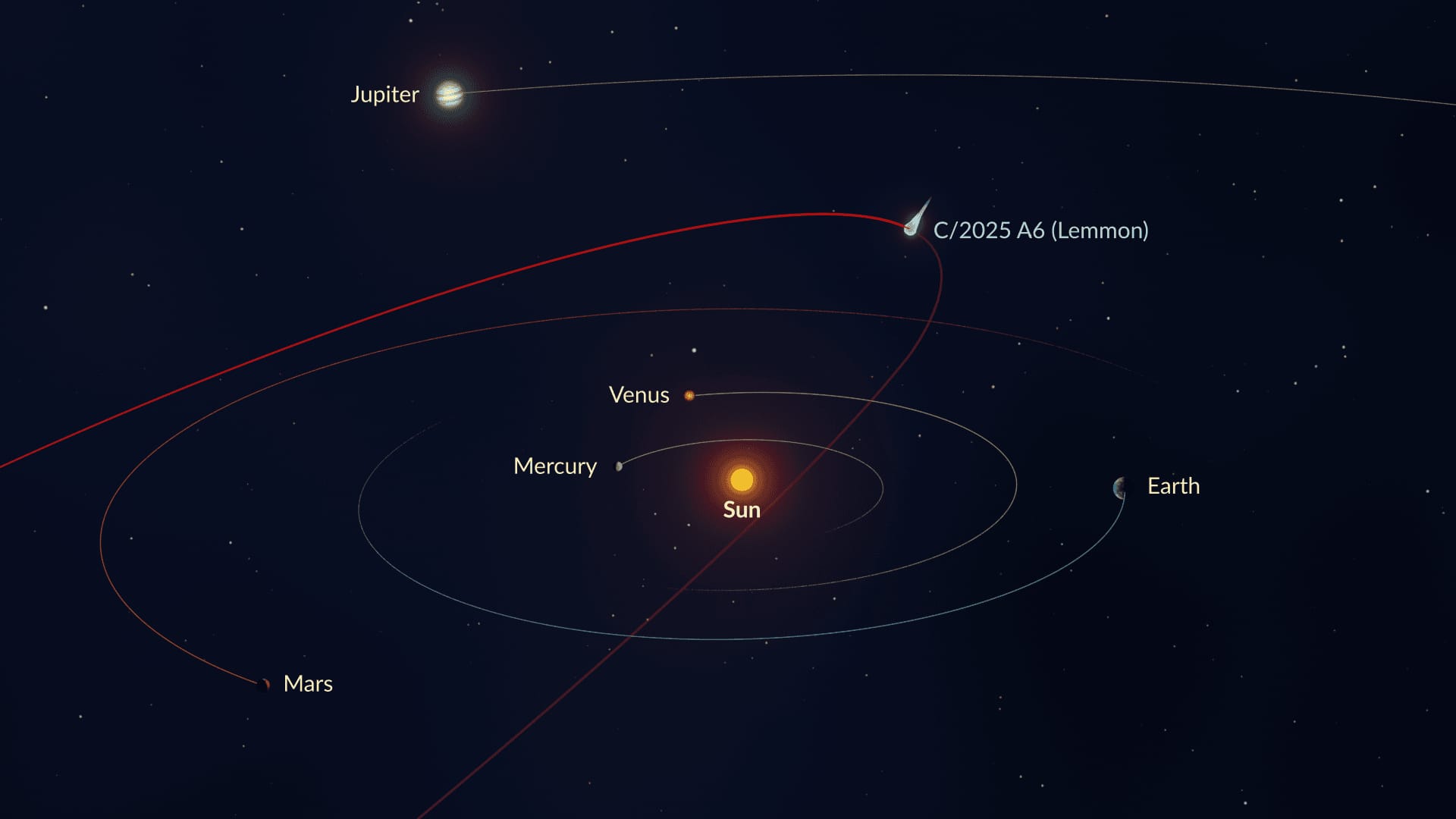 The orbit of comet C/2025 A6 (Lemmon) as it passes through the Solar System in 2025. It will be more than 1,000 years before the comet returns!
Besides, this comet is best visible in the Northern Hemisphere — a rare case. The orbit of C/2025 A6 is tilted by 143.7°, so the comet moves retrograde — opposite the planets’ usual direction — and approaches perihelion on a northern, retrograde path, favoring northern observers.
Where to See Comet Lemmon Tonight in the U.S.
Comet C/2025 A6 (Lemmon) will be well visible in the evening sky from October 18 to November 12. During this period, its brightness will range between magnitude 3.8 and 4.8. To the naked eye, the comet will look like a dim star with a faint blur, while through binoculars or a small telescope, it will appear as a small hazy patch with a bright core and a short tail pointing away from the Sun.
The best time to observe comet Lemmon in the U.S. will be October 25–28, when the comet is near its peak brightness and stands relatively high above the horizon.
For example, in New York on October 27, after sunset and the end of civil twilight (6:26 p.m. EDT), Comet Lemmon will be about 30° above the western/southwestern horizon. The comet will set around 9:05 p.m. EDT.
For comparison, in Los Angeles on the same evening, after the end of civil twilight (~6:30 p.m. PDT), the comet will be about 29° above the western horizon and will set around 8:49 p.m. PDT. Thus, even on the West Coast, observing conditions will be quite similar.
If you can’t observe the comet on the given dates, try any evening around them. It will appear at roughly the same time, only dimmer. By November 10, its maximum altitude will drop to about 16–19°, depending on your location.
In the sky, you’ll find the comet in the constellation Boötes in late October and closer to Ophiuchus in early November.
Tip: Choose a location with an open western horizon and away from city lights — this way, the comet will become visible just a few minutes after sunset.
Where to See Comet Lemmon Tonight in Canada
Comet C/2025 A6 (Lemmon) should be easy to spot in the evening sky from October 18 to November 12. Expect its brightness to be around 3.8 to 4.8 magnitude. To the naked eye, it will resemble a faint, slightly fuzzy star; in binoculars or a small telescope, it will look like a small hazy patch with a bright center and a short tail pointing away from the Sun.
Best viewing time: October 25–28, when Comet Lemmon is near peak brightness and sits relatively high above the horizon.
For example, in Toronto on October 27, after sunset and at the end of civil twilight (6:44 p.m. EDT), the comet will be about 37° above the horizon, or roughly two handspans at arm’s length. Look in the southwestern and western skies. It will sink slowly and set around 9:32 p.m. EDT.
Across most of Canada, times and altitudes differ by only a few minutes and a few degrees, so viewing conditions will be similar.
If those dates don’t work, try nearby evenings. The timing will be about the same, though the comet will be a bit dimmer. By November 10, its maximum altitude will drop to roughly 15°.
Where to look: In Boötes in late October, shifting toward Ophiuchus in early November.
Tip: Choose a spot with a clear western horizon, far from city lights. The comet should become visible a few minutes after sunset.
Where to See Comet Lemmon Tonight in the U.K.
Comet C/2025 A6 (Lemmon) will be visible in the evening sky from October 18 to November 12. During this time, its brightness will range between magnitude 3.8 and 4.8. To the naked eye, it will look like a faint, slightly fuzzy star; in binoculars or a small telescope, it will appear as a small hazy patch with a bright core and a short tail pointing away from the Sun.
Best viewing time: October 25–28, when the comet is near its peak brightness and sits relatively high above the horizon.
In London on October 27, after sunset and at the end of civil twilight (5:17 p.m. GMT), the comet will be about 29° above the horizon — roughly one and a half hand spans at arm’s length. Look for the comet between the southwest and west. It will gradually descend and set around 8:18 p.m. GMT.
Across the U.K., times and altitudes differ by only a few minutes and degrees, so viewing conditions will be similar throughout the country.
If you can’t observe it on those exact dates, try nearby evenings. The comet will appear around the same time, just a bit dimmer. By November 10, its maximum height will drop to around 13°.
Where to look: In Boötes in late October, moving toward Ophiuchus in early November.
Tip: Choose a spot with a clear western horizon, away from city lights. The comet should become visible a few minutes after sunset.
How Bright Will Comet Lemmon Get in October 2025?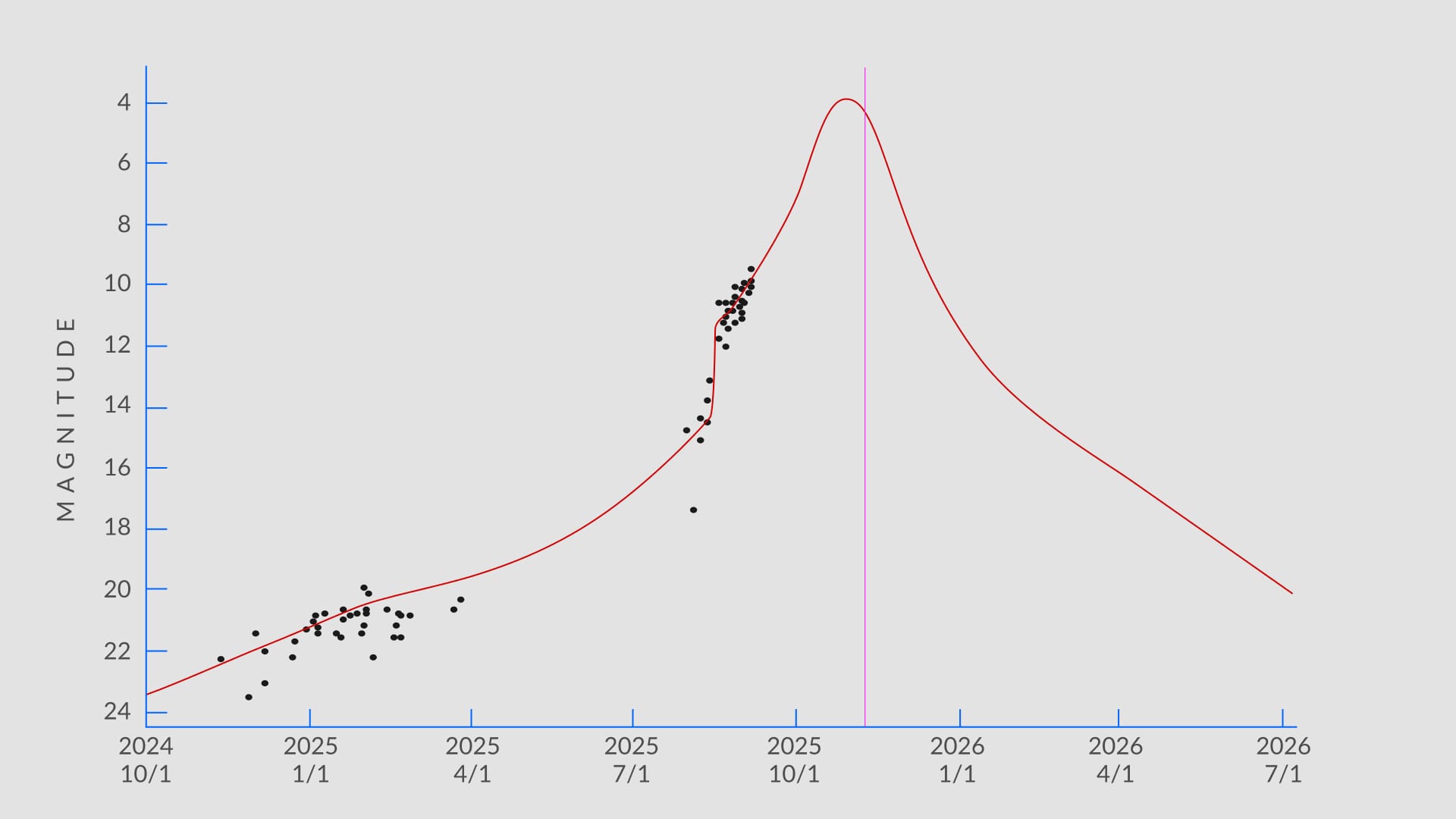 This chart shows the estimated development of the comet’s magnitude.
Let’s talk about numbers. In astronomy, magnitude values work as follows: the lower the number, the brighter the object.
The current forecast puts the peak brightness around magnitude 4 in late October, which would make Comet Lemmon a naked-eye object from dark locations and an easy target in binoculars.
So, despite being the best comet of 2025, Comet Lemmon won’t become a “great” comet, like NEOWISE or (arguably) Tsuchinshan-ATLAS. However, this comet is still way brighter than about 90% of comets visiting our Solar System, so don’t miss out!
You will need help to locate Comet C/2025 A6 in the sky — use any astronomical app, like Star Walk 2 or Sky Tonight. This way, finding the comet will only take you a few seconds.
Remember: comets don’t follow scripts, so get prepared for surprises. Follow us on social media, where we will provide the latest updates on C/2025 A6 (Lemmon).
Is Comet Lemmon Visible to the Naked Eye?
Good news — Comet Lemmon can now be seen without binoculars!
Starting around October 20, people from different parts of the world reported that the comet became bright enough to spot with the naked eye. Some observers estimate C/2025 A6 has reached a magnitude of about 3.6, though more reliable data from COBS suggest it’s closer to 4.
Still, it’s not an easy target — you’ll need a very dark, clear sky, far away from city lights. It won’t be visible from urban areas without equipment, but binoculars will make it easier to find. Give your eyes at least 30 minutes to adjust to the dark before looking for faint objects. (And don’t forget to switch on Night Mode or Red Mode in your stargazing app.)
Anyway, if you want to see Comet Lemmon, plan a trip out of town this weekend! We’d love to see your results — share your photos or impressions of the comet with us on social media.
Visibility of Comet C/2025 A6 (Lemmon) in October 2025
C/2025 A6 (Lemmon) is now visible both in the evening and in the morning in the Northern Hemisphere. Middle and higher northern latitudes are especially favored — in the mid-northern latitudes, C/2025 A6 (Lemmon) is circumpolar and doesn’t set below the horizon for a short period of time in October.
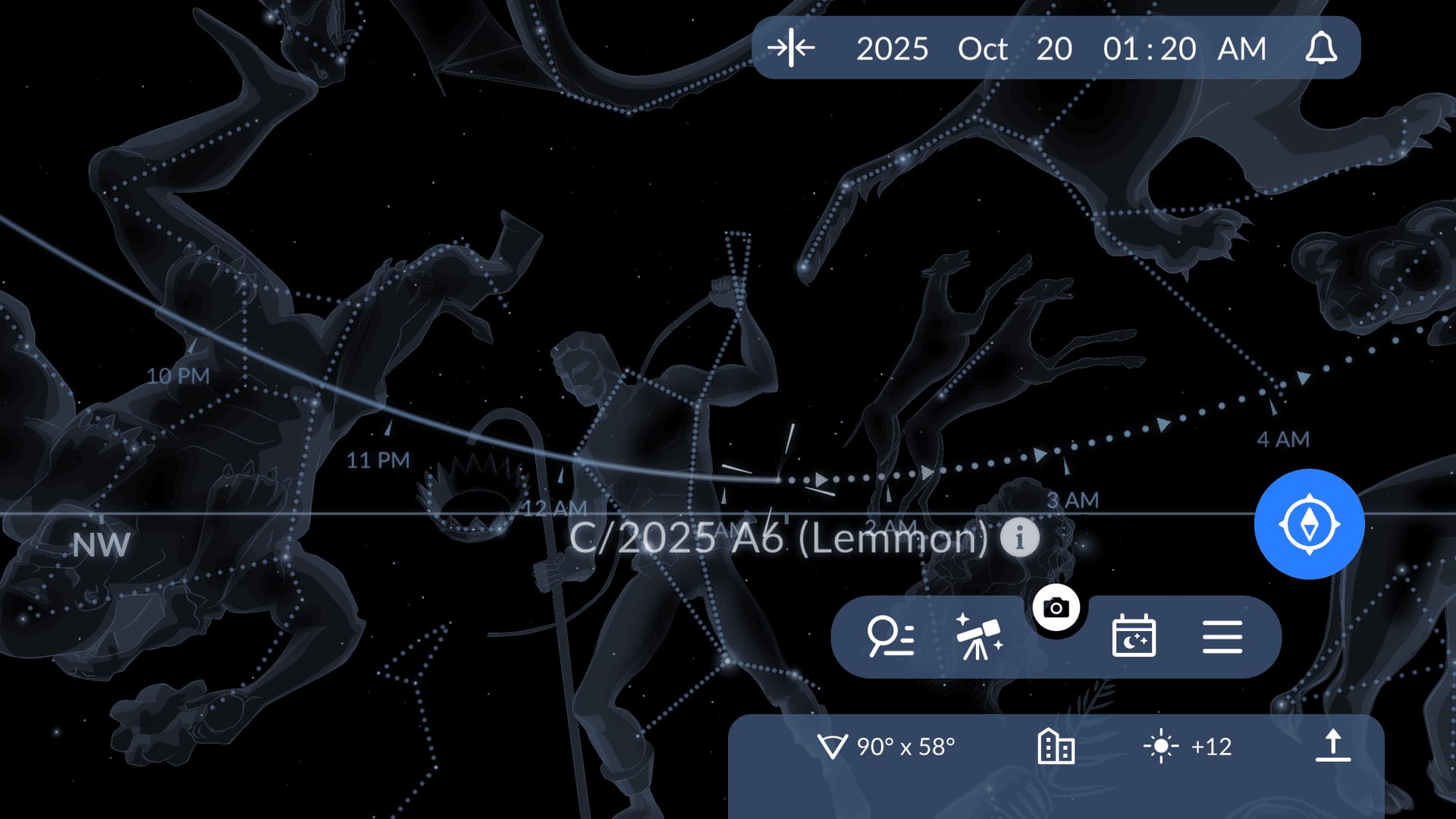 Starting from mid-October 2025, comet C/2025 A6 (Lemmon) won’t set below the horizon in latitudes of 48° N or above.
By late October to early November, the comet may reach magnitude 4, then fade quickly afterward. In late November, it sits very low in the bright evening twilight for most northern observers, making it practically unobservable.
In the Southern Hemisphere, C/2025 A6 (Lemmon) is not well placed now, but should appear in November.
Comet Lemmon Trajectory: Track C/2025 A6 Across the Night Sky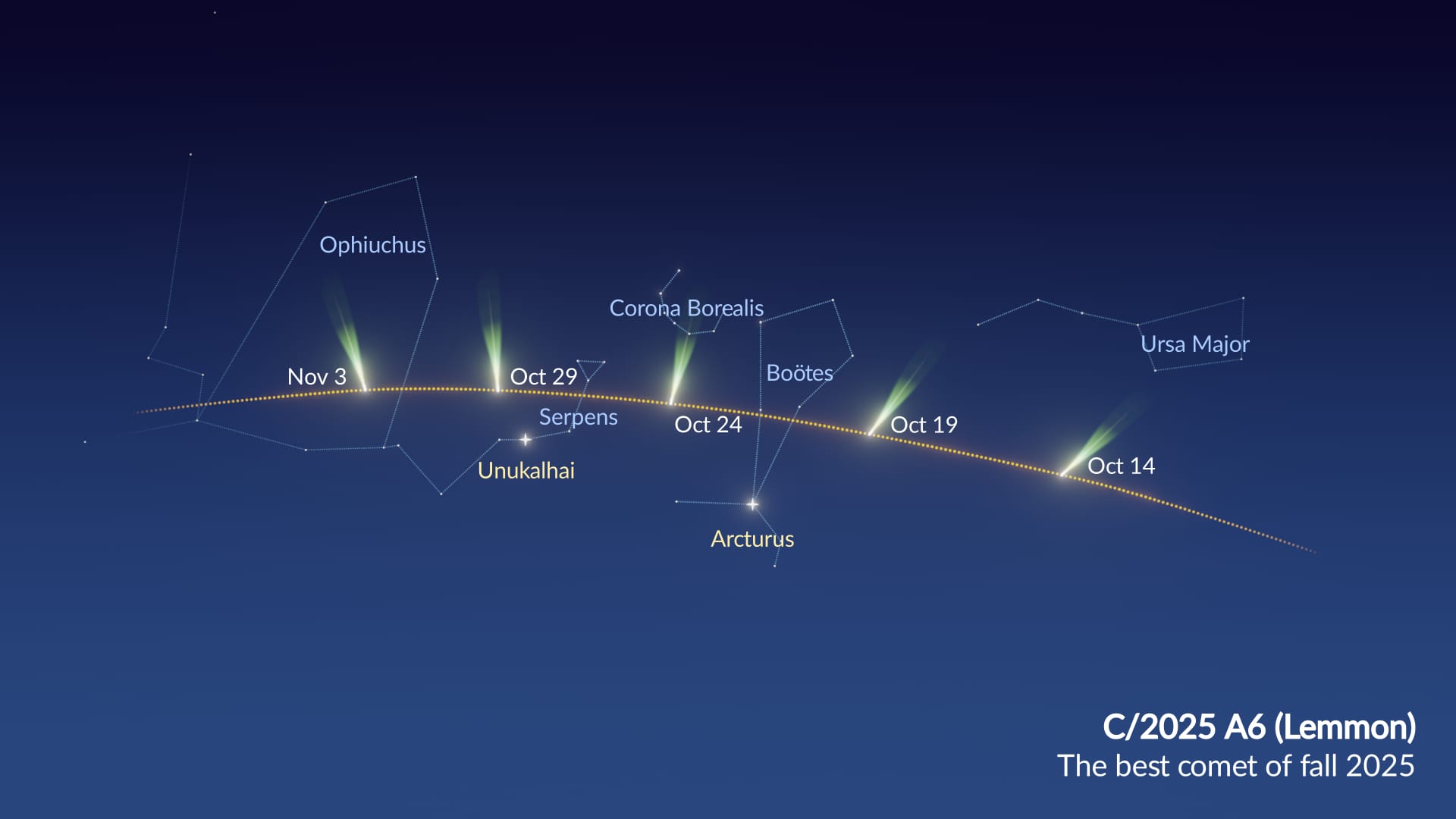 Path of C/2025 A6 (Lemmon) across constellations in October-November 2025.
Right now, the comet appears against the backdrop of the Boötes constellation, visible in the evening sky. Then it will travel into the southern constellations — Serpens, Hercules, Ophiuchus. Around mid-November, it disappears into evening twilight.
How to See Comet Lemmon in October 2025: The Complete Guide by Weeks
Here is the detailed path of Comet Lemmon so you know where to look to find it. Prefer the easy route? Open the free Star Walk 2 app, search C/2025 A6 (Lemmon), and follow the on-screen arrow to the comet in your sky.
October 14–20
C/2025 A6 (Lemmon) is visible both in the evening and morning sky, in the faint constellation Canis Venatici. In the evening, look above the northwest horizon (west of the Big Dipper). In the morning, look northwest, north of the Big Dipper. On October 16, it passes less than 1° from Cor Caroli (mag 2.9). Elongation¹ ~48°.
Another comet is putting on a show around the same time — C/2025 R2 SWAN. Look southwest, at the constellation Sagittarius. The comet will reach magnitude 6-7 on October 20, visible via a pair of binoculars.
¹Simply put, elongation is the angular distance separating a celestial object from the Sun. The bigger the number, the better an object is visible, since sunlight doesn’t interfere with observations.
October 21–27
Early in the week, C/2025 A6 (Lemmon) is visible in both the evening and morning sky in Boötes. Starting around October 24, it’s an evening-only object as it moves into Serpens.
Comet Lemmon reaches its closest to Earth on October 21, and the same night is the New Moon! This is one of the best times to see the comet — look northwest of the Big Dipper at around 19:00 local time. Elongation ~37°.
But that’s not all: one of the best meteor showers of the year, Orionids, also reaches its peak of activity that night, so you can hunt the comet and catch shooting stars in a single observation session.
On October 25–27, everything lines up for seeing Comet Lemmon: it’ll be high enough in the sky for many places, close to its brightest, and the Moon will be near its new phase, so the sky will be darker. And it’s the weekend — a perfect time to leave the city lights behind and enjoy the night sky!
October 28–November 3
C/2025 A6 (Lemmon) is visible in the evening — first, in Serpens, then moves to Ophiuchus around October 31. Look low above the western horizon; the nearest bright star is Unukalhai (mag 2.6), about 9° (one fist at arm’s length) to the west. Also, the comet appears in the evening sky in the Southern Hemisphere. Elongation ~33°.
November 4–10
C/2025 A6 (Lemmon) is visible in the evening, in the constellation Ophiuchus. Moves closer to the horizon each day, gradually fading. The Full Moon occurs on November 5, but fortunately, it is positioned on the opposite side of the sky. After November 9, Comet Lemmon will fade rapidly. Elongation ~30°.
November 11–17
C/2025 A6 (Lemmon) is visible in the early evening, very close to the southwestern horizon in the constellation Ophiuchus. Gradually losing in the evening twilight. Elongation ~24°.
Comet Lemmon Photography Tips: Guide for Beginners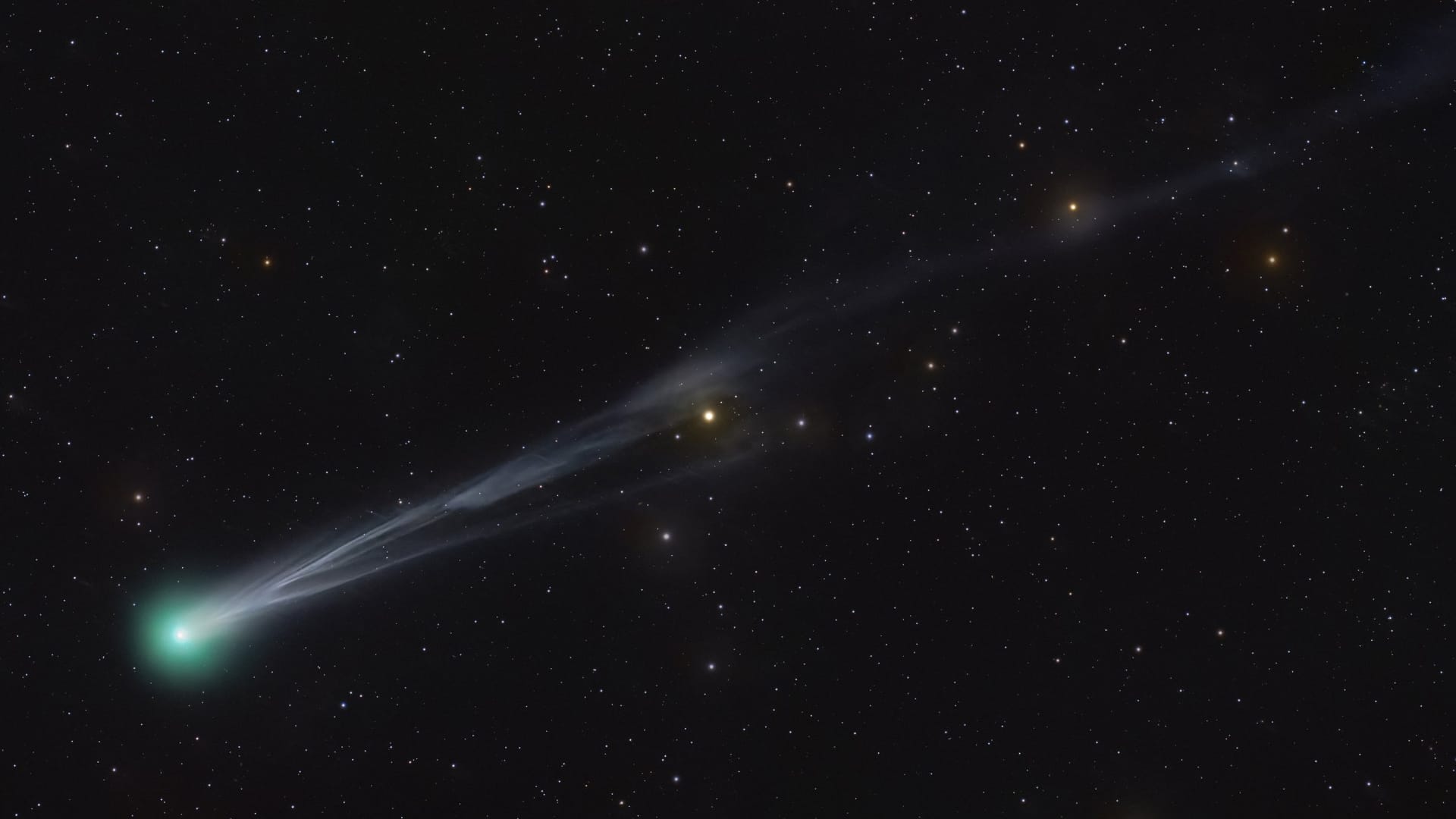 Comet C/2025 A6 (Lemmon) captured on September 26, 2025, by Victor Sabet and Julien De Winter.
The comet won’t stay long — but your photos will. Comet Lemmon offers a perfect chance to practice astrophotography — it’s expected to be the brightest comet of 2025, visible under dark skies with a long tail stretching several degrees across the sky, making it especially rewarding to photograph.
When photographing a comet, keep two things in mind:
Comets move across the sky. Short exposures of a few dozen seconds won’t show much motion, but in longer sequences or stacked images, the comet’s core may slightly shift compared to the stars.
Dark skies matter. Light pollution and moonlight reduce contrast. For best results, choose dark conditions. The free Star Walk 2 app can help you locate the comet, check its altitude, and find the observing time when the sky is darkest.
Next, let’s explore how to capture the comet using different gear — from a smartphone on a tripod to a camera with a star tracker or even a telescope.
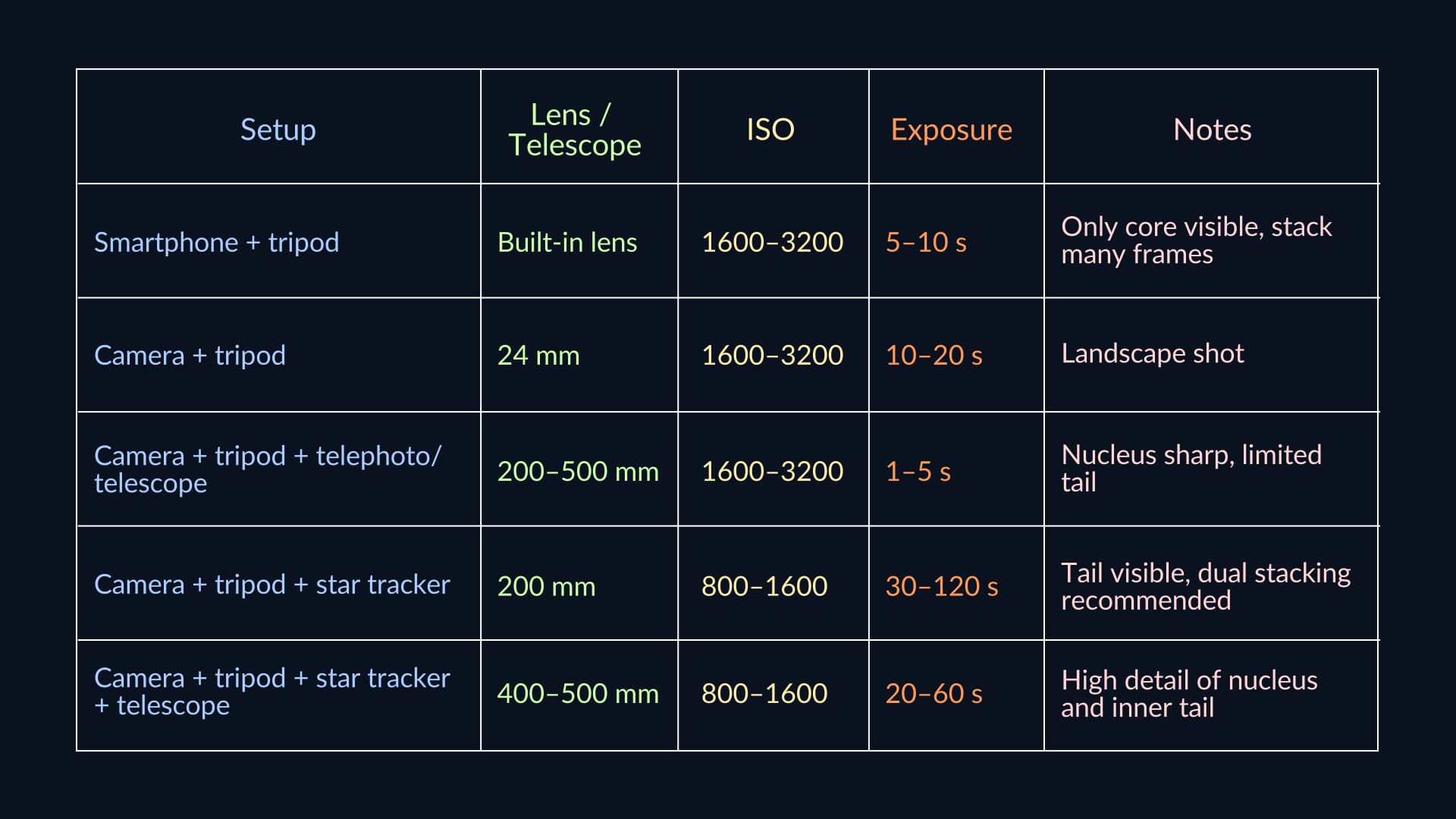 Here’s a quick cheat sheet on camera settings for different devices for capturing Comet C/2025 A6 (Lemmon).How to Photograph a Comet with a Smartphone
Using just your phone, the comet will likely appear as a faint, fuzzy spot, and the tail may be barely visible — but it’s still worth a try! If you can’t see Comet Lemmon with the naked eye, a picture might reveal it. Just find the comet’s location in the sky with the free Star Walk 2 app, take a picture with the right settings, and voilà! Here’s how to capture it:
Set your phone on a tripod or stable surface.
Turn on Night mode or Astrophotography mode (available on some phones).
If your phone supports Pro/Advanced mode, adjust the settings manually. Here is a short settings guide:
ISO (sensitivity): Use 1600–3200. Higher ISO settings make the image brighter but also add noise.
Exposure (shutter speed): Set to 5-10 seconds. Longer exposures may blur stars and the comet.
Aperture (f-number): Usually fixed on phones. A lower number (like f/1.8) lets in more light.
Zoom: Stick to 1× or 2× for clarity. At 0.5× wide-angle, the comet looks too small. At 2×, it stands out more while still showing the surrounding sky. If your phone supports 3× or higher, try it for a closer view of the comet.
How to Photograph a Comet with a Camera and Tripod
This is the first step beyond smartphone photography. With this setup, you can capture either a wide-field shot of the comet in a landscape or a closer view showing the comet and its short tail.
Lens: 14-35 mm for landscapes; 85-135 mm for closer comet shots.
ISO: 1600-3200.
Exposure: 10-20 seconds with a wide-angle; 5-10 seconds with a short telephoto to avoid star trailing.
Aperture: As wide as possible (f/2-f/2.8).
Focus: Set manually on a bright star near the comet.
Tip: The Star Walk 2 app in AR mode can help you align the comet with a landmark, such as a tree, mountain, or building, for a striking composition.
Using a Telephoto Lens or Telescope for Comet Photography
This setup lets you zoom in for a larger image of the comet’s nucleus and part of its tail. Without tracking, however, you’ll be limited to short exposures.
Focal length: 200-500 mm telephoto lens, or a small telescope (80-100 mm aperture).
ISO: 1600-3200.
Exposure: Very short, 1-5 seconds to avoid smearing.
Aperture: Around f/4-f/5, typical for telescopes.
You’ll capture a sharp cometary core with a faint hint of the tail. To reveal more detail, take multiple short frames and stack them during processing.
How to Capture a Comet with a Star Tracker
A star tracker follows the sky’s motion, allowing longer exposures that reveal faint details in the comet’s tail.
Lens: 50-200 mm.
ISO: 800-1600.
Exposure: 30-120 seconds, depending on focal length.
Aperture: f/2-f/4.
Technique: Create two stacks — one aligned with the stars and one with the comet. Combine them during processing to get both stars and the comet to look sharp in the picture.
Advanced Setup: Star Tracker + Telephoto Lens or Telescope
This setup provides the most detailed results, capturing fine tail structures and even subtle color variations (ion tail vs. dust tail).
Focal length: 300-500 mm lens, or a small refractor telescope.
ISO: 800-1600.
Exposure: 20-60 seconds per frame.
Aperture: f/4-f/5 (typical for telescopes).
Stacking: Align frames on the comet to keep its nucleus looking crisp and clear.
When and How Comet Lemmon (C/2025 A6) Was Discovered
The Mount Lemmon Survey first recorded the object on January 3, 2025, at magnitude 21.5 — it was so faint it was first thought to be an asteroid-like object. Later, precovery images from Pan-STARRS (taken on November 12, 2024) were identified. Follow-up observations revealed a condensed coma (≈2.2 arcsec) and a short tail (≈2 arcsec, noted on February 21, 2025), confirming its cometary nature. One and a half months after its discovery, the object was announced as C/2025 A6 (Lemmon). C/2025 A6 (Lemmon) is dynamically old, meaning it has passed near the Sun before.
F.A.Q: Comet LemmonWhen to see Comet Lemmon?
Comet C/2025 A6 (Lemmon) is already visible in the evening sky for observers in the Northern Hemisphere. You can watch it throughout the month — under dark skies, it may be visible to the naked eye, but you’ll get the best view with binoculars.
What is the best time and direction to see Comet Lemmon?
The best time to observe Comet Lemmon will be around October 27, 2025. At this time, the comet will reach its peak brightness and remain relatively high above the western horizon during twilight.
How long will Comet Lemmon remain visible?
Comet Lemmon will be visible until mid-November via a pair of binoculars. However, from about November 10, the comet will fade quickly, so it’s better to observe C/2025 A6 around its peak brightness at the end of October.
Can I see Comet Lemmon without binoculars?
Yes — you’ll likely be able to spot Comet Lemmon with the naked eye in late October, but only under perfectly dark skies, far from city lights. For now, the comet is easily visible with binoculars, so grab a pair and go comet hunting tonight! Watch towards the western horizon in the evening and look for a hazy star-like object with a bright center and a short tail.
Does the Moon affect the visibility of the Comet Lemmon?
Yes. The Moon is a powerful source of light that can interfere with observations of fainter objects. So, aim for moonless nights for observations of the Comet Lemmon.
New Moon: October 21
First Quarter Moon: October 29
Full Moon: November 5 (luckily, the comet will be on the opposite side of the sky)
Last Quarter: November 14
See the Moon phases calendar on our website for more details.
Did the Sun affect Comet Lemmon (C/2025 A6)?
Comet Lemmon has passed near the Sun before and had an orbital period of about 1,350 years — in other words, people last saw it more than a millennium ago. However, the current passage through our Solar System altered Lemmon’s orbital period (which isn’t a rare event for comets in general). On April 16, the comet passed within 348.5 million kilometers (216.6 million miles) of Jupiter. Jupiter’s gravitational field sapped some of Lemmon’s orbital energy, shortening its period by about 200 years, and now it’s approximately 1,154 years.
Which apps can help to find Comet Lemmon in the sky?
Sky Tonight and Star Walk 2 are free apps that show the exact position of any comet or celestial object in the sky from your location. You can easily identify stars, constellations, planets, comets (like Comet Lemmon, Comet SWAN, or 3I/ATLAS), satellites, and deep-sky objects in real time — just point your phone at the sky, and the app will do the rest!
Both apps are easy to use and will help you locate Comet Lemmon. The main difference is that Sky Tonight offers more advanced features for amateur astronomers, while Star Walk 2 provides a relaxing stargazing experience with soothing music and stunning visuals. Additionally, Sky Tonight includes all astronomical objects for free, whereas Star Walk 2 requires an extra purchase to access smaller Solar System objects like comets.
All About Comet Lemmon (C/2025 A6): Summary and Highlights
Type: dynamically old, long-period comet
Orbital period: 1,350 years (inbound)/ 1,154 years (outbound)
Perihelion: November 8, 2025, at 0.53 AU
Closest to Earth: October 21, 2025, at 0.60 AU
Forecasted peak brightness: mag 4 (easy in binoculars; naked-eye under excellent conditions) around October 27, 2025
Best visibility: Northern Hemisphere, late October – early November
C/2025 A6 (Lemmon) is a great target for late October to early November 2025. It’s already around magnitude 4, visible through binoculars and even to the naked eye under perfectly dark skies. Observers in the Northern Hemisphere get the best view first, while in the Southern Hemisphere, the comet will become visible in mid-November. For the live position of the comet in your sky, use the free Star Walk 2 app.