
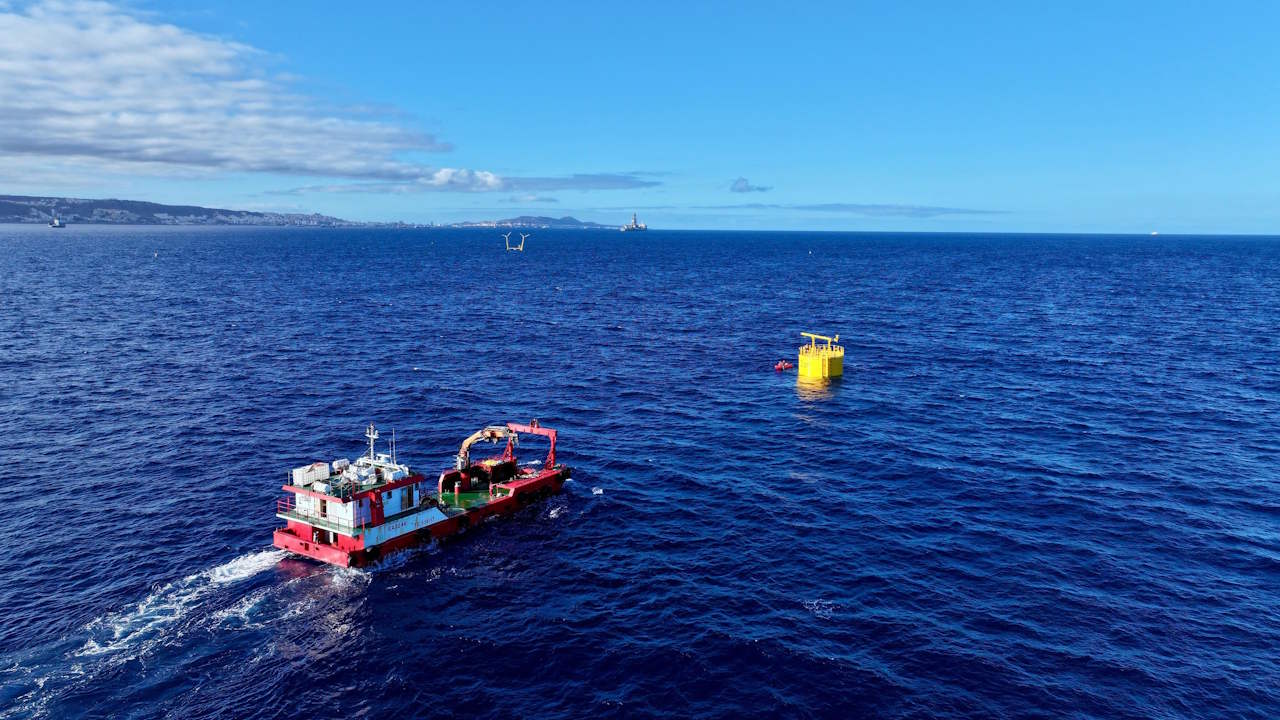
A British firm has installed a prototype ocean energy unit off the coast of Gran Canaria in the Spanish Canary Islands, to test the “resilience” of a technology it says is capable of converting solar heat energy stored in the oceans into renewable baseload power.
The prototype ocean thermal energy conversion (OTEC) power module – developed by British firm Global OTEC – has been towed out to the Oceanic Platform of the Canary Islands, or PLOCAN test site to assess its ability to withstand hurricane-level storms and the rough conditions of the Atlantic Ocean.
If successful, OTEC could provide invaluable baseload power to tropical island states and countries which face extreme weather but are also heavily reliant on diesel generation.
“This is more than just a test of the core technology, which has already been proven to work – it’s a demonstration of resilience,” said Dan Grech, founder and CEO of Global OTEC.
“If we can demonstrate that OTEC platforms can operate safely and continuously through extreme weather, we open a new chapter for clean baseload power in regions that need it most.”
The prototype has been nicknamed Don in honour of Don Lennard, a British aircraft engineer and Royal Navy veteran who dedicated his life to advancing OTEC technology.
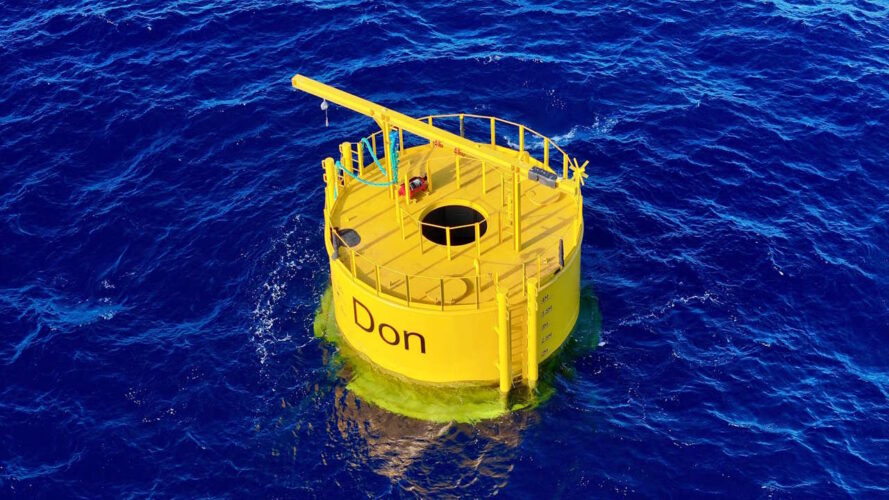 Image Credit: Global OTEC
The technology is not new, but it has failed to evolve and this is the first major test in decades.
The technology uses warm surface seawater to evaporate a working fluid with a low boiling point, which in turn produces vapour that spins a turbine to produce electricity. At the same time, colder deep water is drawn up through a pipe to cool the vapour, turning it back into a liquid which can be then immediately reused.
This cycle can run continuously, serving as a baseload power source that works day and night, every day of the year, and could serve as a vital power source for island nations around the globe.
As a result, OTEC offers significant environmental benefits compared to fossil fuels and nuclear power, but also requires less land than renewable energy technologies, and according to Global OTEC, has the potential to produce far more useful and affordable energy.
With the platform’s cylindrical hull now deployed at the test site, the project team will next install and connect the cold water pipe ahead of a full structural testing period during which it will face the rough conditions of the Atlantic Ocean.
Global OTEC expect the testing to provide a detailed analysis of its resistance, materials, and design.
“The data collected during the tests will validate our computational models and show how accurately we can simulate the interaction between the large-diameter riser and the vessel under a range of conditions,” said Sam Johnston, lead engineer at Global OTEC.

Joshua S. Hill is a Melbourne-based journalist who has been writing about climate change, clean technology, and electric vehicles for over 15 years. He has been reporting on electric vehicles and clean technologies for Renew Economy and The Driven since 2012. His preferred mode of transport is his feet.