
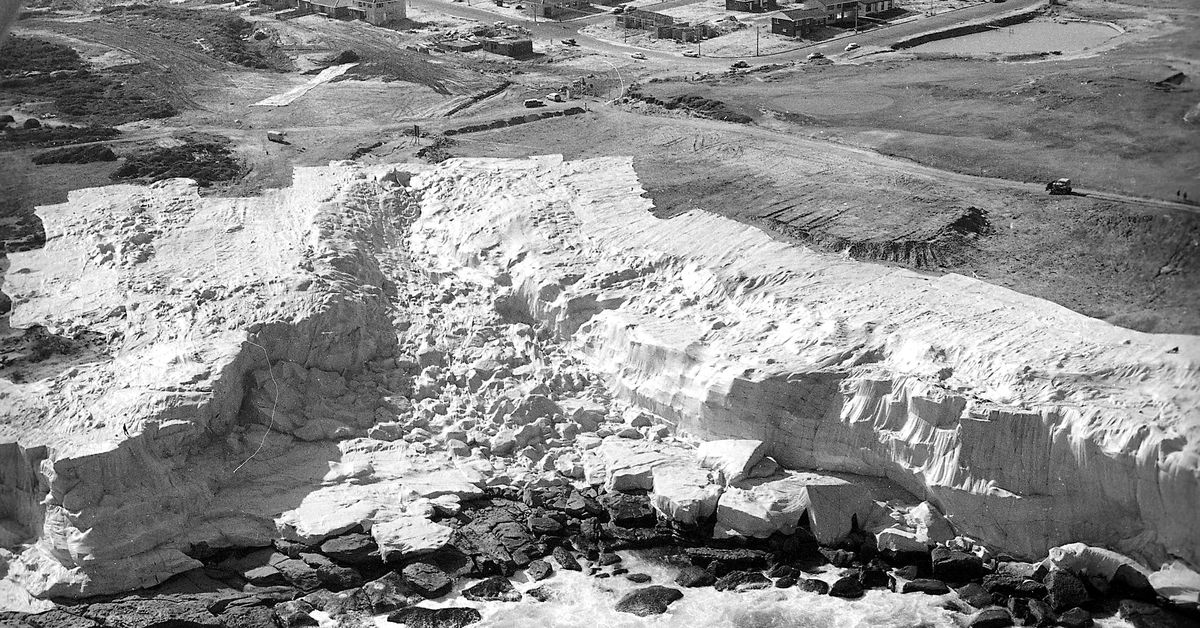
Art pushed new boundaries on October 28, 1969, when work to wrap an entire Australian clifftop in 100,000 square metres of plastic was completed, creating the world’s biggest artwork.
The public was finally able to see 2.5 kilometres of Little Bay, in south-east Sydney, shrouded beneath plastic polyweave from cliff top to base.
The brainchild of the work, known as Wrapped Coast, was Bulgarian-born artist Christo Vladimirov Javacheff and his wife Jeanne-Claude Denat de Guillebon.
 The 2.5km clifftop of Little Bay in south-east Sydney was wrapped in plastic sheeting in October 1969. (Sydney Morning Herald)
 Mountain climbers and art students were recruited to create the ambitious artwork. (Sydney Morning Herald)
They spent 10 weeks at the Little Bay coordinating an army of art students and climbing enthusiasts given the arduous task of wrapping the headland, The Sydney Morning Herald reported at the time.
A special gun was used to fire steel rivets to secure clips into the clifftops for the 56km of climbing rope required.
Many people working on the project were left with ankle sprains and cuts from stumbling into holes near the cliff that had been concealed by the straw-coloured plastic fabric covers.
One member of the local climbing club suffered cuts to his back when he fell five metres onto a ledge.
Art lovers praised Javacheff for putting Australia on the map for contemporary art, but some locals were less impressed.
 A fire at a local tip threatened the art project. (Fairfax Media)
Fishing enthusiasts and keen swimmers were worried the huge expanse of plastic had taken their favourite spots.
The project, backed by a local philanthropist, was also been hampered by curious residents and tourists wandering over Little Bay.
A much more serious threat was a fire at a local rubbish tip that threatened the artwork until firefighters put it out.
The shrouding of Little Bay was the first large-scale environmental artwork by Javacheff and de Guillebon, and at the time the largest single artwork ever created.
The pair went on to produce many other public works at famous sites, such as suspending vinyl drapes through New York’s Central Park and wrapping Berlin’s Reichstag building.