
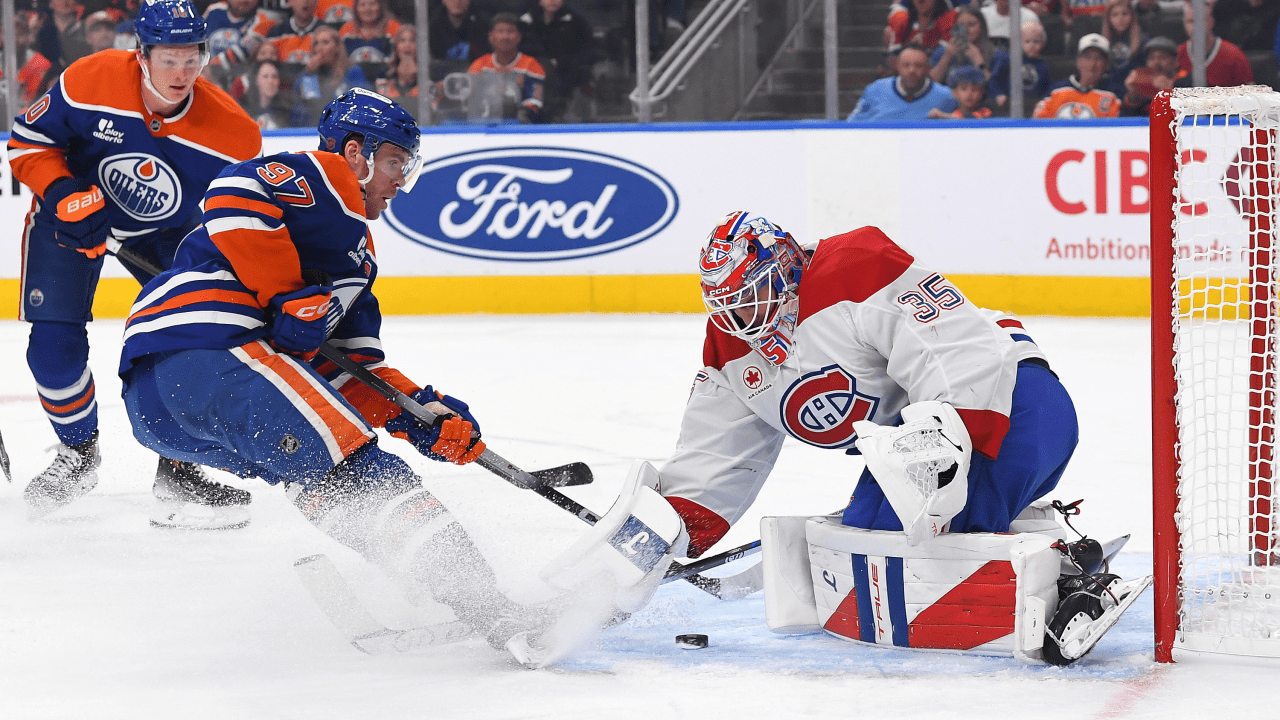
Not all goalies have the same level of recall, however.
That’s probably not a shock when it comes to Montembeault’s Montreal playing partner, Jakub Dobes, who has only played 22 NHL games.
“I know (Edmonton Oilers forward Leon) Draisaitl has a big blade but there’s a lot of players in this League and they change constantly so I don’t know if I’ll be as good as Monty,” Dobes said.
But Jonathan Quick knows many puck-stopping peers will be surprised to learn that after 19 NHL seasons, he’d struggle to identify some New York Rangers teammates.
“I know a lot of guys can do that,” Quick said shortly after making 23 saves in a 2-0 win against the Vancouver Canucks on Tuesday, his 64th shutout in the NHL, tying former Rangers great Henrik Lundqvist for 17th on the League’s all-time list, two behind Patrick Roy. “They know if everyone is a right shot, white tape, this, that and the other. I feel like I’m in the minority, where I don’t. I don’t know if I could tell you my teammates.”
The question then is: What information really matters to an NHL goalie?
If there is such a thing as goalies having a “book” on shooters, what are the crucial tidbits they need to know?
For Quick, it’s more about the locations from which a player releases a shot.
“A lot of it has to do with their feet and where the puck is in relationship to the feet,” Quick said. “I have a lot of things that help me narrow down where they’re putting it, but where the puck is in the relationship to the feet is one of the bigger things that I focus on.”
Whether a player shoots left-handed or right-handed is another important one.
Not only does it dictate whether that player can one-time a pass or not, which can affect whether a goalie has enough time to push across on their skates or needs to slide across on their knees, but it also changes how far that pass will travel before it’s on their stick, and therefore the location where a goalie is pushing.
“I don’t look at the tape. I just look at if he’s a lefty or a righty,” Dobes said. “It’s important because you’ve got to know if you have to push further or push less further.”
Murray says knowing where all the right and left shots are on the ice is key.
“Handedness changes the way you approach the game,” he said, “especially on the power play, whether it’s going from forehand to forehand through a seam, or from forehand to one-timer, whether they’re coming downhill or opening up for a one-timer. So I think most guys know.”