
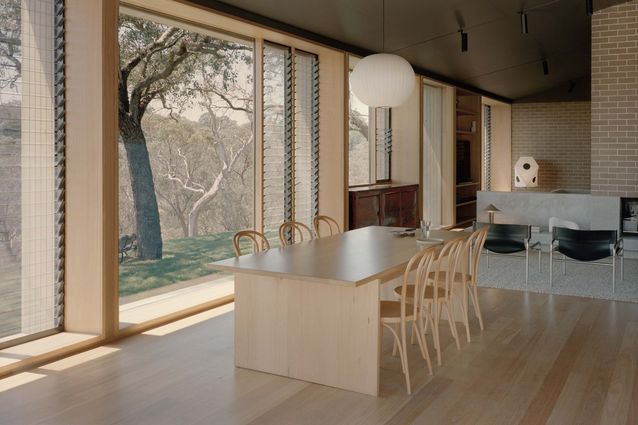
It’s a testament to the way Figureground Architecture has nailed the brief for Warrandyte House that we conducted our Houses interview without disturbing a wing of teens enjoying a school holiday sleepover. This chill party house for five has a flowy, indoor–outdoor vibe that left me imagining nights under the stars by the firepit, and craving longer with the resident llama. The house just has a welcoming ease.
Perched on a ridgeline, this handsome split-level home on a five-hectare hobby farm is designed around tranquil views in all directions to bushland and rolling hills. Not surprisingly, the spectacular escarpment and valley below kept drawing us outside to breathe it all in.
Located around 25 kilometres north-east of Melbourne, Warrandyte is more bushy hamlet than ’burb, and it was the sprawling landscape setting that brought the family to the area. However, as Figureground director Matt Rawlins explains, the old house on the site was a gloomy 1980s brick veneer dwelling, with low ceilings and zero relationship with its steeply sloping site and towering eucalypts. The clients, one of whom works in landscaping, wanted a single-storey family home that was strongly connected to its place. It needed spaces for togetherness and retreat, better connection to an existing in-ground pool overlooking the valley below, spaces for cooking and eating outdoors year-round, and easy access to equipment sheds. This little farm may be a hobby, but it still requires upkeep.
View gallery
Figureground’s response was an elegantly sprawling, indoor–outdoor pavilion house with three purposeful wings for living, services and rest. Openings to terraced gardens and external decks ease inhabitants and guests around the home, which steps two metres down from the its west-facing entry at the top of the ridge to the pool deck at its eastern edge. “We aligned the house with the contours of the site and scooped out a little more earth to bury it deeper into the ridgeline and better deal with those levels heading down to the pool,” Matt explains. “The house is designed to negotiate that two-metre height difference in a very subtle way.”
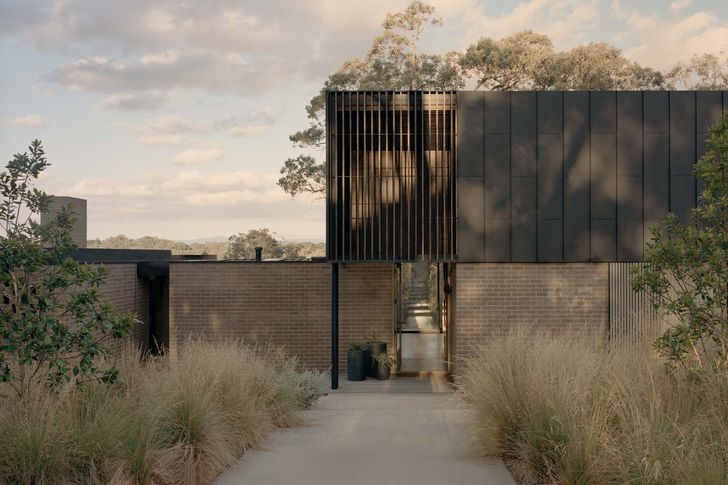
The rectilinear form of dry-pressed brick is crowned in rich charcoal-coloured corrugated steel and grounded into whispy native landscaping. Massed grasses whisper in constant motion, softening edges and blurring junctions. Approach is from the west, down an entry bridge of monumental concrete steps. A deck connects the entry to separate pavilions for the carport and mudroom, and filters through to an outdoor dining area and the pool beyond. “We wanted the entry to be a little bit permeable, giving you different access paths,” Matt says.
View gallery
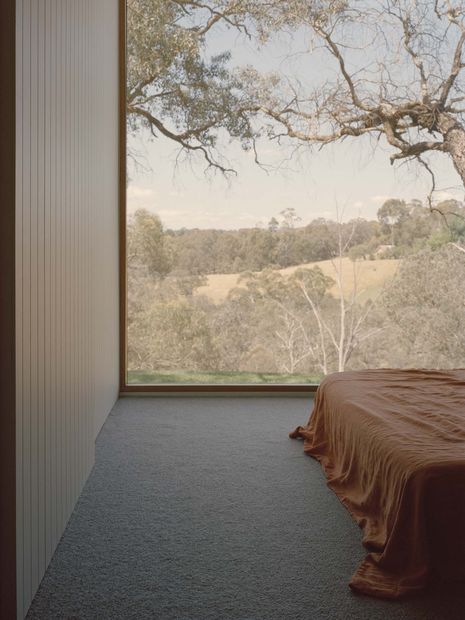
Inside, private and public spaces are separated by a central services pod containing study, store and bathroom, with sliders for opening or closure. An L-shaped bedroom wing is topped with an attic that’s perfect for sleepovers, and culminates in a rumpus room with an adjacent main bedroom that is animated by views southward to surrounding box gums.
Each wing occupies its own discrete level, linked by a few steps that make the rise and fall subtle, as intended. A skillion roof helps volumes expand and compress expressively.
At the double-height entry, opaque glass admits translucent light and dancing shadows from the exterior’s hit-and-miss brickwork. Stepping down into the kitchen/dining and living zone, which is warmed by a double-sided log fire, the dark ceiling swoops down dramatically and focuses attention on sweeping views across the north-east. “Deep revealed timber window sections draw the focus out,” Matt says. “It foregrounds the eucalypts and the valley beyond.” And though this space felt like the culmination of our journey, we both knew we were about to head back outside to take it all in again from another angle.