
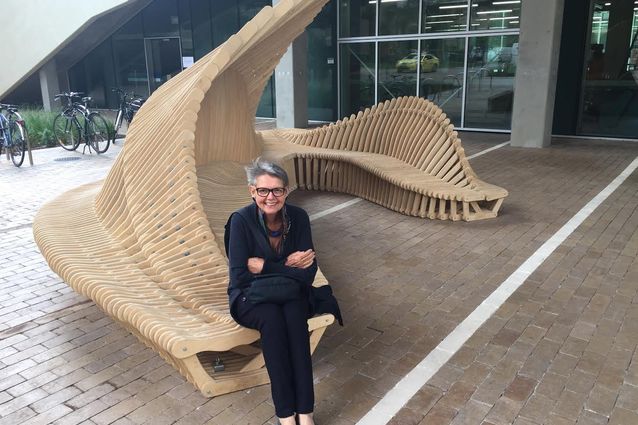
The recent death of Anne Cunningham (born Margaret Anne Salter) reminds us of the importance and influence of the generation of women architects who helped reshape modern practice in Australia. When Anne Cunningham and Ann Keddie formed their eponymous firm in 1981, they created perhaps the first all-female architectural partnership in Australia. Both had young children and they shaped their practice to suit, including enabling part-time and flexible working hours, which attracted a series of talented staff. Based in Melbourne, the firm specialised in residential projects and won a series of awards for their public housing schemes.
Cunningham studied architecture at the University of Melbourne between 1961 and 1965, graduating with a Bachelor of Architecture early in 1966. She was elected an Associate of the Royal Australian Institute of Architects (RAIA) the following year. On graduation, she joined Yuncken Freeman Architects, where she worked on a series of commercial projects; then with Donald Hendry Fulton (1968–70) on industrial and housing projects, including the mining township of Weipa. Married in 1968, she and husband Dr Ian Cunningham, welcomed their first child in 1970, and a second in 1972. Between 1971 and 1973, the family lived in Kuala Lumpur, where Cunningham lectured in architecture at the Mara Institute of Technology. They then moved to the USA, where she worked part time for G Herschman Architects Inc in Cleveland, Ohio, on residential and commercial projects between 1973 and 1974. Returning to Australia via the United Kingdom, she worked first with architect Peter Sanders, and on Heritage Commission survey on shipwrecks. She had her third child in 1976, and established private practice the same year, focusing on residential projects. At a time in which women were still expected to give up work on marriage, and particularly after the arrival of children, Cunningham consistently maintained her professional career and trajectory from graduation through to forming her own firm.
With a respected and successful practice between them, Cunningham and Keddie were key instigators of the Association of Women in Architecture (AWA) in Melbourne, which began in 1979. The group was set up to support women disaffected by the RAIA and was a vital touchstone for women working in the profession at that time, drawing together the long-established – Ellison Harvie (1902–1984) – with contemporary practitioners and students for mutual support. Cunningham would also contribute to the Human Rights Commission study into women in architecture of 1985. She contributed widely in support of the profession, including contributing to the Architecture in Schools program over 1979–83, then as part of its steering committee in 1984. She was then encouraged by Dimity Reed to stand for office in the RAIA, firstly in the Victorian Chapter as Vice President (Education) (1984), and then as a member of the National RAIA Council (1985). Elected Fellow of the RAIA in 1982, she was recognised a decade later with an inaugural Victorian Women Achiever Award in the small business category, an initiative of the Women Chefs d’Enterprise (1992). In 2000, both Cunningham and Keddie were awarded Life Fellowships of the RAIA.
Cunningham started ArchiTours in the late 1990s, which toured modern architecture in Melbourne and Sydney, a venture in which she was later joined by Stephen Crafti. After the dissolution of the Cunningham and Keddie practice in 2004, she continued to practice, becoming increasingly interested in sustainable solutions, that she realised through regenerative landscaping, recycling and retrofitting at her property in central Victoria.
Anne Cunningham was an inspiration, role model and mentor to generations of women in architecture in Victoria. She not only led through practice, but actively fought for and provided support to women in the profession. Her award-winning architecture was based on meaningful engagement with clients, using participatory design approaches and user-centred needs analysis, to deliver a new approach to public housing.
This tribute is republished from Parlour, a research-based advocacy organisation working to improve equity in architecture and the built environment professions. Read the original tribute by Julie Willis here.