

They’re creatures often associated with tropical waters and exotic shores, but a Sydney research project has revealed one of the world’s most enigmatic marine animals is really as local as our backyard magpies and ringtails.
Green sea turtles and their more elusive cousins, the hawksbills and loggerheads, are capable of some of the most epic migrations on earth, yet preliminary data from a tracking effort spearheaded by Taronga Zoo suggests they spend much of their time in NSW as homebodies who stick to one particular beach or bay.
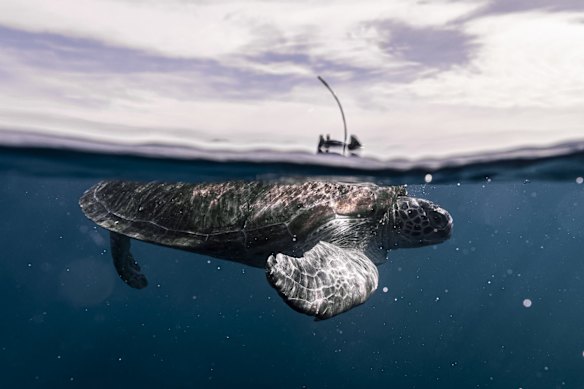
A tracking project run by Taronga Zoo is revealing world-leading insights into the lives of endangered sea turtles.Credit: Brook Mitchell
“They are staying inshore and residing in coastal bays and estuaries,” Dr Jo Day, a conservation biologist at Taronga, said. “Our tracking data is showing that a lot of our turtles are residents to those areas, and it’s surprising how small their home ranges are. That’s really new, exciting information.”
One green turtle didn’t leave Freshwater beach during a three-month tracking stint between February and May. It’s an animal capable of crossing oceans, but barely bothered to make the measly two-kilometre trip to the turtle (and snorkeller) hotspot of Cabbage Tree Bay off Shelly Beach.
“It’s still around,” Day said of the Freshwater turtle. “We have lots of public sightings of that turtle, so it does seem to be a resident of that area.”
Day said the research collaboration between Taronga, the Sydney Institute of Marine Science, NSW National Parks and the Gumbaynggirr Land and Sea Rangers was aimed at translating local expertise to scientific knowledge that could galvanise conservation efforts.
“Our overarching aim is to understand what type of habitats marine turtles are choosing to forage and rest, and the ultimate aim is to protect those environments.” More data is needed to firm up the researchers’ findings.
A study published by Australian scientists this year showed efforts to protect sea turtles have made a significant difference, with the number of nesting females tracking up in many areas across the world.