
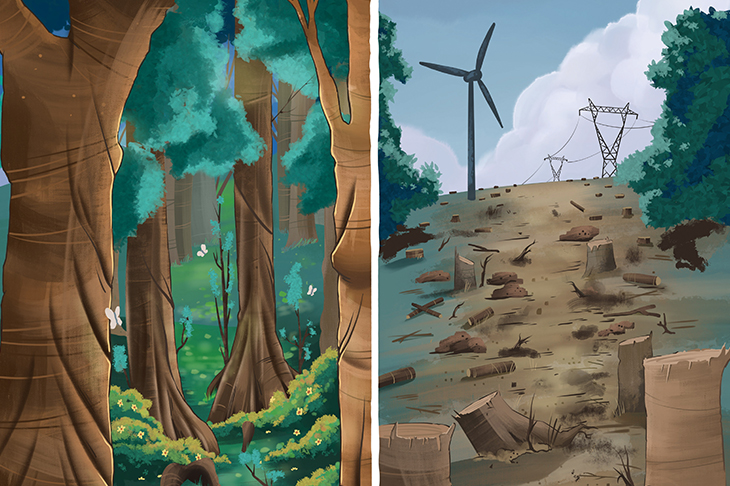
My father-in-law was both a scientist and a farmer — the kind of man who could think in systems and work with his hands. About twenty years ago, he was one of the first landholders in New South Wales approached by a wind developer. They came to his property at Nimmitabel, southeast of Cooma, full of questions and earnest conviction, wanting a slice of the high ridgeline he owned near the Great Dividing Range.
Until his passing not so long ago, he loved to dine out on how he “hunted them off the place.” Around the kitchen table, he asked two simple questions that silenced them. At that time, the ambition was more modest: renewables were intended to play a small, complementary role in a balanced energy system, not to replace it wholesale. Yet even then, he saw the flaw. He asked how it could possibly make sense to plug a scatter of small, intermittent power stations into a grid built for large, dispatchable ones — a plan he described as plainly nonsensical. His second question was equally practical: who would clean up the mess when he was gone?
We are now deep into an 82-per-cent renewables target that presumes those answers exist, yet they do not. The questions — of system architecture and end-of-life responsibility — are still plaguing what has now become fantastical.
The national energy transition has not been so much designed as improvised. It has grown out of political slogans and activist momentum rather than disciplined system planning.
The phrase “Rewiring the Nation” sounded visionary in Canberra. To anyone who has lived in rural Australia, it is absurd. The notion that a continent could be criss-crossed with tens of thousands of kilometres of new transmission lines — through farms, forests and national parks connecting hundreds of standalone energy factories— was never costed, mapped or tested. It was an act of faith dressed up as policy.
Successive governments and agencies kept filling the vacuum. Bits and pieces were farmed out — to AEMO to model the grid, to CSIRO to bless the cost curves, to university-quango hybrids like Net Zero Australia to estimate land use. But no one ever built a comprehensive plan. The bureaucracy — DCCEEW, Rewiring the Nation itself, the Clean Energy Regulator, ARENA and the CEFC — and the state energy corporations in NSW, Victoria and Queensland simply inherited the modelled assumptions and pressed on. Market bodies like the ESB, AEMC and AER largely nodded them through.
Characteristically, in government Labor has overreached spectacularly. They created a wild renewables target and let the project be influenced by our very own plutocrats, campaigners and funders with vested interests, from green investment funds to political activists such as Simon Holmes à Court — none of whom had credentials in energy engineering or grid economics. They provided the political grift while the practical detail has been missing.
When Malcolm Turnbull superciliously referred to the energy transition as a matter of “engineering and economics,” he meant it genuinely and reassuringly: a technical problem that the so‑called clever classes could solve. Yet that very phrase has turned against largescale renewables. It is precisely the engineering and the economics that are now defeating the crusade – not just in Australia but across the developed world.
When the Prime Minister and Chris Bowen talk about Australia’s “unlimited wind and solar resources” they forget to add the crucial qualifier: those resources are spread thinly across a vast continent. Harnessing them is not free. It requires an engineering feat unlike anything ever attempted — thousands of kilometres of new transmission lines, industrial-scale renewable zones, and massive storage capacity that does not yet exist.
The Net Zero Australia consortium estimated in 2023 that achieving full decarbonisation would require the equivalent of five Tasmanias of land for solar farms alone. Even that figure, huge as it was, understated the total footprint once transmission, storage and a little more wind is added. And that modelling is already outdated. Since then maximum energy-demand projections have surged — driven by electrification, population growth and the voracious appetite of data centres. On any realistic adjustment, the figure is now closer to seven to ten Tasmanias.
It is another example of how the facts have changed while the zealotry has not. Instead of recalibrating, governments and investors double down. Are we really going to keep plastering the Australian landscape with more and more panels — swallowing farmland, ridgelines and open country until there is nothing left but industrial glare? The whole exercise is farcical.
Last week was a bad one for Australia as a renewable-energy superpower. On Monday came the alarm from Tomago Aluminium — Australia’s largest smelter — that it cannot secure affordable power under the transition. On Tuesday, Bill Gates went full Bjorn Lomborg and declared that climate change will not end civilisation. On Wednesday came the inflation data, with energy prices again driving the rise. On Thursday, Reuters reported that curtailment of renewable power in Australia has become so severe it should serve as a warning to Asian grids. And by the weekend, the National Party had walked away from net zero altogether.
This week Professor Dieter Helm of Oxford University, the UK’s most respected climate and energy economist, published a searing but sobering piece which amongst other things said: “[The] future is increasingly being cemented into place by decisions taken now, and hence for the foreseeable future up to 2040 and even beyond, the government is baking in very high costs. Why? Because it is putting in place contracts that embed these high prices; it is creating a much more fragile system with ever-greater intermittency; .. and the regulator is forced to commit to doubling the size of the grid to deliver the same output of firm power. As a result, not only is the government baking in very costly energy for the next 15–20 years, but it is also protecting customers from any benefits that might come from low and stable gas prices. The irony is profound: you really could not make this up.” Sound familiar?
The disaster is well and truly playing out in New South Wales. The Central West Orana Renewable Energy Zone — the government’s flagship and the first to move to ‘delivery’ — has already blown out wildly in costs and absorbed billions in public funding and vast political capital. Like Snowy 2.0 and HumeLink, it may now proceed simply because too much has been invested.
But the madness continues. The New England REZ — still years away from construction — has just undergone a transmission line route change announced by EnergyCo, creating fresh disruption, uncertainty and serious questions about integrity of the determination. It proceeds through some of the best farmland in the state, indeed the nation. Each revision brings new environmental impacts, new rounds of consultation, new properties to decimate. Watch the New Englanders roar.
Every new large scale renewables project is now underpinned by price guarantees through the so called ‘Capacity’ Investment Scheme – the only capacity scheme in the world to include renewables – the price of which is secret and hidden from public scrutiny and parliamentary oversight. That it has come this far, with departments, agencies and consortia advancing schemes of such scale and opacity, would be laughable if it were not so serious. That the coalition has stood by mute to date is unfathomable.
For those of us who live beyond the city limits, the consequences are not theoretical. The so‑called energy transition has become a rolling imposition on rural landscapes and communities — on people who were never consulted but are now asked to host the infrastructure that keeps the knowledge classes virtuous.
What the architects of this project never grasped — and perhaps never cared to grasp — is that for many rural Australians, the compensation for being outside the great Sydney and Melbourne property booms in recent decades has always been something else: the beauty of where we live. Our wealth is not measured in capital gains but in horizon lines — in the space and silence that city dwellers only glimpse on long weekends.
That trade-off is now being broken. The view from a farmhouse verandah that once stretched across paddocks and hills is being replaced by fields of glass and steel, and by transmission towers marching across ridgelines. The sense of place that defines rural Australia — its visual and emotional integrity — is being traded away by people who will never see it, in pursuit of an energy ideal they have lost control of.
Only a couple of years ago, Chris Bowen and the Australian Energy Infrastructure Commissioner spoke often about the need for “social licence.” But in recent months that language has disappeared. There is dawning recognition that they will never win social licence for the industrialisation of rural landscapes. And as public consent slips away, the project is taking on a distinctly more authoritarian tone — compulsory-acquisition powers, truncated approvals, and rhetoric about “urgency” and “national interest” used to override community and environmental concerns.
Equally indefensible -and more scandalous – is the refusal to even address the back end of the transition: decommissioning and rehabilitation. Every serious resources project in Australia must lodge rehabilitation bonds — sometimes hundreds of millions of dollars — in government-controlled accounts to ensure the landscape is restored. Yet no comparable requirement exists for large-scale solar or wind developers. The panels will rot in paddocks in twenty years time; the cost of the clean-up will be way beyond landholders and even taxpayers.
Australia has become the last country in the developed world to receive the memo: that large-scale renewables, at this penetration, are not working anywhere as promised. Costs are soaring, timelines are blowing out, and social licence is already dead.
My father-in-law’s questions were not rhetorical. They were the genuine questions of a scientist who understood the difference between a hypothesis and a fact, and of a farmer who knew the difference between theory and ground truth.
He asked how it could possibly work — and who would clean it up. More than two decades hence, those answers remain elusive.
The great renewables fantasy is unravelling, now daily. For those of us in the regions — for whom its promises were always utterly false — it can’t come soon enough.