
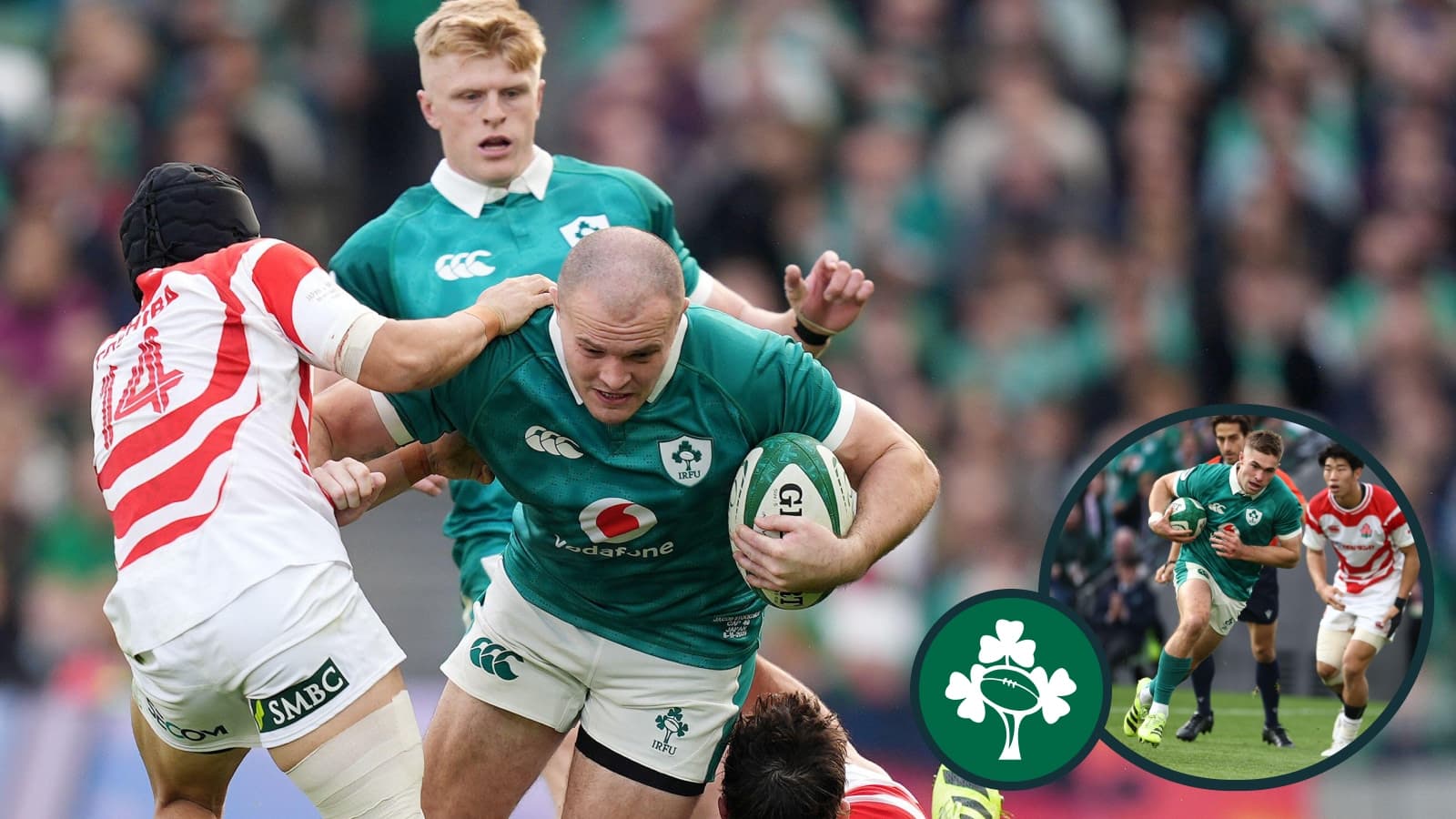
After an underwhelming 41-10 victory for Ireland over Japan in Dublin on Saturday, here’s our five takeaways from the Autumn Nations Series fixture at Aviva Stadium.
The top line
60-5 was the result here in 2021 when the sides last clashed, Ireland producing some scintillating, free-flowing rugby in a compelling nine-try success. Here, fielding a team with eight changes from last week’s loss to the All Blacks in Chicago, they fluffed their lines badly for a very long time.
A scoreline of just 17-10, two-tries-to-one at the break, was concerning and the humdrum continued into the second half, where it wasn’t until the 66th-minute, when sub Gus McCarthy’s maul try made it 27-10, that the restless home fans could breathe a small bit easier.
Two further tries followed to spin the margin of the six-tries-to-one victory out to 31 points, but this Irish performance should have been much, much smoother given the tier-two status of the opposition they were hosting.
After all, the team they fielded ahead of the follow-up, more intense fixtures versus Australia and South Africa, still possessed a strong spine in the presence of Caelan Doris, Andrew Porter, James Ryan, Tadhg Beirne and Jack Crowley.
Doris was pumped and was especially useful with his contribution in the Irish defence, but the overall collective performance simply didn’t click, certainly not in a first half where lineout accuracy and creativity on the ball suffered.
They did manage to build a 17-point buffer. A scrum infringement got Ireland on the board with a sixth-minute Crowley penalty, but it needed a yellow card 11 minutes later for Charlie Lawrence’s tip tackle on Tom Farrell for the hosts to start stringing things together more threateningly.
The numerical imbalance had a clear role in the opening try on 20 minutes, the Japanese cover left scrambling by a Thomas Clarkson bust into the 22 following a raid down the right, and the recycle ended with Doris providing the assist for Crowley’s easy run-in on the left.
That was the extent of the damage inflicted by Ireland, and they instead had to wait until the 30th minute to pounce again, Japan paying a heavy price for not playing to the whistle. The visitors were caught napping, waiting for the referee to call a halt to play after a Beirne fumble.
The ball, though, had gone backwards from Beirne’s error and Ryan reacted quickest, popping a pass to invite Nick Timoney to gallop in the score from the 22.
It was a laboured spectacle not helped by Ronan Kelleher’s unconvincing time at the lineout, and the Irish were wounded by what conspired in the closing minutes of the half as they saw their 17-point lead shaved to seven, and they also lost Jacob Stockdale to a yellow card.
It was a 37th-minute maul that got the Japanese on the board with a converted try, Kenji Sato credited with the touch, and Seungsin Lee then added a penalty after Stockdale saw yellow for a high tackle on Kippei Ishida.
Why World Rugby prevented Nigel Owens from speaking about Tadhg Beirne incident
This situation now added an unexpected layer of intrigue to the start of the second half, but Japan never went all out to heap on the pressure with a man advantage. Instead, Ireland headed off the potential crisis with a 48th-minute unconverted Porter try.
The under-par Crowley was soon hooked for Sam Prendergast as part of a three-player switch that was followed by the 54th-minute try from Stockdale that was disallowed for offside.
That decision left Ireland waiting a further 12 minutes before securing a three-score lead, McCarthy touching down at the back of a maul. His namesake Paddy, the sub loosehead, added another on 72 with Tommy O’Brien getting in on the back four minutes later.
This late flourish, though, can’t dilute the flakiness of what preceded it. A win for Ireland, but rather than burnishing confidence, the mundane standard of the exercise for more than an hour only sounded the alarm with Joe Schmidt’s Wallabies and Rassie Erasmus’ Springboks coming over the horizon.
Irish lineout issues continue
It was midweek when Planet Rugby highlighted the ongoing troubles that the Irish lineout has been experiencing in the last while. They were only 11 from 16 on their own throw in Chicago with Dan Sheehan and Ronan Kelleher on the oche, and it hurt them in the 13-26 loss.
Ultimately, there was no L suffered against the Japanese, but you would have expected a big uptick in the bumbling Irish set-piece. Except it didn’t materialise. With Kelleher named as the starter, his throwing accuracy was worryingly only three from six, 29 minutes into the contest.
Most damaging was his penalised dummied throw after a penalty had been kicked to the corner. That was at a time when Ireland should have been making hay, but they were left flustered, and it denied them the pressure needed to fracture a plucky Japanese pack.
Remember, this is a Paul O’Connell-coached lineout with Beirne and Ryan as its on-field guardians. However, something isn’t gelling. Is it that Ireland have hookers in Sheehan and Kelleher – both 2025 British and Irish Lions tourists – who are more focused on general play contributions than being nailed-on accurate with their bread-and-butter task?
Whatever it is, it was interesting to see how more cohesive the lineout became when rookie hooker McCarthy was sent on as a 58th-minute replacement. He scored off one maul, and another throw also led to a score.
That was a good note on which to round off the day, but there can be no getting away from this general lineout headache. A remedy must be found.
Jury back out on Crowley
Having forced his way back into the section following a run of consistent fine form with Munster, this was a stage set for Crowley to flourish and boss a fixture like the way Johnny Sexton used to do.
The out-half, who selection jostle with Sam Prendergast has been a hot topic for a year now, did get off to a decent start, scoring the first try with Japan a man down. But Crowley never kicked on from there, and his box of tricks remained shut.
That would have been to the immense frustration of the likes of the debut-making Farrell, who didn’t get much of an invite in space to make a lasting impression, and it can’t go unnoticed that Ireland finished with more of a zip about them with Prendergast on as a replacement.
Now, it has to be factored in that the Japanese at this late stage were blowing hard, so it was easier for the sub to make headway, but it will stoke the No.10 selection debate ahead of the visit of the Wallabies.
At least the fit-again Doris produced a standout performance at No.8 in his first Test start since March to demonstrate that there is zero rustiness regarding his level of play.
We’ll give Tommy O’Brien a mention also, as his determination to keep trying was ultimately rewarded with his late score, but there is much for Ireland to do yet to get back to the clinical levels they enjoyed in 2024.
Poor reflection on Eddie Jones
There is an old adage in sport that you should never go back once a door has closed the first time around. Eddie Jones is finding this out to his cost. Whereas the Miracle of Brighton achievement versus the Springboks ushered him into the England job, Japan 2:0 with Jones in charge is proving to be a very different experience.
In fairness, winning on the road against the world’s best teams at this time of the year has historically always been too steep a hurdle. Just look at last weekend’s 7-61 hammering by South Africa at Wembley.
They would have been over the moon at reaching the interval in Dublin, only 10-17 down – they seemed destined to be scoreless before an unexpected late, late momentum shift in that opening period.
However, the credit they will feel they deserve for keeping an out-of-sorts Ireland honest was diminished by their inability to come out blazing in the second half. They were just seven points down and had an extra man with Stockdale’s yellow card.
But, other than winning a penalty, they didn’t fire a shot in the opening part of the second period, and that must reflect poorly on Jones. The interval allowed him ample time to unleash a plan that really ruffled the Irish, but he had nothing in the locker to do something to genuinely put the result in jeopardy.
Empty seats
Empty seats at the 51,700-capacity were either a reflection of the state of flux Farrell’s side are currently in or else an example of the cash-hungry IRFU overplaying its hand with ticket prices.
We’re inclined to lean more towards the latter. The match day experience at the Aviva has long been a bone of contention – Saturday’s second half, for instance, featured a karaoke session featuring Sweet Caroline blaring over the PA system. Let the fans create the musical atmosphere!
Excessive ticket prices have only added to the level of discontent, and it left some fans voting with their feet, deciding a fixture versus Japan simply wasn’t worth it.
It’s a situation that the IRFU must review. Yes, there were some busloads of kids up from the country to take in what is increasingly a care opportunity to watch Farrell’s national team.
But there mustn’t have been great value in this promotion when seats were left empty. It’s back to the drawing board in the marketing department.
READ MORE: Scott Robertson gives World Rugby ‘important feedback’ after Ireland v All Blacks issue