
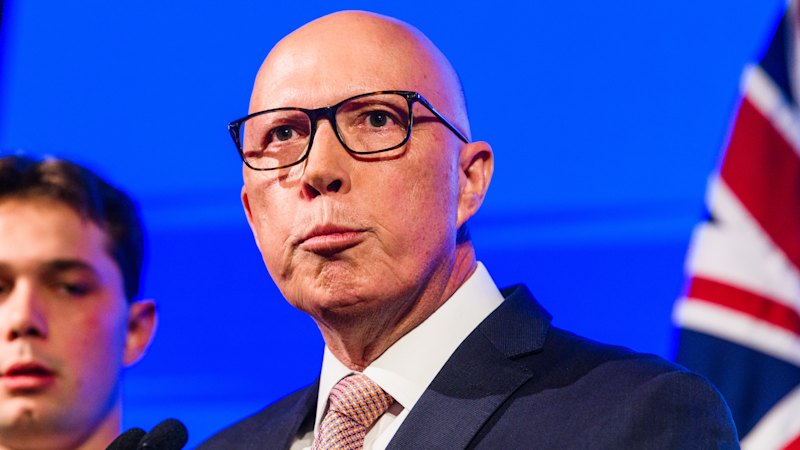
A review into the 2022 election loss by Senator Jane Hume and former party federal director Brian Loughnane, set targets for female representation and recommended the creation of the Margaret Guilfoyle Network to “unite and elevate Liberal women”, but did not recommend the adoption of quotas.
“I don’t think that has really done much, but that’s not a fault of the network itself. There has to be mechanisms across every state to actually progress those women,” the Liberal said.
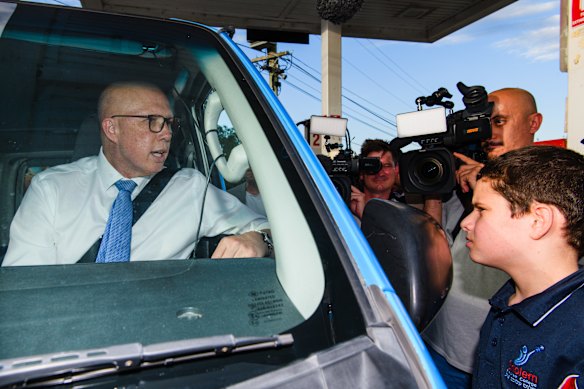
Then opposition leader Peter Dutton in April on his petrol station tour during the election campaign.Credit: James Brickwood
Charlotte Mortlock, the executive director of Hilma’s Network — a group seeking to boost a “rapid influx of women and a lowering of the average age of Liberal Party members” — said many in the party were pushing for quotas and the idea was “still on the cards to be achieved this term”.
“It is a decision that cannot be made federally, it must be made by the state divisions, which is why we weren’t expecting it to be included in the federal review,” Mortlock said.
“The federal review’s position on quotas does not alter our ongoing commitment to improving female representation across the party at every level.”
Loading
Another Liberal who spoke on the condition of anonymity said the party “absolutely need to preselect more women in winnable seats”, but wasn’t sold on quotas.
“I’m yet to get my head around how they would work in the Liberal Party structure. Labor have a whole let of mechanisms through their factional divisions, so quotas are an easier fit in the Labor Party. Even though there are groupings, we don’t have that formality,” they said.
In her first major speech as leader in June, Ley said she was open to quotas but not wedded to them, adding that “what is not fine is not having enough women”.
The party selected mostly younger women in a group of seats it thought were winnable but did not win, including Kooyong and Chisholm in Victoria, Parramatta, Warringah, Wentworth and Robertson in NSW, South Australia’s Boothby and Lyons in Tasmania.
The party’s election policies and presentation turned off many women voters, as the review will make clear when it is made public after parliament rises for the year.
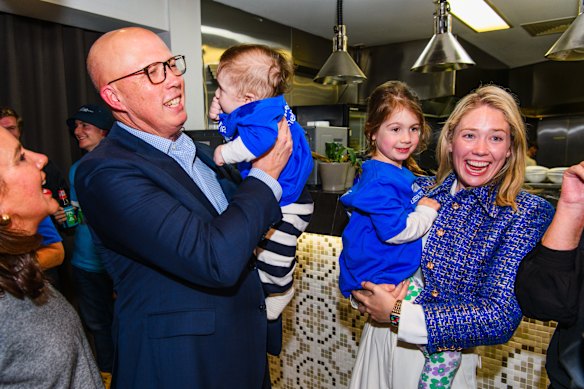
Peter Dutton campaigning in Kooyong with Liberal candidate Amelia Hamer. Independent candidate Monique Ryan retained the formerly blue-ribbon Liberal seat at the 2025 election.Credit: James Brickwood
The Liberal Party’s gender imbalance in its ranks of MPs has barely changed in a decade. One third of Liberal MPs are women, despite the party having a target of 50 per cent female representation.
The election probe is being kept secret until later in the year, at which point it will be made public and form an important part of writing the history of – and apportioning blame for – the party’s worst election loss.
A critical observation of Minchin and Goward is that the Coalition failed to change its psyche, tone, campaigning and media strategy after losing the 2022 election to Labor and going from government to opposition after nine years in power.
One source familiar with the findings said it had become clear that Dutton’s team included former Morrison government ministers who “lacked the hunger” to shift from a bureaucratic, cautious governing style to the nimble approach needed to hold the government to account.
Unlike when Tony Abbott and Anthony Albanese were opposition leaders, Dutton’s operation made its daily political decisions without continuous input, data and research from the party’s professional campaigners, led by federal director Andrew Hirst, who ran the winning 2019 campaign and two subsequent election losses.
It was widely reported during the election campaign that Dutton’s office and Hirst’s team had a poor working relationship, a claim substantiated by Minchin and Goward.
“The Dutton opposition was totally obsessed with unity, and outside of the Voice [to parliament Indigenous referendum], never morphed into a fully functioning political unit,” one source said.