
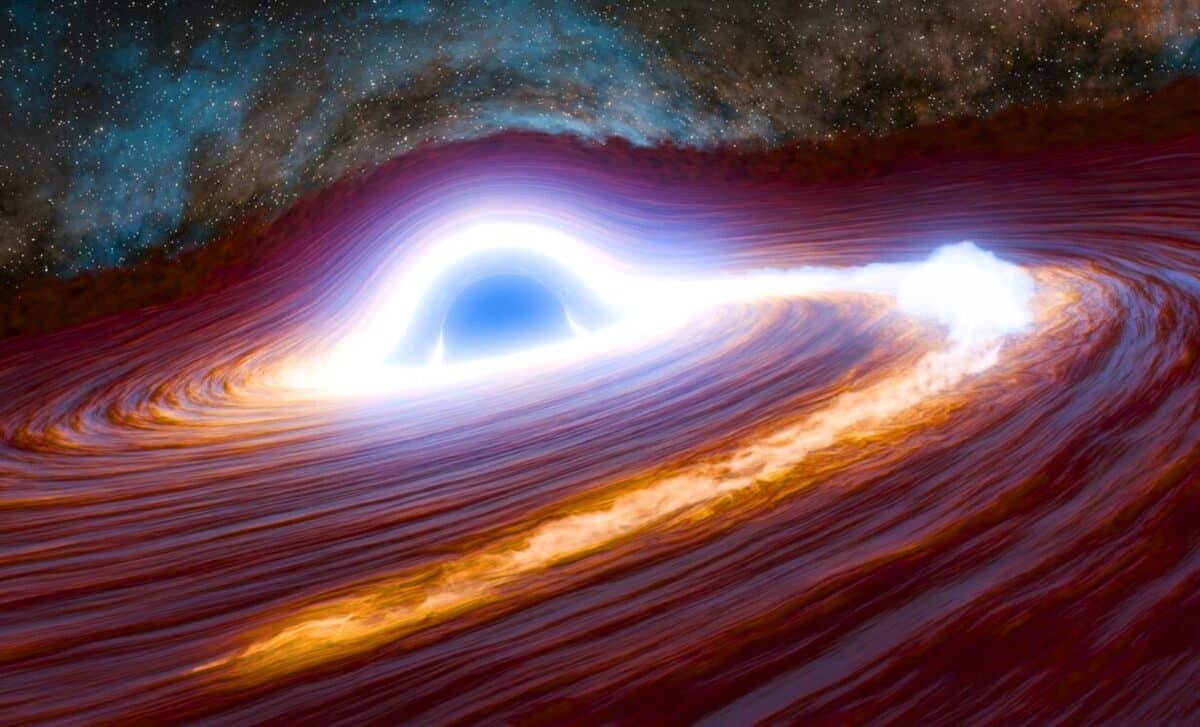
Astronomers have recorded the most luminous flare ever emitted by a black hole—an event so extreme it briefly outshone the light of 10 trillion suns. The outburst, originating from a galaxy over 10 billion light-years away, eclipses all previously observed black hole flares in brightness and scale.
The flare, traced to an active galactic nucleus (AGN) designated J2245+3743, was detected by Caltech’s Zwicky Transient Facility (ZTF) and the Catalina Real-Time Transient Survey. Within months, its brightness skyrocketed by a factor of 40—a change rarely seen in galactic cores. The black hole behind the event is estimated to be 500 million times the mass of the Sun.
Scientists believe this intense outburst marks a tidal disruption event (TDE), in which a massive star wandered too close to the black hole and was gravitationally torn apart. The event represents a breakthrough not just for its power, but for what it reveals about how black holes behave in the early universe.
A Star Devoured, Energy Unleashed
First flagged in 2018 by the ZTF, the event initially drew little attention. But when researchers later reviewed long-term data, they noticed something odd: the flare was decaying far more slowly than expected. A second round of observations, this time from the W. M. Keck Observatory in Hawai‘i, confirmed the anomaly—a supermassive black hole emitting a flare more luminous than anything seen before.
“The energetics show this object is very far away and very bright,” said Matthew Graham, lead author of the Nature Astronomy study and project scientist for ZTF. “This is unlike any AGN we’ve ever seen.”
Researchers determined the black hole had likely consumed a star with a mass at least 30 times greater than our Sun. That scale makes J2245+3743 not only the brightest TDE on record but also the most massive stellar disruption ever observed.
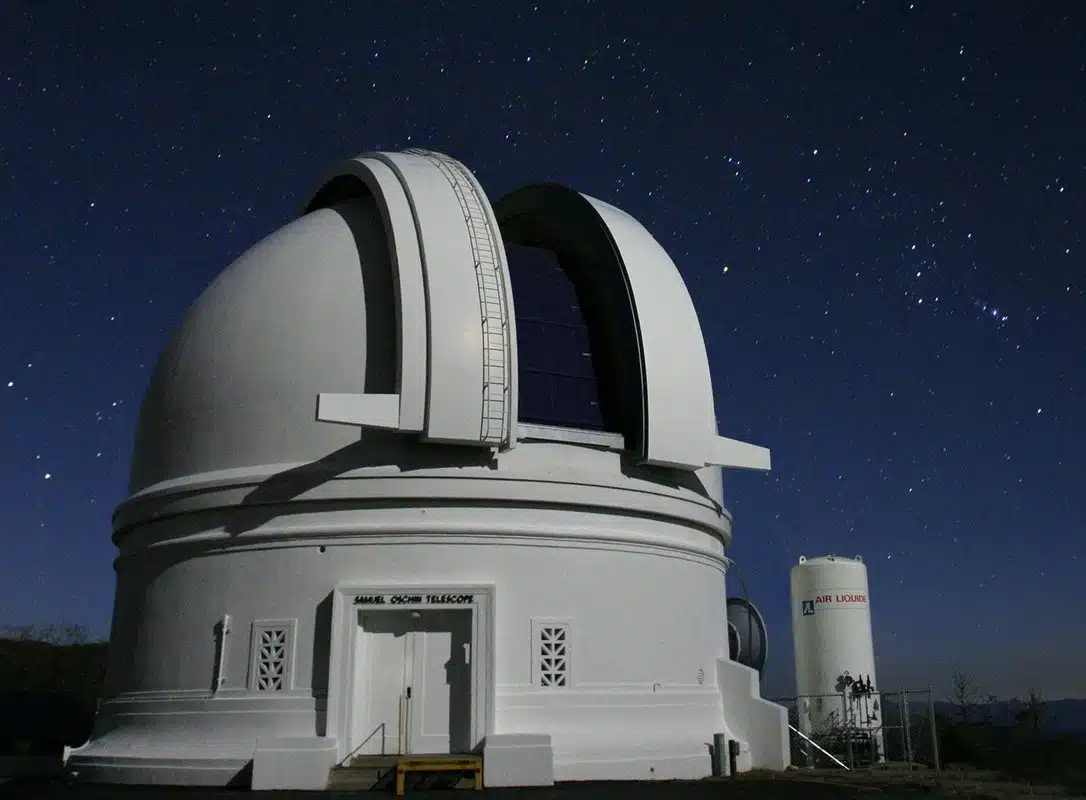 The 48 Inch Samuel Oschin Telescope At Palomar Observatory, Where ZTF Resides. Credit: Palomar/Caltech
The event’s redshift of z = 2.6 places it in a cosmological era when the universe was just a few billion years old. As the light crossed the expanding fabric of space, time itself stretched. According to Graham, “seven years here is two years there. We are watching the event play back at quarter speed.”
Flare Cuts Through Black Hole’s Own Glare
Tidal disruption events typically occur in quieter environments. AGNs—black holes surrounded by dense disks of gas and dust—are notoriously difficult to observe in detail because their own emissions drown out fainter transients. But the flare from J2245+3743 was so intense, it punched through the AGN’s constant radiative background.
At its peak, the flare radiated light equivalent to 10 trillion suns. As Caltech explained, that output is comparable to converting the entire mass of the Sun into energy, using Einstein’s equation E = mc².
Astronomers considered—and ruled out—several alternative explanations, including relativistic jets beamed directly at Earth. Observations from NASA’s Wide-field Infrared Survey Explorer (WISE) indicated that the light was not narrowly beamed, confirming the flare’s true isotropic intensity.
“If you convert our entire Sun to energy, using Albert Einstein’s famous formula E = mc², that’s how much energy has been pouring out from this flare since we began observing it,” said K. E. Saavik Ford, a professor at the City University of New York and co-author of the study.
For comparison, the previously most luminous TDE—nicknamed Scary Barbie—was 30 times weaker and involved a star only 3 to 10 solar masses in size.
New Questions From the Edge of Time
Most stars of such enormous mass are exceedingly rare. But researchers suggest this one may have formed within the AGN disk itself—an environment known to feed stars with surrounding material, allowing them to grow beyond the usual limits.
“Stars this massive are rare,” Ford added, “but we think stars within the disk of an AGN can grow larger.”
The flare’s long decay offers an observational gift. Because of cosmological time dilation, astronomers are effectively watching a star die in slow motion—an opportunity to study the mechanics of TDEs in extraordinary resolution over several Earth years.
The research also underscores the value of long-running surveys. As Graham put it:
“We’ve been observing the sky with ZTF for seven years now, so when we see anything flare or change, we can see what it has done in the past and how it will evolve.”
A Violent Glimpse Into the Early Universe
J2245+3743 may be singular in scale, but astronomers believe similar events are likely scattered throughout the cosmos—simply awaiting detection. As next-generation observatories like the Vera C. Rubin Observatory come online, the search for high-luminosity black hole flares is expected to accelerate.
The implications are profound. If AGN disks routinely birth and destroy supermassive stars, they could play a far more active role in galactic evolution than previously thought. These environments may not just host black holes—they may feed and regulate them through a cycle of star formation and destruction.
What remains unclear is how common such flares are—and what governs their intensity. Does the structure of the AGN dictate whether a flare becomes observable? Could some black holes be devouring even larger stars, hidden behind veils of dust or angular orientation?