
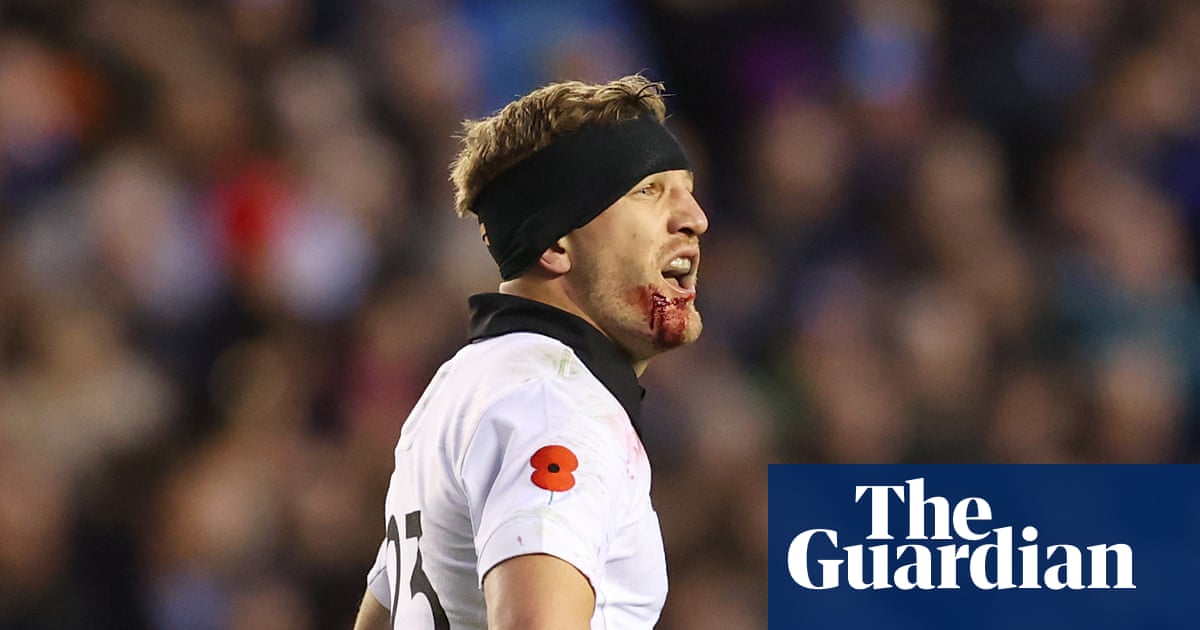
This week’s column is being compiled slightly differently. It’s not easy to type while looking upwards and smiling warmly at the bookshelf but, hey, that’s the price to be paid for method sportswriting. When you’re putting together a piece on Damian McKenzie, the All Blacks’ so-called “smiling assassin”, it’s important to try to get into character.
The head bandage took time to apply as well, as did the fake-blood drizzle of ketchup down the cheek. Anyone who watched the later stages of New Zealand’s win against Scotland on television on Saturday, however, will appreciate why the extra touches felt appropriate. It is not every day a player preparing to kick the clinching points in a major Test resembles a happy, beaten prizefighter.
There was also the spectacular nature of the aforementioned DMac’s 74th-minute try, which enabled the All Blacks to avoid a potentially grisly fate at Murrayfield. To call it “well taken” would be to understate massively the spatial awareness and body contortions that enabled him to elude Blair Kinghorn and George Turner and somehow score in the left corner. So much for the theoretical laws of physics.
All of which prompted a couple of post-match reflections. The first is the priceless value of a playmaker who can come on – in this case for the injured Caleb Clarke – and reshape a game. At the weekend, in addition to his support running off the ball and deceptive strength in fending off Kinghorn, there was also a brilliant 50-22 to admire in a sparkling cameo effort that duly earned him the man of the match award.
And the second? That the New Zealand rugby public are lucky still to have him and Beauden Barrett to remind them how the beautiful game can look. Both players have had their critics over the years, often carrying the can when the All Blacks have fallen short of their best, but imagine what the landscape would have been like without them this past decade? Significantly duller, for starters.
Because let’s ignore, for now, the argument as to whether either man is a superior specialist 10 to Richie Mo’unga and focus instead on what the pair have brought to the world game more broadly. Regardless of your nationality the answer is a sizeable amount. Take Barrett. Picking a favourite Barrett brother is akin to choosing your favourite child but has any player, after 143 Test appearances, ever looked quite so serenely untouched by father time’s gnarled finger?
When he is interviewed after games these days the 34‑year‑old not only still has a full head of hair but, regardless of continent or weather conditions, barely a lock of it is ever out of place. He also retains the deceptively effective pitter‑patter running style of old and is contracted to remain an All Black until the end of 2027. Whatever he is now eating and drinking, we all need some of it.
Beauden Barrett barely seems to break sweat when he plays. Photograph: Tim Williams/Action Plus/Shutterstock
Ditto McKenzie, who turns 31 in April and has also signed a deal committing him to New Zealand rugby until 2029. So far he has won 72 Test caps and scored 353 points, 248 of them via kicks at goal. Latterly these have developed into absorbing mini‑dramas in their own right. The shy preparatory smile – find someone who gazes at you the way DMac looks at those distant posts – has long been an attempt to enjoy the moment and to try to reduce the pressure around goalkicking. In the majority of cases, give or take days when he has a disconcerting river of blood running down his face, it works.
Sure, it remains debatable whether there is room for Barrett or McKenzie in the greatest collated All Blacks matchday squad of the professional era, with Dan Carter and Christian Cullen still in pole position to claim the 10 and 15 shirts respectively. But what the current duo have always stood for is something beyond national boundaries: the idea that skill and vision can still win you top-level games if sufficiently trusted to flourish.
Maybe it is just something in the Kiwi milk. McKenzie is from dairy farming stock in Southland at the bottom of New Zealand’s South Island while the Barretts were also raised on a dairy farm just south of New Plymouth. More relevant, perhaps, is that all that wide open space – combined with sporty elder siblings – gives kids the scope to let their imaginations roam, whether or not they are running with a rugby ball.
Either way, as McKenzie darts here and there for New Zealand and the Chiefs, there is always the chance of something special or off-script happening. Which invites the question of whether the same characteristics would have developed had he grown up on a far-flung British dairy farm instead. Modern-day English rugby, for the most part, tends to focus more on physical size and data than instinctive genius, assuming Premier League football hasn’t creamed off the best young athletes already.
That said, the All Blacks are anything but dewy‑eyed romantics when it comes to winning Test matches and their core priority will definitely apply in London this Saturday. For all the individual abilities of Barrett and McKenzie, visiting sides know to expect an aerial assault when they face Steve Borthwick’s England, whether it comes in the shape of the high‑flying Tommy Freeman and Tom Roebuck or the bucket‑like hands of Freddie Steward.
It means the All Blacks may have to rethink their backline formation slightly for this weekend – or find alternative ways to play the game more on their preferred terms. Whether or not New Zealand’s super sub starts, though, viewers will be able to gauge the state of play by the number of times they glimpse McKenzie’s winning smile.
Mixed messages
Another week, another red-card dispute. This time last week the Breakdown flagged up the injustice of Tadhg Beirne’s 20-minute red card against New Zealand in Chicago. With weary inevitability, that decision was subsequently rescinded by a disciplinary panel a few days later.
Now it is the turn of South Africa’s Lood de Jager, who was shown a “full fat” permanent red just before half-time for a shoulder to the head of France’s Thomas Ramos. Given Ramos had just lowered his height and the Springbok lock was attempting to stoop to make the tackle, it was surely a situation where the matter should have been referred to the bunker for a proper assessment of the situation.
Lood de Jager (second left) is shown a red card by the referee, Angus Gardner, during South Africa’s game against France. Photograph: Michel Euler/AP
Instead the referee, Angus Gardner, decided the lock’s actions had always been illegal and basically amounted to a deliberate shoulder charge with intent rather than something that merited only a 20-minute red. De Jager’s hearing is set for Tuesday and the authorities will be praying this charge sticks. Because if it also ends up being dismissed or downgraded, the fallout will be significant.
One to watch
All roads lead to Twickenham where England host New Zealand on Saturday. The All Blacks beat their opponents three times in 2024 but only by a combined margin of 10 points. This time, with the hosts at full strength, the weather is also forecast to be damp which might aid the aerial kicking game of Steve Borthwick’s squad. The last time they defeated the All Blacks in London was in 2012 and, at least in English minds, opportunity now knocks.
Manu Tuilagi throws a pass during England’s 38-21 victory against the All Blacks in 2012. Photograph: Andrew Fosker/Seconds Left/ShutterstockStill want more?
South Africa beat France, in Paris, with 14 men, proving they are still a cut above the rest of their rivals, writes Robert Kitson.
Richard Sharp was an England and British & Irish Lions fly-half who has died aged 87 and was a link to an almost-forgotten past. Read Ian Malin’s obituary.
And Sarah Rendell was on hand to witness Wales’s continuing difficulties against the top nations, in this case Argentina.
Memory lane
On this day in 2017 Ireland recorded their biggest-ever win over South Africa, beating the Springboks 38-3 in Dublin. Here, we see Tadhg Furlong and Siya Kolisi getting acquainted in a scrum. Ireland have won three of the sides’ four meetings since; they meet again at the Aviva Stadium on 22 November.
Photograph: Clodagh Kilcoyne/ReutersSubscribe
To subscribe to the Breakdown, just visit this page and follow the instructions.
And sign up for The Recap, the best of our sports writing from the past seven days.