
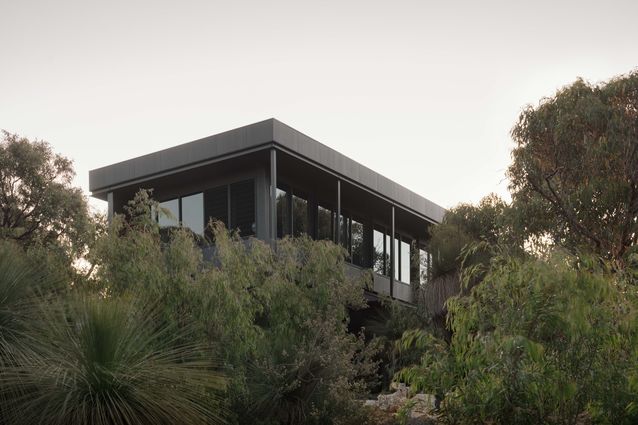
There are six seasons in the Noongar calendar. Makuru (typically around June and July) is the coldest and wettest season, and even so, the south-west of Western Australia is bustling with Perthites and locals. I visited Injidup Springs House in a gap between rains, finding a black box pushing out of the bush into a sand driveway. Around it, the black trunks of the grass trees seem to merge with the folded black steel cladding of this cubic box.
The cube is one of a pair, and beyond them lies a larger linear building, also black, which extends down until it meets a simple, windowless concrete block wall. I am drawn in, to a deep-set entry where black steel and grey concrete blocks meet. The two perpendicular walls have formed a large open-sided courtyard, filling with bush. It’s more than a house, as I soon find out: a main house (the linear building); an attached but separate recording studio; and two freestanding accommodation bungalows (those bold cubes) for collaborators and visitors to the studio. This is a place of living and making.
View gallery
The guest bungalows are generous double-height volumes that introduce the simple material palette for the main house: cork, ply, tile, steel. Tall, north-facing openings frame views while mezzanines provide extra sleeping space.
The main house is a north-facing strip of rooms, with excellent passive solar design employed almost silently. Entry is via a few steps up into the middle, into a covered external space. This is a balcony, but here, it’s integral to arrival, rather than something to walk onto – or not – at the end of a living space. Beyond this protected outdoor room are the living wing to the east and bedrooms to the west.
View gallery
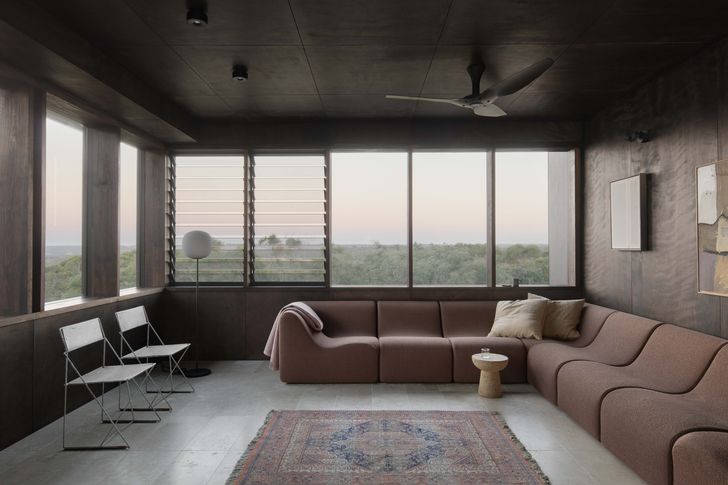
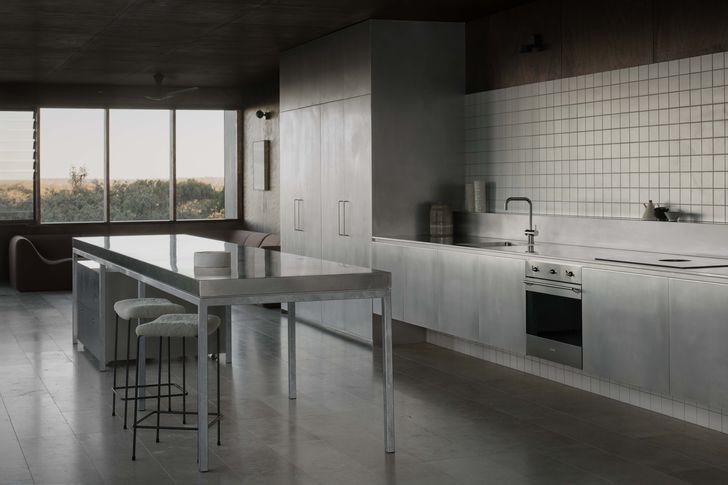
A large sliding door connects the living area to the covered outdoor room; travertine tiles link outside and in. Stainless steel kitchen joinery and dining bench give way to an open lounge area. Often, when houses have great views – as this one does – the designers glaze walls completely. This fails to understand the importance of framing views, to give a greater sense of outlook. Here, however, Whispering Smith has brought the sill up to allow occupants to furnish around the room, introducing closely spaced deep columns to create a series of windows that wraps the east and north walls. As you walk to the east end, you sense being above the ground, as the land falls away under.
In the bedroom wing, rooms are to the north and the corridor is to the south. Cross-ventilation, perfectly handled, is allowed through vertical shutters on the south facade, aligned with doors to the rooms. A main bathroom revels in light blue mosaic tiling, the fully tiled bath an essay in solid and open across the northern edge. I was briefly transported back to France, and the bathroom at the Villa Savoye (1931) by Le Corbusier.
View gallery
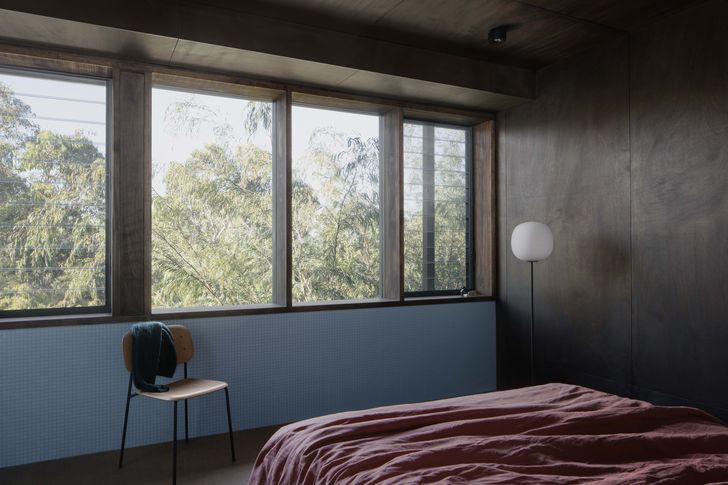
Bedrooms are clad in dark-stained ply, making the greenery outside stronger in contrast. Cork underfoot is comforting and warm. In the main bedroom, there’s no door between the ensuite and bedroom. Like the space, materials are fluid, with mosaic tiling extending across the bedroom’s north wall.
The recording studio is a different material proposition, solid and in the ground. In concrete block, it’s a reversal of the lightweight structure of the main house. To get to the studio, you need to go outside, around and down to the ground. Entered from under the main house entry – another inversion – the studio is a bunker running north–south. Its solid western edge is the concrete wall of the entry courtyard.
Inside the bunker are two tall rooms lined in dark-stained cedar batten, one a control room and the other a recording studio. Designed in collaboration with the client and an acoustician, these rooms are like large instruments, with a sense and sound of their own. Each has a single window to the east – one a perfect circle, the other a tall isosceles triangle. I am reminded of the houses of the late Perth architect Ralph Drexel, with circular cuts-outs and simple geometries. My sense of influence returns to the local.
The dense coastal bush that surrounds Injidup Springs House is slowly taking back the site. This regeneration has been made possible thanks to careful clearing at the start of construction. The house, a series of pavilions connected by the outside, sits as simple figure both in and out of the land. It seems like it has already been there for many seasons.