
Mid-day Saturday I stood near the entrance of the ALEXA mall at Alexanderplatz, watching waves of people flow in. A kiosk attendant told me this bustle was typical for this particular mall, as it was the most popular and famous one in Berlin. Mixed into the crowd were folks rocking their NFL team gear from Falcons, Packers, Eagles, Lions, Ravens, Giants, Bengals, Patriots, and Panthers. They donned their team logos on beanies, scarves, and jerseys. One standout was an immaculate puffer in Panthers teal that looked like a really good gift that was given to the woman wearing it.
The harder call was where these people came from. Clearly, some fans were Americans who flew in. Some were expats living across Germany and other parts of Europe. But, many were German. That was the scene and energy in Berlin.
Berlin had been transformed into an NFL city for a weekend. And across the city, brands leaned in. I walked into three separate pop-ups that each claimed the title “Falcons Haus.” All were packed. Hotel lobbies doubled as fan meetups. Street conversations sparked with a nod to a logo.
Why Germany makes sense
Germany is no experiment for the NFL. It’s actually a core market. The game this weekend, between the Atlanta Falcons and Indianapolis Colts, at Berlin’s iconic Olympiastadion Berlin (a venue built for the 1936 Summer Olympics) reflects that commitment. The stadium itself hosted American-football activity decades ago, and the local culture was shaped by it.
But the roots here don’t start with today’s marketing push. They go back around 75 years, planted in a West Berlin that was on the front lines of the Cold War. From 1945 into the 1990s, this city — and especially the U.S.-military presence known as the “Berlin Brigade” — introduced American music, American diners and American football to West Berlin. Over that period, U.S. GIs regularly formed full-contact football teams on military bases and fields across West Berlin.
An entire generation of Berliners grew up around that game. It became a familiar piece of the American cultural footprint in a city divided by the Wall. Then, when the league and local clubs developed amateur and semi-pro teams, the foundation was already laid. By the time the NFL first held a regular-season game in Germany — starting in Munich at Allianz Arena (2022 and 2024), moving to Frankfurt’s Deutsche Bank Park (2023), and now Berlin’s Olympiastadion (2025) — the league wasn’t introducing a new sport. It was reigniting a passion that had been here for generations.
The trip-turned-experience
For the fans who flew in from the U.S., this wasn’t just the Falcons-Colts game. It was an opportunity to turn their love for their favorite team into a vacation experience.
I met a couple from Atlanta who had jumped on tickets about a month after the NFL announced the Berlin game. They decided to build an entire European trip around it—Paris first, then a quick Eurostar ride to Amsterdam, before finishing in Berlin for game weekend. By the time I caught up with them, they were beaming about their galavant across Europe, with the NFL game as simply the cherry on top.
Another couple were lifelong Colts fans who had booked their trip through Marriott Bonvoy Moments—the program that lets members use points to access exclusive events, from VIP sports experiences and concerts to behind-the-scenes travel perks. For the Berlin game, the NFL Moments package included premium seats, special fan access, like pre-game field passes, and a curated stay at one of Marriott’s partner hotels.
As for me, I was also invited by Marriott Bonvoy and stayed at the Courtyard in Berlin. Upon entering, I could see the lobby transformed for game weekend—jerseys on display, branded signage, fans chatting in team colors, and photo setups that made the space feel more like a fan zone than a hotel. The perk was participating in Marriott Bonvoy’s Keysakes campaign, which turns a simple room key into a collectible piece of art celebrating the NFL’s global reach. Each card, designed by a local artist, serves as a travel keepsake and enters guests into a sweepstakes for a once-in-a-lifetime Super Bowl Sleepover Suite experience.
It wasn’t about the keycard itself. It was about how travel brands are evolving to match this new kind of fandom. Staying at a partner hotel became part of the event, and an extension of the fan experience.
Sports tourism: what it is, and how big it’s getting
If you’ve noticed more people planning trips around their favorite teams or events, you’re watching sports tourism in action. It’s when travel and fandom collide. Fans hopping on planes not just to attend a game, but to make it part of a broader travel experience. That could mean flying to another country to catch the NFL, heading to Milano Cortina for the Olympics, or following Formula 1 from Monaco to Miami.
The popularity of this trend by the numbers are staggering. The global sports tourism market is projected to top $1.8 trillion by 2030! It’s one of the fastest-growing sectors in travel because it taps into both passion and purpose. People want experiences that mean something to them. Moments they can feel, post on social, and remember.
And it’s not just mega-events like the Super Bowl or World Cup. Golf tournaments, marathons, surf competitions, and even fan conventions are fueling a steady rise in travel tied to sports. I had a good friend travel to South Africa earlier this year for Comic Con Africa. These trips done right blend leisure and loyalty with fans booking extra nights to explore the host city, which, of course, adds to the host city’s economy.
That’s the sweet spot for destinations and brands alike. Cities get an economic bump from sold-out hotels and packed restaurants. Airlines, travel platforms, and loyalty programs recognize that sports fans are among the most committed travelers in the world, willing to spend more, go farther, and plan earlier to be part of something they love.
The NFL’s global expansion fits right into that movement. Hosting games in places like São Paulo, Brazil, Dublin, Ireland, London, England, and this game in Berlin, Germany. This turns local matchups into international showcases.
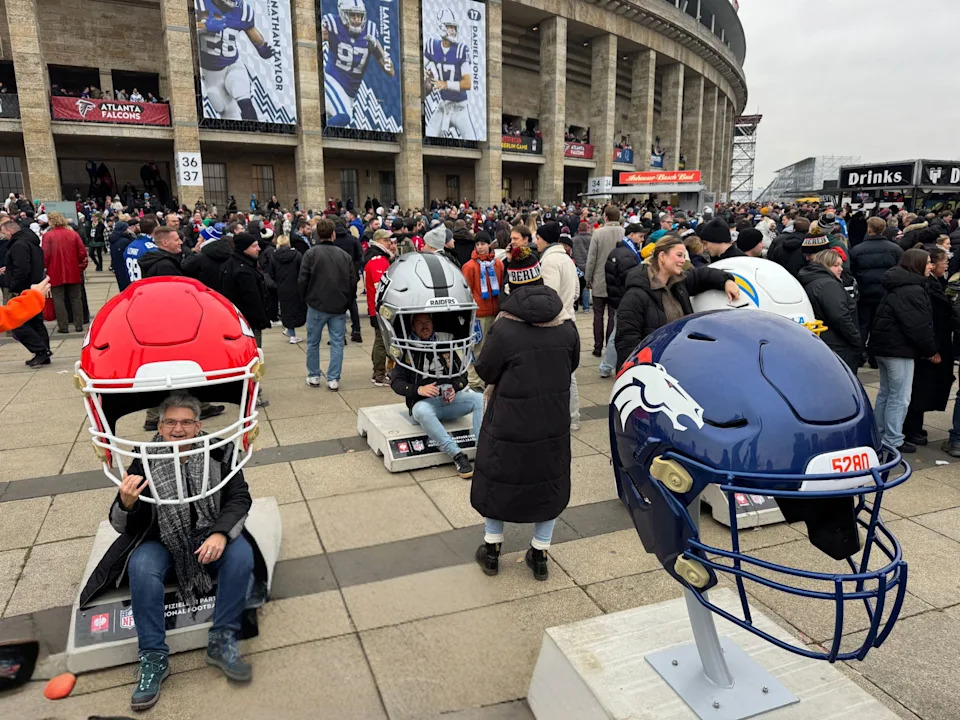
NFL fans outside of the 2025 Berlin game represented from every single team.
(Dream Network Media)On the ground in Berlin
By game day, Berlin felt electric. The U-Bahn to the stadium was packed with folks wearing their favorite teams’ jerseys. It’s not like what you’d see at a domestic NFL game — you’d never see fans from the Browns or Patriots at a random Falcons-Colts game. But here, we spotted jerseys from every single NFL team represented in the crowd.
Walking into historic Olympiastadion was a moment. Even without being dressed up by the NFL’s branding, the venue carries its own weight in history. Built for the 1936 Olympics, it’s where Jesse Owens famously defied the odds and the propaganda, winning four gold medals in front of the Nazi regime. That legacy hums beneath every event held here, and walking into the stadium that day, I felt it too.
The fan zones were alive, the food vendors had massive lines serving bratwurst and pretzels. And it was all flanked by a massive NFL store where you can buy officially branded gear that marks this specific game-day event. Overpriced? Of course. But it’s the kind of consumer energy that these pop-up shops thrive on — understanding that the fans will feel the need to buy a tribute to mark this experience. And when they wear it, it’s an if-you-know moment.. A nod to anyone who shared that experience.
I, too, consumed — paying 40€ for a New Era snapback.
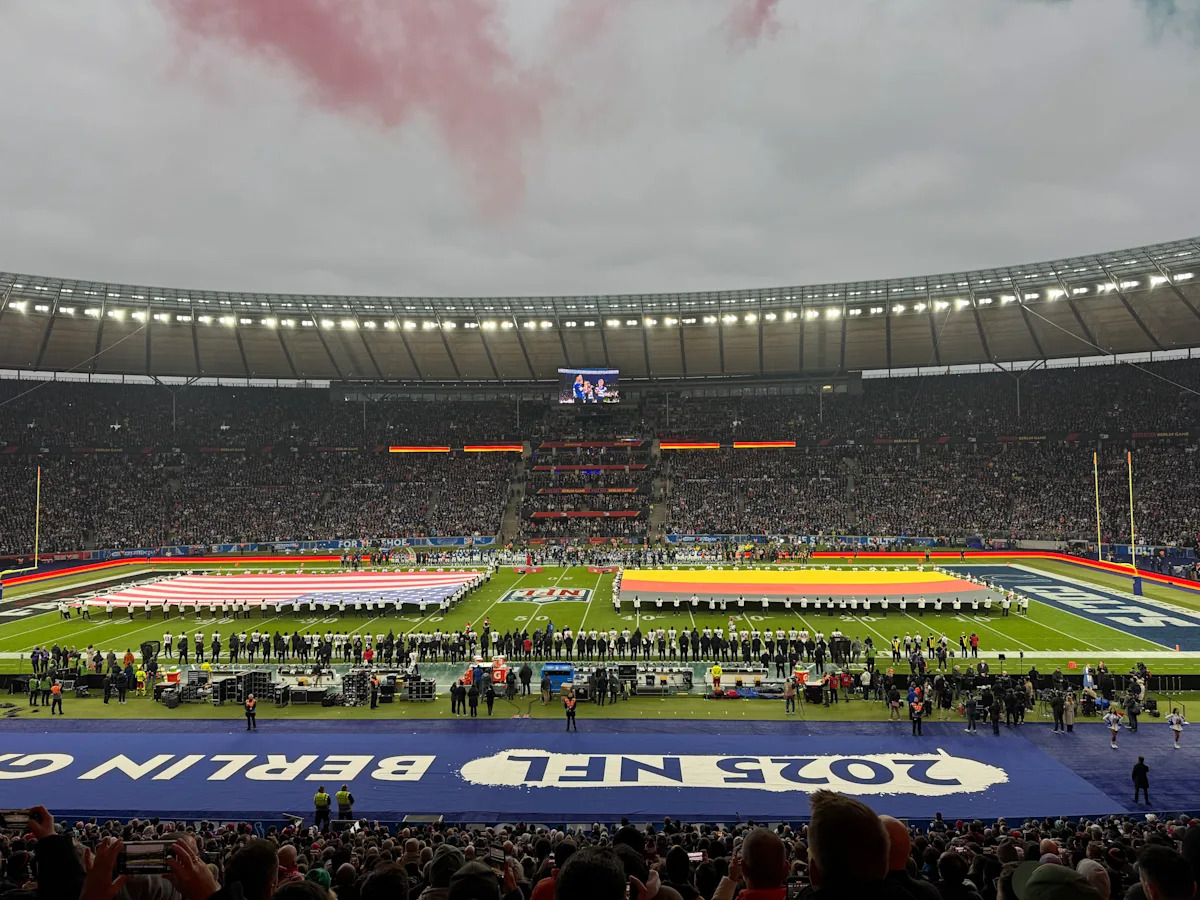
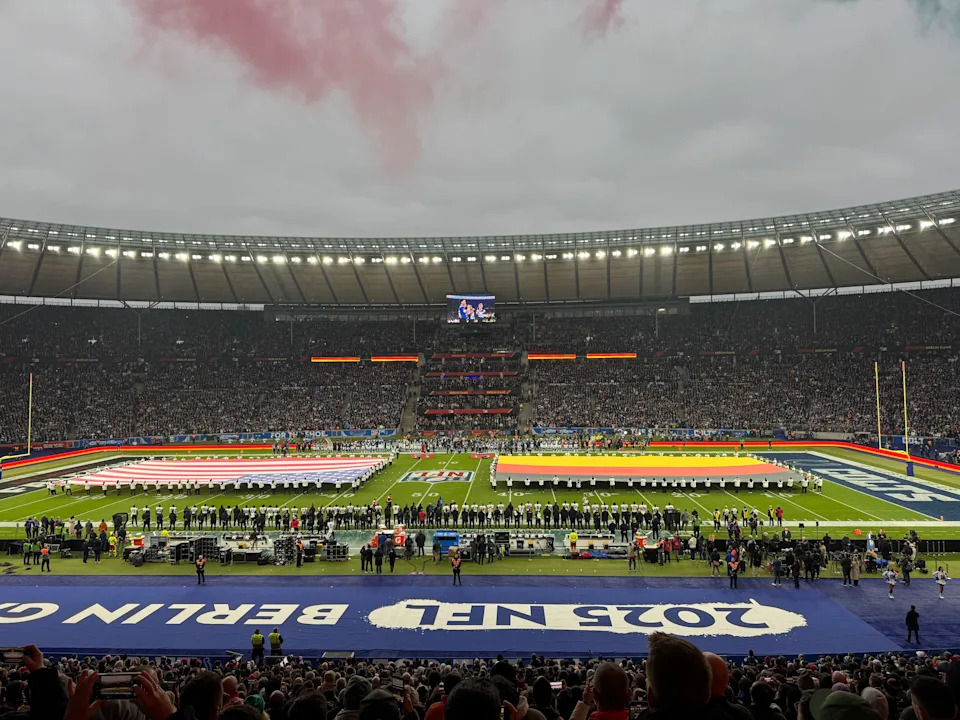
Inside, the transformation was complete. First look at the field was overwhelming. From our seats, colored flags were waved to create patterns representing both countries (the United States and Germany) and, of course, the NFL’s logo.
The in-game entertainment was non-stop—an American performer sang the U.S. national anthem, fireworks crackling, then German group sang theirs. Between downs and commercial breaks, there was a variety-show range of entertainment. But unlike a typical U.S. crowd, the crowd didn’t need pumped-in sound to keep the energy up. On several occasions classic football (soccer) chants would erupt from the stands and infectiously roll across the stadium, like a wave. And oh, we also did the wave. Of course.
Over the course of the night, it was abundantly clear that it was a majority German crowd and the in-game entertainment catered to that. Major announcements were made in both English and German.
With a 3:30 p.m. kickoff, darkness fell by 4:45. So, as the game went on, and the temperature dropped.
It was a close one, with the Falcons leading the majority of the game. The Colts would eventually win in overtime, 31–25. But, as a Falcons fan myself, I wasn’t surprised. It was a very Falcons way to lose.
For the rest of the NFL fans in attendance, no one seemed to care about the score. The real win was the experience.
 Smart planning for your next game-abroad
If you’re thinking about building a trip around a game (NFL or otherwise) the secret is in the prep. International sports weekends sell out fast, and once they do, even finding a nearby hotel can feel like a championship-level challenge.
Start with the tickets. As soon as schedules drop, set alerts and join team or league newsletters. Once you’ve secured your seat, book flights and hotels immediately. The best locations, typically close to stadiums or train lines, will go first.
Next, leverage loyalty. If you have premium travel cards or memberships, check their event partnerships. These programs often offer early access, bonus perks, or special fan experiences you can’t buy elsewhere. Airlines also tend to run limited promotions around international sports events, especially those tied to major teams or host cities.
Build in extra days. You’ve already crossed an ocean, so make it count. Add at least one day before and after game day to explore, unwind, and actually experience the destination. In Berlin, that might mean a walk through the East Side Gallery, a stop at a local beer garden, or a guided history tour of the Olympiastadion to see the 1936 relics up close.
Pack right. Weather can shift quickly in Europe’s fall season, so layers are your friend. This is when fan gear, like team scarfs nad puffer coats, can double as warmth.
Finally, budget for the extras. Expect event pricing (food, merch, rideshares) and plan for it. Use public transit when you can; in cities like Berlin or London, it’s fast, safe, and part of the experience.
The goal isn’t just to chase your team across borders, it’s to make the game part of your bigger travel experience.
Want travel resources that help you make the most of your vacation experiences? Visit my Travel Downloads Library and sign up for my newsletter.