
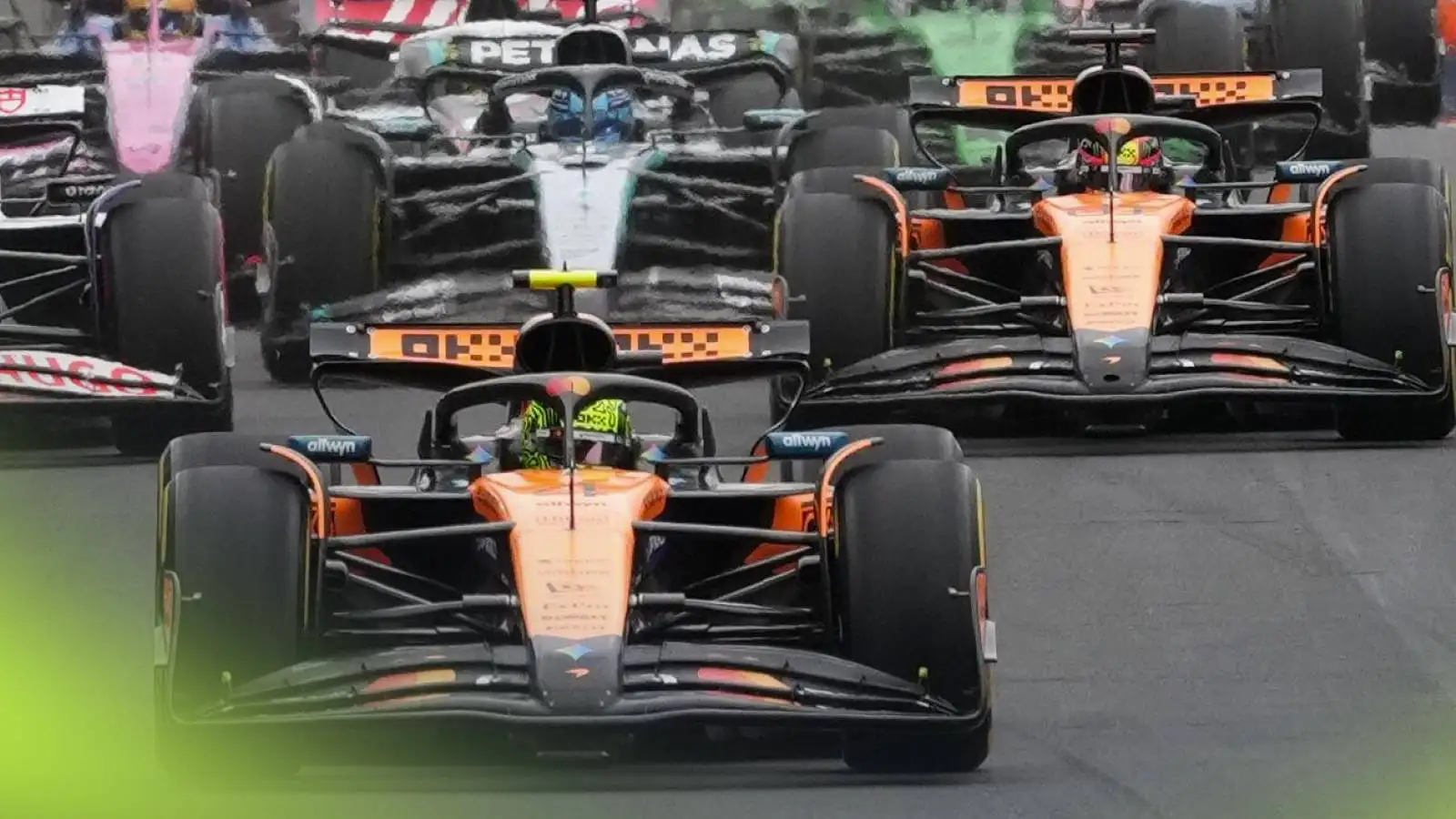
F1 liveries are set to become a little more exciting going forward, with new rules established for the 2026 season.
Car liveries with excessive amounts of bare carbon won’t be permitted in 2026, with the F1 Commission agreeing on some changes to the rules.
F1 Commission agrees on car livery rules revision
The rules pertaining to car liveries are not currently particularly prescriptive, with Article 9.1 of the Sporting Regulations specifying that cars must be presented in “substantially the same livery at every competition”, and that driver numbers must be clearly legible on the bodywork.
At the F1 Commission meeting held on Friday, to discuss further refinements to the various rulebooks for 2026, an agreement amongst the Commission representatives was reached to decree that, from 2026, a minimum of 55 per cent of the car’s surface area (when viewed from the side and above) must be covered in either painted or stickered liveries.
This will ensure a reduction in the amount of bare carbon fibre on display, with an aim to increase visual differentiation between cars. This follows discussions with the Technical Advisory Committee (TAC) regarding the topic of a minimum surface requirement.
Furthermore, changes in the regulation covering permanent driver numbers will be made, with the Commission agreeing that a proposal to allow drivers to change their permanent race numbers, as chosen upon entry into F1, will be permitted. The exact mechanism of this proposal is yet to be decided.
No mandatory two-stop strategies… for now
Another recent topic that has made F1 news headlines has been a suggestion to explore mandatory two-stop strategies during a Grand Prix.
This was discussed at the F1 Commission, along with the considerations of such a change, such as the mandatory use of all three tyre compounds during a race, as well as tyre specifications, and limitations.
The discussions took into account feedback from the teams and Pirelli, based on analysis and simulations.
At present, no changes have been agreed, with the topic set to be revisited during the F1 2026 season.
Also discussed were changes to the Aerodynamic Testing Restrictions (ATR) to bring Formula 1 in line with “contemporary processing and simulation technology while mindful of cost considerations”.
On top of that, redesigns to the current Driving Cooling System (DCS) have been proposed, along with an increased weight allowance.
The Grand Prix Drivers’ Association (GPDA) and driver feedback will be sought in order to refine the DCS further, as the possible mandating of the system continues to be discussed.
All the agreed changes will be put to the FIA’s World Motor Sport Council on December 10th for ratification into the respective regulations.
Read Next: Lewis Hamilton ‘very excited’ as rising Ferrari star catches the eye