
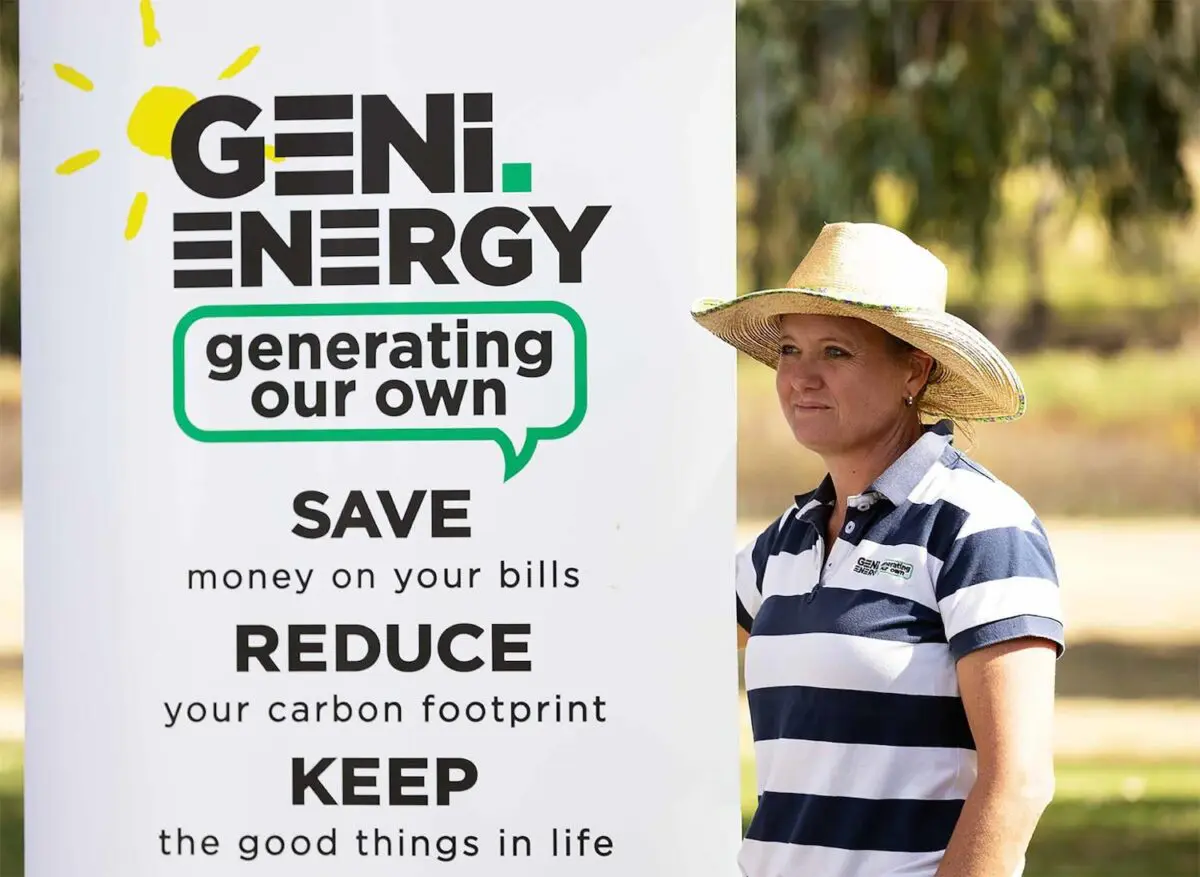
At this week’s Senate inquiry into information integrity on climate and energy, a local farmer and renewable-energy advocate told Senators how misinformation has derailed a fully funded, community-backed battery project for the town of Narrabri in north-west NSW.
Sally Hunter, a farmer and community leader who co-founded the non-profit Geni.Energy, said false and exaggerated claims about battery safety and performance had destroyed years of work and wasted hundreds of thousands of taxpayer and ratepayer dollars.
“Despite strong community support, this project has been derailed because of the spread of false and exaggerated information,” Hunter told the committee.
Geni.Energy secured $500,000 in federal funding under the Community Batteries for Household Solar program to build a 500 kWh community battery in Narrabri’s town centre. The local council initially voted unanimously to support the project, providing a letter of endorsement and a memorandum of understanding.
Council also directed the group to use an appropriate site for the battery – a car park already designated as a renewable-energy hub – and prepared a construction certificate for it.
But midway through lease negotiations, the council reversed course. “It was at this point that the wheels fell off,” Hunter said. Council blocked the staff from finalising the rental agreement, which “was enough to kill the project.”
Hunter said she could not say who convinced the council to reverse the project but told Senators, “what occurred was not due process, and it was certainly not based on fact.”
The false claims made by council included wild exaggerations about fire risks and outages. “At one council meeting, it was compared with a grid-scale battery 900 times larger for how long it would burn for,” she said.
“There was a total lack of comparative risk analysis with other technologies in our community that we live with every day.”
Councillors claimed the battery could blow up, catch fire all the time and might shut down the town for seven days, Hunter said. Local Facebook pages, she added, became “the castle of propagated misinformation,” while a fake account, “Joey Perth”, was used “deliberately to deceive people.”
The battery would have enabled the local community to store solar energy, help stabilise the grid, and reinvest profits into local projects. “The profits we would generate from buying and selling into the grid would actually be put into community projects that could create lasting benefits—solar panels on the footy club, a battery in the school, whatever was needed,” Hunter said.
A supporter of the project later wrote to the local newspaper expressing dismay at the council’s decision and disputing claims that there would be “no community benefit from the battery”, which she said was “completely untrue.”
The cancellation not only halted a community-owned battery but also removed a grid-connection point that could have supported other renewable projects.
Filling the information void
Appearing alongside Hunter was Andrew Bray, National Director of RE-Alliance, who work with regional communities to help them get the most out of the shift to clean energy. He told the committee that Hunter’s experience underscored a national problem: the lack of accessible, trusted information for regional communities navigating the energy transition.
“While the rollout can be messy and communities have legitimate concerns that deserve to be addressed, one of the biggest contributors to community anxiety is not being able to easily access factual, locally relevant and trusted information,” Bray said.
RE-Alliance has been advocating for the federal government to establish Local Energy Information Hubs—community-based centres that would provide accurate, independent information about renewable projects and help residents participate in the transition.
“When there is an information void we see it filled, time and time again, by false and exaggerated claims,” Bray said. “It’s not necessarily the fact that the information is false ….it’s about creating the climate of fear and confusion that the people who spread misinformation are trying to create, and that has a real impact on community cohesion.”
Bray noted that the Australian Energy Infrastructure Commissioner has recommended that government provide a publicly accessible map of renewable-energy projects, but “the government did not step up … and Rainforest Reserves [of Australia] came out and did it first … in a way that was quite deceptive in a number of areas.”
“There’s a real price in not acting on these things as quickly as they need to be,” he said.
For communities like Narrabri, that price is already visible: a shelved project, wasted funds and lost trust. Hunter told Senators that misinformation doesn’t just distort public debate—it changes real-world outcomes.
The Narrabri community battery is a project that could have demonstrated what local ownership of the energy transition looks like. Instead, it’s become an example of how misinformation can stop good ideas dead in their tracks.

Anne Delaney is the host of the SwitchedOn podcast and our Electrification Editor. She has had a successful career in journalism (the ABC and SBS), as a documentary film maker, and as an artist and sculptor.