
The growth in solar and wind energy capacity across the globe in the first three quarters of 2025 has outpaced even rising electricity demand, ensuring that global fossil power generation will remain flat in 2025 for the first time since the global Covid 19 pandemic.
These are the headline conclusions from a new report published on Thursday by global energy think tank Ember, which analysed global electricity generation in the first three quarters of 2025.
According to Ember, the solar energy industry is “reshaping global electricity generation”.
In the first three quarters of 2025, solar generation increased by 498 terawatt-hours (TWh), up 31 per cent over the same period in 2024.
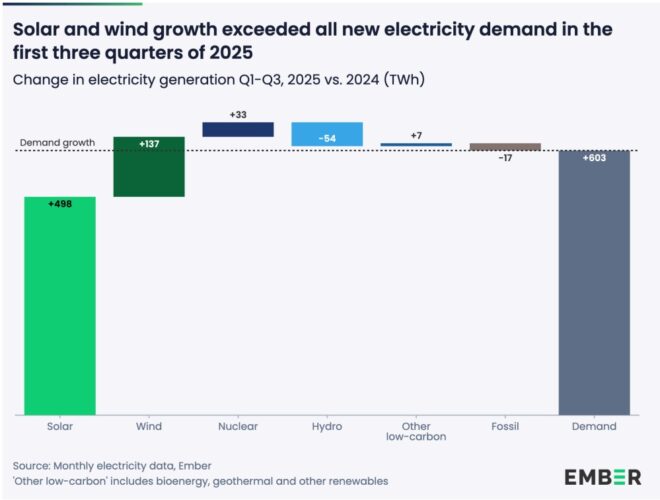
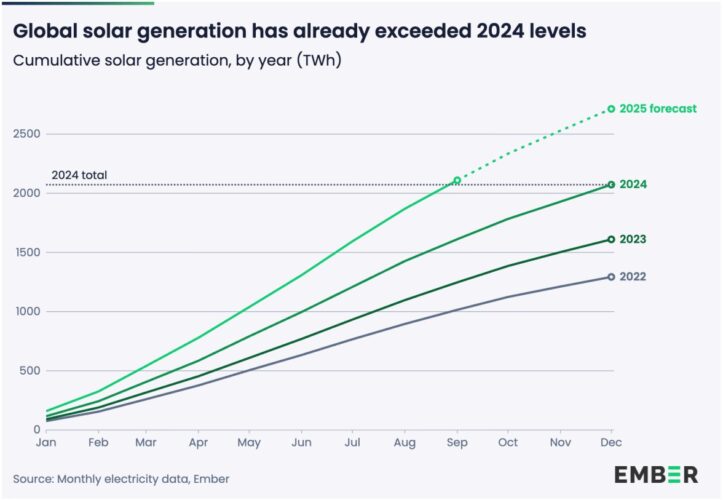
This means that solar has already exceeded total solar generation for all of 2024, with three months of the year left to go. Ember predicts that solar generation growth in 2026 is expected to top out at around 640 TWh.
Ember says solar domination has been such that its total generation growth for 2025 is three-and-a-half-times that of the next closest increase, that of wind energy, which saw generation growth of 137 TWh through the first three quarters of the year.
Solar and wind delivered combined growth of 635 TWh, outpacing the rise in global electricity demand of 603 TWh.
Nuclear generation increased by only 33 TWh, or 1.7 per cent, while hydro generation saw a substantial decline, down 54 TWh, or 1.6 per cent. Fossil fuel generation fell by 17 TWh, about the same level recorded in the first nine months of 2024.
Solar and wind together accounted for a 17.6 per cent share of the global electricity mix through the first three quarters of the year, up from 15.2 per cent in the same period of last year.
All low-carbon sources combined to provide 43 per cent of global electricity, with fossil fuels providing 57.1 per cent, down from 58.7 per cent in the same period of 2024.
Coal specifically saw its share of the global electricity mix fall from 34 to 33.1 per cent, falling below that of the entire renewable contingent in the global mix, which rose from 32.5 per cent over the first three quarters of 2024 to 34.2 per cent in Q1-Q3 2025.
As such, Ember concludes that there will be no growth in fossil generation for the full year of 2025, the first time since the global COVID-19 pandemic that fossil power will not have risen despite growing electricity demand.
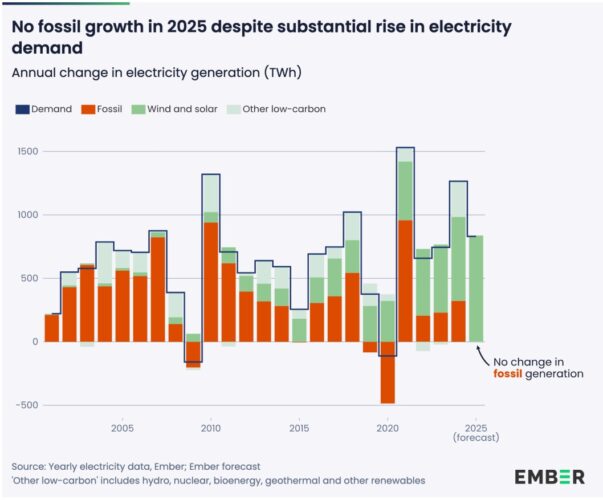
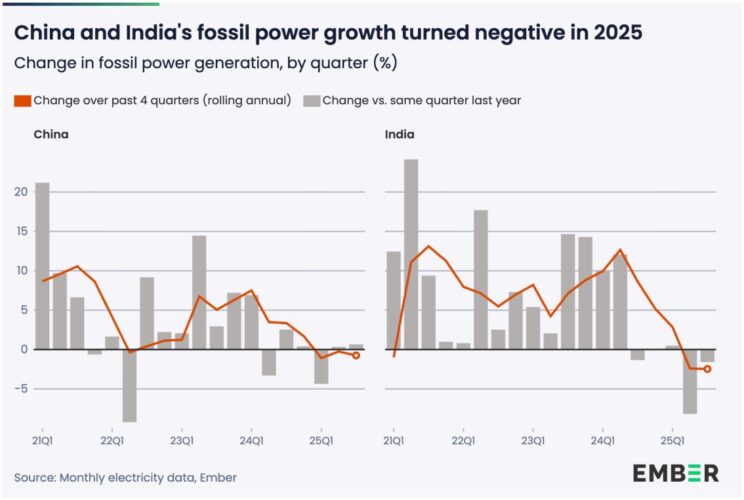
Importantly, and highlighting a shift in the global dynamic, small increases in fossil fuel generation across the European Union and United States were offset by declines in China and India.
China, for example, saw fossil generation fall by 52 TWh through the first three quarters of the year, down 1.1 per cent from the same period a year earlier, confirming what Ember describes as a “structural change in the country’s electricity system” which saw renewables meet all new demand.
Similarly, in India, fossil generation declined by 34 TWh, down 3.3 per cent, reflecting record solar and wind growth combined with mild weather that helped to slow demand growth.
“Together, these two markets tipped the global balance and anchored the first year of fossil stagnation since the pandemic,” concluded Ember.
“Record solar power growth and stagnating fossil fuels in 2025 show how clean power has become the driving force in the power sector,” said Nicolas Fulghum, senior data analyst at Ember.
“Historically a growth segment, fossil power now appears to be entering a period of stagnation and managed decline. China, the largest source of fossil growth, has turned a corner, signalling that reliance on fossil fuels to meet growing power demand is no longer required.”
Mirroring the global trend – or, more accurately, leading the trend – solar was the dominant technology in China, accounting for more than half of Q1-Q3 solar power growth at 280 TWh, up 44 per cent over the same period in 2024.
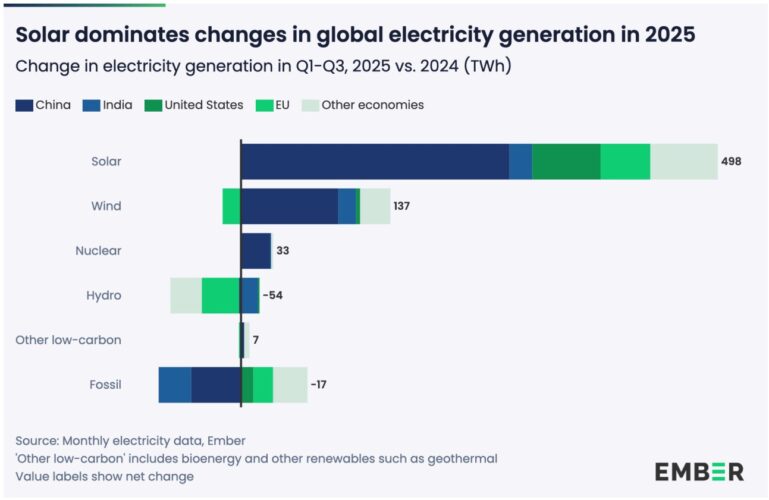
Solar also increased by 71 TWh, or 30 per cent, in the United States, despite the efforts of the new administration to undermine renewable energy at every turn. Whether this continues, however, will depend on how hard the Trump administration targets state- and commercial-driven efforts.
China also drove global wind power levels, seeing growth of 102 TWh, or 14 per cent.

Joshua S. Hill is a Melbourne-based journalist who has been writing about climate change, clean technology, and electric vehicles for over 15 years. He has been reporting on electric vehicles and clean technologies for Renew Economy and The Driven since 2012. His preferred mode of transport is his feet.