
Your support helps us to tell the story
From reproductive rights to climate change to Big Tech, The Independent is on the ground when the story is developing. Whether it’s investigating the financials of Elon Musk’s pro-Trump PAC or producing our latest documentary, ‘The A Word’, which shines a light on the American women fighting for reproductive rights, we know how important it is to parse out the facts from the messaging.
At such a critical moment in US history, we need reporters on the ground. Your donation allows us to keep sending journalists to speak to both sides of the story.
The Independent is trusted by Americans across the entire political spectrum. And unlike many other quality news outlets, we choose not to lock Americans out of our reporting and analysis with paywalls. We believe quality journalism should be available to everyone, paid for by those who can afford it.
Your support makes all the difference.Read more
An invasive fish species is threatening the livelihoods of a northwestern Sri Lankan village, aggressively consuming traditional fish and shellfish in the Deduru Oya reservoir.
However, local fishers are determined to transform this adversity into an advantage.
Over the past two years, fishermen have observed a sharp decline in their usual catches, while snakehead fish, previously unknown in Sri Lanka, have appeared in vast numbers.
Officials suggest these fish, common in countries like Thailand and Indonesia, likely arrived as imported ornamental species. It is believed their owners released them into the reservoir once they outgrew their tanks.
Dr Kelum Wijenayake, an academic researching the species, notes that the snakehead has no natural predators within Sri Lanka’s ecosystem.
The Deduru Oya reservoir has provided an ideal breeding ground, offering ample food and an absence of threats, allowing their population to flourish unchecked.t

open image in gallery
Ranjith Kumara, right, and Saman Kariyawasam eat giant snakehead fish in Walpaluwa, Sri Lanka (AP)
They also often come to the surface to inhale outside oxygen and are able to survive with just enough water to keep them hydrated, he said.
They have sharp teeth, strong jaws and are aggressive eaters, which means their increased presence can damage the local ecosystem that evolved over millennia, he said.
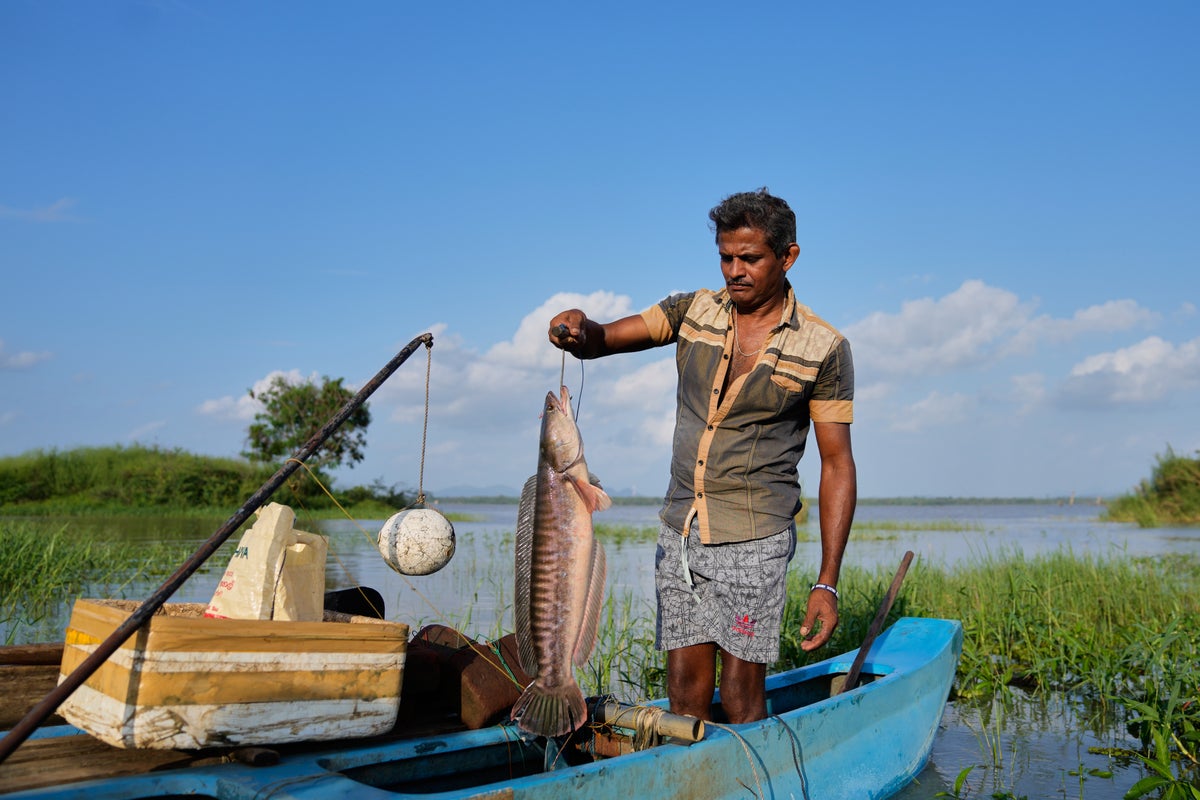
They also grow bigger compared to traditional freshwater fish species. Fisherman Nishantha Sujeewa Kumara said he once caught a fish weighing 7 kilograms (15 pounds), while the native species he usually catches weigh mostly less than a kilogram.
“Although we had heard of the snakehead fish before, none of us had ever seen one until a hobbyist angler came and caught it. That was the first time we saw it, because this fish cannot be caught using nets — it has to be caught by angling,” said Ranjith Kumara, the secretary of the area’s fishers association.
“We started fishing in this reservoir in 2016. Back then, we used to catch small prawns and other high-value varieties, but now they’ve become very rare.”

open image in gallery
A fisherman brings his catch ashore from the Deduru Oya Reservoir, where giant snakehead fish have become an invasive species (AP)
Authorities organised an angler competition to try to control the snakehead population, but it was unsuccessful.
Fishers, however, hope to turn the invasive species threat into an opportunity.
Ranjith Kumara proposed that authorities promote angler tourism as a consistent control method, which could also provide alternative economic avenues to the villagers who are mostly engaged in fishing and farming.
Fisherman Sujeewa Kariyawasam, who produces salted dried fish using the invasive species, said although fresh snakehead fish has relatively low market demand, the dried fish made from it is tasty and a popular delicacy.
“I am working to further develop this business. As demand continues to grow, more snakeheads will be caught for production, which in turn will help control the spread of the snakehead population.”