
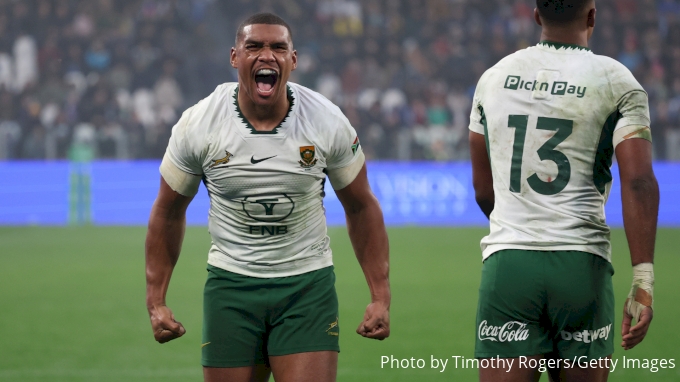
South Africa’s 32 – 14 victory over Italy in Turin was the type of performance that has come to define the world champions in the Rassie Erasmus era.
They were outplayed for long stretches, reduced to fourteen in the 11th minute and forced into emergency reshuffles across the pack and backline.
Yet the outcome never truly shifted away from them, even when the numbers and momentum suggested it should. Italy played some of their best attacking rugby of the past two years, but once again lacked the conviction to translate territory into points.
South Africa, meanwhile, won every big moment, adapted on the fly and showed why their championship minutes reputation remains unmatched.
Italy’s multiphase identity is emerging, but conviction is still missing
Italy’s best passages came when they fully committed to their Rugby League–style multiphase attack. Their shape looked clean, their tempo was decisive, and their intent clear: stress the South African edges, test the scramble defence and force the Springboks to defend repeated clean, quick ruck ball. Ange Capuozzo made 38 metres and produced two line breaks. Niccolo Cannone led all carriers with 13. Italy made 76 carries and repeatedly pierced the Bok line.
But when they reached the red zone, the conviction disappeared. Given the chance to go to the corner, they often opted for the posts. Given the chance to stress a South African pack down to 13, they chose safety. The return of only one try from 114 passes tells its own story. Against this South African side, caution does not win; the teams that have beaten the Boks have doubled down when they have had an advantage.
South Africa’s discipline remains a worry but the red card looked harsh
South Africa conceded nine penalties and again lost a lock to a red card. The decision against Franco Mostert will be debated because the footage showed no clear head contact, and there was significant mitigation with Paolo Garbisi falling into the tackle after Ethan Hooker’s initial hit. A yellow or 20-minute red would have been more appropriate.
The deeper concern is the pattern: South African locks have gone upright in consecutive Tests and paid for it. It is a technical issue that the coaching ticket must address urgently. And yet, even with the card, the Springboks reorganised instantly, steadied their scrum and reasserted their shape. Their discipline may falter, but their clarity never does.
South African versatility is a defining competitive advantage
Very few international squads can reshuffle as efficiently or as creatively as the Springboks. This match demanded it. Andre Esterhuizen came on early to provide structural balance, carrying 6 times for 38 metres and making nine tackles. Ethan Hooker showed he can operate as a wing–centre hybrid. Canan Moodie shifted seamlessly between strike roles, and Damian de Allende remains the most versatile midfielder in world rugby.
This is intentional team-building, not luck. Rassie Erasmus identifies unique selling points in individuals and builds systems around them. It is the reason South Africa survives chaotic Tests, and it is why they can lose a player early and still look composed by the 25th minute.
South Africa won every championship moment
Two turning points defined the match. The first was the final play of the opening half. Italy had dominated possession, Garbisi had already missed two penalties, and the crowd sensed momentum. Instead, South Africa won back-to-back scrum penalties, went direct, and Marco van Staden finished under the posts. A 3 – 3 match became 10 – 3 to the visitors.
The second came in the 48th minute. Italy had a five-metre lineout, numbers on the edge and a chance to level or lead. South Africa slammed the door shut. That defensive stand was the moment Italy’s belief cracked. The Boks followed it with a Pollard penalty, a scrum-led try for Morne van den Berg and scoreboard separation that Italy never recovered from.
This is why South Africa keeps winning. They may not control the full 80, but they control the moments that matter.
South Africa’s key playmakers delivered
The final quarter showcased the Springboks’ ability to punish fatigue and hesitation. Canan Moodie finished with 41 metres and two defenders beaten, and his break down the left was the decisive moment that set Grant Williams up for the 71st-minute try. Morne van den Berg controlled the tempo with 51 passes and 12 kicks, adjusting the speed of the contest brilliantly. Ethan Hooker capped his outing with a dynamic finish in the 79th minute, showcasing the footwork and spatial intelligence that has the Bok coaching team so excited.
Italy had standouts of their own. Manuel Zuliani made 17 tackles and won two turnovers. Giacomo Nicotera and Ross Vintcent each finished with 14 tackles. Cannone, Capuozzo and Brex all posed threats with the ball in hand.
But the difference was simple. South Africa’s best players delivered in the decisive minutes. Italy did not; instead, they took easy three pointers, which in other circumstances would’ve made sense. When they had a clear numbers advantage and were making great ground, settling for three was a let-off for the Springboks.
How To Watch Rugby Matches In The United States On FloRugby
Professional club rugby in Europe all streams on FloRugby and the FloSports app in the United States. FloRugby and FloSports also are the U.S. home to:
FloRugby also is home to match archives and match replays.
Join The Rugby Conversation On FloRugby Social