
Normal text sizeLarger text sizeVery large text size
It’s been 300 days since Maisie Mooney started exchanging photos with another teenager on Snapchat. They haven’t missed a day. Sometimes they send pictures of their faces, or their friends. More often, though, it’s something mundane. Like a picture of concrete, or the floor. They’ve never met in person, but there’s a niggling anxiety that keeps Maisie engaging in the daily back-and-forth with this stranger. It’s the pressure of the “snap streak”.
“Streaks are like a stupidly big thing for our generation,” Maisie’s friend, Flora Peatling, explains. If you don’t snap someone back, the app pings your phone, warning you’re about to lose your streak. The other person will keep snapping you too, to try to keep it alive.
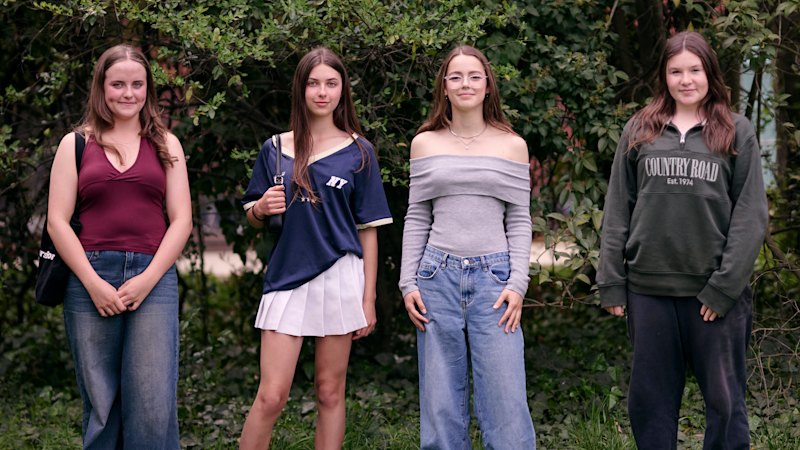
Maisie, Flora and their friends Anik Louw and Genevieve Rutledge – Canberra teenagers aged 14 and 15 – are all about to lose their snap streaks. They’ve agreed to forfeit social media access for five days during the October school holidays in an experiment for Good Weekend.
Losing a snap streak can be a big deal. Teens who know they won’t be able to use the app for a few days will often ask their friends to log in and do their streaks for them. They might pay Snapchat a few dollars to recover lost ones. Maisie recalls asking her parents to break the night-time lock on her phone when she’s been too stressed to sleep because she hadn’t snapped someone back. Flora describes it as a feverish panic. Genevieve likens it to waking up and remembering an assignment is due. “It’s that kind of stress,” she says. “You’d have to quickly log on and check it all and be like: ‘OK, I can go about my day now.’ ”
When we meet on the Monday at the beginning of their digital detox, the stress of lost streaks is on Maisie’s mind. So much so that she’s ended a bunch of them early to stop the bombardment of notifications when she returns to the apps. It’s made her reflect on her social media habits. “I realised when I was losing my streaks that I had a bunch of 50-day streaks with people I don’t know, who were just sending me photos of the ground.”
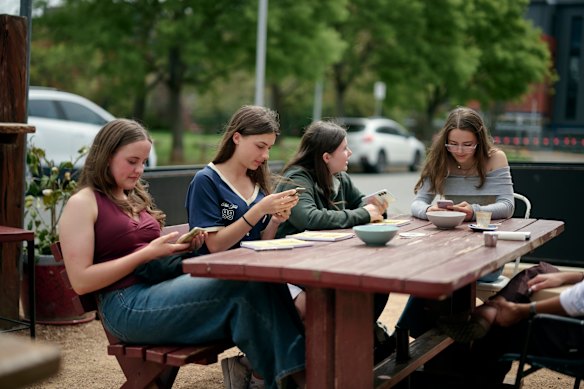
Teenagers born around the time of social media favourite Snapchat’s founding in 2011 are the first generation raised in a world where such platforms are ubiquitous.Credit: Rohan Thomson
She concedes that it sounds absurd, but for teenagers born around the time Snapchat was founded in 2011 – the first generation raised in a world where social media is ubiquitous – snap streaks are just another part of their elaborate online lives. They keep up with pop-culture trends on TikTok and with each other’s adventures on Instagram. It’s where they discover new hairstyles, music and recipes – a creative outlet and a place for community.
That world will be switched off when Australia becomes the first country to ban young teenagers from social media next month. On December 10, eight major platforms – Snapchat, Instagram, Facebook, TikTok, YouTube, X, Reddit and Kick – will be required to boot under-16s off their apps and show how they’re trying to stop them from joining up again or risk fines of up to $49.5 million. Other popular apps such as Roblox and Discord are exempt for now, but the list will be dynamic.
These four girls have agreed to a trial ban so they can share what it might feel like for the close to a million Australians between 13 and 15 (as of the 2021 census) who are the focus of the new rules. And they have their reservations.
“If you’re not posting stories then you start thinking, ‘Oh people must think I’m not doing anything, and I’m just sitting at home bed-rotting for the whole holidays,’ ” says Maisie, while Flora is worried about losing contact with people. “But when I think about it, the people who care about you can still call and message,” Flora says. “So I’m excited to not put my energy into: ‘Let’s see what this person I’ve never talked to is doing for their school holidays.’ ” Their biggest fear is boredom. Or as Anik, who spent 27 hours on social media the previous week, puts it: “Not knowing what to do with your brain.”
Monday: Maisie’s diary
When I got home…i went to do my snaps and scroll, when I couldnt i grabbed my ipad and started watching tv. while watching tv i wanted to do my snaps. when i couldnt i felt a little weird, like when you know you had homework to do but can’t remember what it is. i continued to watch tv till i needed to get ready for work.
I got to work early and didnt know what to do because i normally do my snaps. i am now on my break and didnt know what to do so i am writing. i am really bored because idk what to do. i feel a little bit of FOMO coz i dont know if people are messaging me, also a little bit of anxiety coz idk if the snaps r important or if i am really missing out on something.
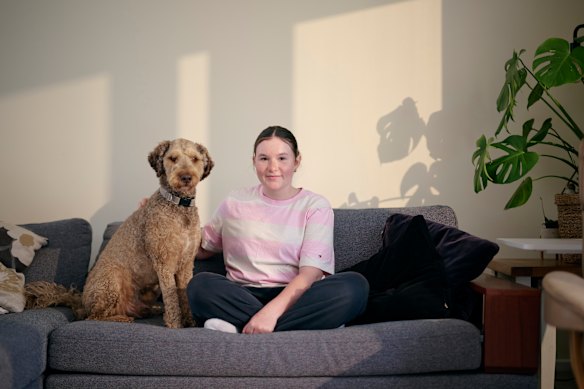
Maisie Mooney at home with her dog Milo. Her parents got her to delete TikTok after her daily screen usage soared from 30 minutes to three hours.Credit: Rohan Thomson
Australia’s social media ban is being promoted as a new weapon for parents who’ve been losing the battle to keep kids off screens. The case for action is best summed up in Jonathan Haidt’s 2024 book The Anxious Generation, which argues that smartphones and social media have rewired childhood away from play and led to a rise in mental illness. Six months after Haidt’s book shot up bestseller lists, the Albanese government became the first in the world to announce a social media ban.
An eSafety survey reports that 96 per cent of 10- to 15-year-olds use social media and seven in 10 have seen harmful content online such as misogynistic material or posts that encourage unhealthy eating habits, half have been cyberbullied and about a quarter have been sexually harassed.
“Parents want to get their kids off their devices and onto the playing fields. They want children to be able to enjoy their childhood, and that is what this is about,” Prime Minister Anthony Albanese said, a few months before spruiking the policy at the United Nations. Alongside him in New York in September was Australian mother Emma Mason, whose teenage daughter died by suicide after being bullied online. Jurisdictions including the European Union say they’ll be closely following what happens next.
Australia’s eSafety Commissioner, Julie Inman Grant, is the person tasked with making it work. She’s keen to frame the policy as a social media “delay” rather than an outright ban. The idea is to defer the point at which kids take up social media, so that today’s 10- to 12-year-olds don’t have grounds to hassle their parents for at least another few years. “We’re trying to put friction into a system where none has existed,” Inman Grant says. “One of the huge policy intents of this is to create a normative change.”
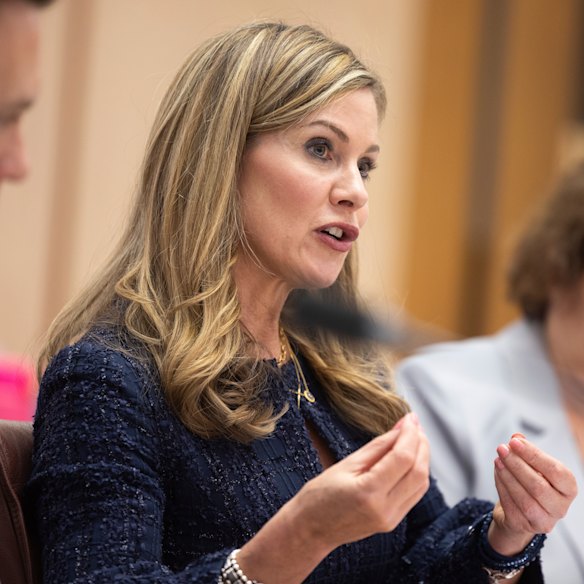
eSafety Commissioner Julie Inman Grant.Credit: Alex Ellinghausen
Inman Grant has been persuaded by the testimonies older teenagers gave during the eSafety Commission’s consultations – stories of bullying, leaked intimate photos, intense online entanglement and incessant pressure to have the perfect body, the perfect holiday, the perfect family, the perfect life. “I think about that a lot,” says Inman Grant. “I was able to screw up a lot when I was a teenager, and it wasn’t filmed with my humiliation amplified online.”
Yet for today’s 13- to 16-year-olds, who are still in the thick of things, it’s a tough sell. Some of Inman Grant’s biggest critics are closest to home. Our video call is interrupted when the commissioner’s 13-year-old twin daughters come to the door. She invites them into the frame to share their thoughts.
“It’s stupid,” says one. “What’s it actually helping?”
“It’s so that you guys are interacting interpersonally,” Inman Grant replies.
“We already do that,” her daughter says. “Everyone already does that. But it helps us connect to people overseas, because how are we supposed to do that now? How are we supposed to meet people? Where am I supposed to watch my celebrity crush at? How can you get inspiration?”
They can’t imagine how these needs will be met without social media. The questions keep coming, too. “How are you going to stop real-life bullying, then? Taking away school?”
Inman Grant politely ends her daughter’s interrogation, but many Australian teens would raise the same grievances if given the chance to debate the eSafety Commissioner one-on-one. “Our young people’s side of the story isn’t being seen, or it’s just being ignored,” says 14-year-old Ananya Sharma, one of several teenagers Good Weekend spoke to about the ban. “Social media doesn’t have as much of a negative impact as it’s perceived to have.”
Some parents make that case as well. Monique Taylor and her 12-year-old daughter, Bronte, live in a small town half an hour from the NSW border town of Albury. Bronte uses TikTok to make fan videos of Taylor Swift and deepen her passion for Greek mythology. Nobody else at her school shares those interests. “She’s a country kid. There are other kids that do it because they’re skateboarders and no one else in the town they live in skateboards, so they film videos and send it to other people,” Taylor says. “That’s where they feel free and brave to be who they want to be.”
‘You just get stuck scrolling and you don’t really want to do anything else.’
Maisie Mooney
Inman Grant is conscious there are kids who feel more themselves online than they do in the real world, particularly from diverse, disabled or LGBTQI+ communities. “It’s a way to find their tribe and really be themselves,” she acknowledges. “I want to make sure this is not something that cuts off their digital lifelines.”
But for all the caveats, her concerns about the persuasive and pernicious design embedded in social media apps persist. She describes gamified features such as snap streaks and addictive elements like the endless scroll as “powerful forces that kids can’t see, let alone fight against”.
That’s familiar to Maisie, whose parents got her to delete TikTok after her daily screen time soared from 30 minutes to three hours. “You just get stuck scrolling and you don’t really want to do anything else,” she says. “I feel like the phone sometimes controls me.”
Flora describes a similar experience, of opening the app to look for a recipe and finding she’s still there hours later, the algorithm leading her down disturbing rabbit holes: get toned with me; this is how you get thin; this is how you lose weight. She started going to the gym, then after a while thought, “I won’t eat.” She says, “It really impacted my mental health and body image badly. When I took a step back, I realised, ‘This is clearly not healthy, what’s the main cause?’ And then I pieced together that it was my Instagram feed.” By hiding video after video, Flora cleansed that content, but there was no easy way to opt out.
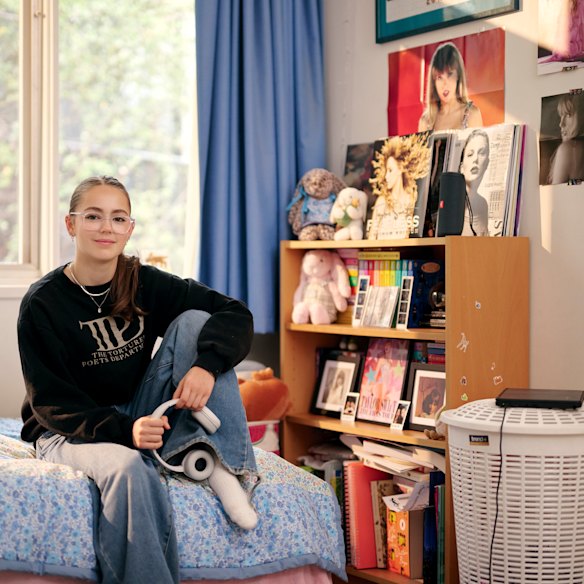
Flora Peatling remembers going down an algorithmic Instagram rabbit hole while looking for a recipe.Credit: Rohan Thomson
Andrew Neal, the principal of Bacchus Marsh Grammar School in Victoria, has watched social media infiltrate the lives of school children throughout his 28-year career, including at its worst, when 50 teenage girls at his school had their likeness used in AI-generated nude photos uploaded online – also known as “deepfakes”. The girls moved on from that harrowing experience with remarkable grace, he says, but it was a wake-up call about how vulnerable they are online.
“Social media is not this benign thing that is full of joy and wonder,” he says. “It actually has some fairly negative sides to it and in some cases can be quite devastating.”
Neal doesn’t think stripping access to apps will completely transform the teenage experience. “The problem of adolescence – which is dealing with how you fit in, how you work with other people and what your personality is – is still central to teenagers developing and becoming adults,” he says. Social media’s role is to magnify all the worst aspects of that time – the insecurities and doubts. “The genie is out of the bottle,” he says. “But the ban adds another armament, or arrow, to reducing the impact on kids.”
Tuesday: Flora’s diary
6.30am: Woke up and went to check Insta. Got pretty frustrated because I couldn’t look. Got extra sleep cuz I didn’t get woken up from phone.
8.30am: Got anxious so checked Reddit msgs and logged out right after. Frustrated I’m not doing better. Hard to stay away when the apps are right there.
Nobody knows exactly what to expect come December 10. That’s because the government has told the tech platforms to decide how they detect underage users and delete their accounts. The eSafety Commission has requested data on how many under-16s are on their platforms – Snapchat, for example, has given an early indication that 440,000 under-16s use its app. On day one, eSafety will be looking for evidence those accounts have been removed. “We’ll check after a week, we’ll check after a month, and then we’ll have periodic check-ins,” Inman Grant says. “We’ll be looking at systemic failures rather than a few individual accounts being missed here and there.”
Insights into how the tools will work can be gleaned from a government-sponsored trial that, earlier this year, tested 60 age assurance tools from 48 companies. Some tools guess a person’s age using face scans, others by assessing hand movements.
When St Mark’s Anglican Community School in northern Perth was invited to be part of the trial, principal Steven Davies took the opportunity to see what it was all about and was surprised to find 400 families volunteered. Years 7 and 8 students were given short tasks to perform to test different age-assurance technologies. “Some were closer than others,” says Davies. “Sometimes they predicted they were 18, so they could have easily got on, and some were closer to their actual age, which would have prevented them. The kids were quite amused.”
Loading
Teenagers online are already bragging about how they will get around the ban by supplying their parents’ information, wearing masks or logging into virtual private networks (VPNs) to obscure their location. Inman Grant intends to stay a step ahead of them: she notes that it’s pretty easy for tech firms to detect when someone’s using the address of a well-known VPN, for example, and that the new rules will require these companies to be on the lookout for workarounds.
Some privacy experts and academics also think the ban is unworkable, citing concerns about the extent of biometric data that will be held by tech platforms, and the fact that age assurance technologies have been proven to be less reliable for people with darker skin tones. Inman Grant concedes she’s not expecting perfection. Still, there’s a chance the ban will be more robust than many teenagers think: these are companies whose billion-dollar business models rely on pinpointing their users’ personal interests to serve content and sell ads. And they have the resources: Meta chief executive Mark Zuckerberg has reportedly given a $US250 million ($380 million) four-year contract to a single AI researcher, while the office of the eSafety Commissioner’s entire budget is $254 million for the same period. Inman Grant says she’s been told by TikTok’s chief executive that the app can detect a child’s age in three seconds using a combination of AI profiling, inference models and third-party verification tools. If that’s the case, hundreds of thousands of under-16s will find their accounts gone next month.

Anik Louw, who spent 27 hours on social media the week prior, says the biggest fear of what to do without it is “not knowing what to do with your brain”.Credit: Rohan Thomson
Tuesday: Anik’s diary
I’m bored and rlly just feel like scrolling. I don’t feel like FOMO or left out I’m just rlly BORED. I might go and watch TV bc im kinda bored of games now. I was definitely bored a lot today but I also think that games definitely don’t get you hooked in as much as social media’s personalised feeds and videos that are specifically generated for short attention spans like teenagers nowadays.
“We should acknowledge that this is going to be difficult for those families with teenagers between 13 and 16 that already have social media,” says clinical psychologist Dr Brad Marshall, director of Sydney’s Screens & Gaming Disorder Clinic and an adjunct fellow at Macquarie University. He says 1 to 2 per cent of teenagers experience extreme screen addiction, while about one in 10 demonstrate heavy smartphone use. Those at the pointy end might experience withdrawals: irritable moods and emotional dysregulation. “There could be some behavioural lashing-out, anger outbursts, some verbal conflict. You might see them socially withdraw, or take a bit of a stand,” he says. “But I don’t believe the average parent is going to see significant withdrawals in their kids.”
He has two expectations. First: that teens will try and find a way around the ban, especially heavy users. Second: that they’ll move to other platforms. If teens migrate to messaging apps or email, Marshall thinks that will be a win – they’re less addictive platforms. “We’re not asking them to go back to sending letters via Australia Post,” he says, comparing today’s public anxiety to the hyped debate two years ago around school phone bans, which are now commonplace.
“There were a lot of opinions, worried that it would isolate kids. If you look at the research, none of that happened,” he says. “Most studies indicate there were improvements in behaviour, or in social interaction at school. Did some of them get around it by putting a fake phone in the pouch, and staff were too burnt out to pull them up? Sure. But you’ll find many of them – not all of them, but many – enjoy that because it means they’re all forced to communicate face-to-face or play a game or sport.”
Social pressure drives thousands of children to social media. According to eSafety research, in 80 per cent of cases, eight- to 12-year-olds who had social media accounts had help setting them up. Usually, that help came from parents or carers. “Why?” asks Inman Grant. “Because they don’t want their kids to be excluded.”
The children Marshall does workshops with say they’re aware the apps want to suck them in. “They understand the impacts on their schoolwork, on their emotions, on their sleep. And it’s not enough for them to actually make the decision [to stop using it], because the social isolation part is what they fear,” he says. “I think there are going to be many kids that are relieved they don’t have to be on there anymore.”
The hope is that a social compact, where all teenagers are in the same situation, will make it easier. It’s also what compelled Maisie, Flora, Genevieve and Anik to agree to this experiment. They say they wouldn’t have done it alone – the FOMO would have been too great.
Loading
Instead, at the start of the week, we delete the apps together before the girls go about their lives. Quickly they encounter a difficult – and annoying – adjustment period. They keep picking up their phones by instinct, only to realise they can’t open the apps. The absence of messages and notifications feels eerie, and their inner voices say “no one really wants to talk to me”. They go to other screen-based activities to fill the void – games, music, FaceTime and online shopping – but frustration mounts.
By Wednesday and Thursday, however, they notice changes. Genevieve spends her first lunch break on her shift at McDonald’s voluntarily cleaning the restaurant, because she doesn’t know what else to do. At the end of the week, she takes herself for walks. “That definitely made me feel better, because I was going outside and in the sun,” she says, and nor is she checking her phone as constantly. “I was really happy about that because I felt much more independent.”
Anik, having spent almost three hours playing phone games on Tuesday, arranges a bunch of extra catch-ups with friends. “I replaced interacting with people online with hanging out with people in real life,” she says. “It was definitely more fulfilling.”
Flora’s screen time goes up – she spends longer on FaceTime calls – but she also plays the piano for the first time in four years and does some writing and walking that she wouldn’t have otherwise. “I feel very cleansed and a lot calmer, honestly, because there’s not so much content and opinions and news and updates from random things being thrown in my face.”
Maisie, meanwhile, gamifies her struggle with compulsion. She starts a tally for every time she picks up her phone only to find nothing there, which is when the FOMO arises. “In the afternoon when I had to take the dog for a walk, I counted. If there were five tallies, I’d take him for half an hour, but if it was over five, I’d take him for an hour.”
By Friday, her knees are sore because her walks have tended towards the longer side. Still, she chooses to walk even further, accompanying her mum to work in the morning instead of staying home because she feels less attached to her devices.
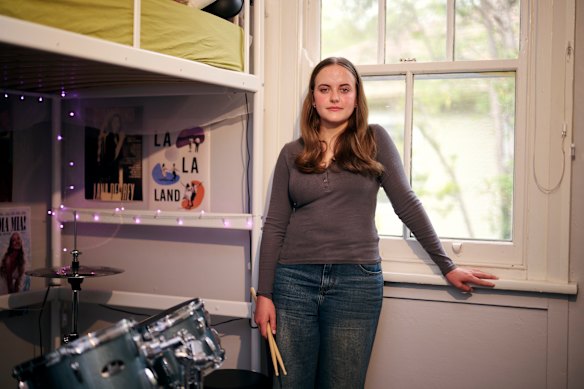
After a few days without social media, Genevieve Rutledge spent a work lunch break voluntarily cleaning for the lack of anything else to do. She also went for walksCredit: Rohan Thomson
Wednesday: Genevieve’s diary
In the morning, my mum and I completed errands, which I would normally not participate in doing. It was really nice to spend time with my mum and I found that my sense of time kinda got messed up because we had done so much in so little time. I didn’t think of going on socials all morning.
Schools will play their part in preparing students. Davies, the St Mark’s Perth principal, is conscious that kids will need strategies to stay socially connected without the apps. “Every school provides great opportunities for kids to get involved in the life of the school and get involved in groups with others. Perhaps schools might re-emphasise those opportunities.” But Neal, the Bacchus Marsh Grammar School principal, isn’t anticipating the school environment will suffer a huge shock, given so many have put phone bans in place. “Schools have effectively got out of this space,” he says. “The key to this is going to be parents, because in reality, it’s them who will have to impose the ban.”
Parents will fall into the same divides that exist with issues like alcohol, Neal predicts. “There will be some for whom this is a ‘thank god this happened.’ There will be a small group who think it’s an outrage, and ‘my child should be able to do what they like.’ In a sense, that’s an age-old fight.” Some parents will help their kids evade the new rules or give them access via their own accounts.
Under a Facebook post sharing a list of five ways families can prepare their kids for the ban, one parent comments: “I’d prefer a list of five ways to bypass it.” A parent who speaks to Good Weekend anonymously says that’s what they intend to do so that their child stays connected to family and friends overseas. “There must be hundreds of families like ours that will set up new accounts for them so they can keep using some platforms,” they say. “The blanket ban does not consider any individual’s situation or needs. Those kids who are using it responsibly will be isolated from perfectly normal daily dialogue.”
Inman Grant says a monumental change is coming for young people. “December 10 is right before school holidays, so people will be leaving and they might not feel that sense of connection,” she says. Her advice to parents for the next month starts with weaning kids off early. If a child is spending six hours a day online, she suggests trying to get it down to five hours the next week, then four, then three. Download their memories and photos. Get contact details for their friends and set up a group chat, and bookmark websites of their favourite influencers. “You can say, ‘Hey, we don’t actually have to wait for Snapchat to delete your app – we’ll wean you down and then we can do it together,’ ” she says. “So start the chat, delete the apps.”
‘I’m definitely not excited for the ban, but I don’t feel I’ll be like, “Oh my god, this is the worst thing in the world.” ’
Anik Louw
Thursday: Genevieve’s diary
I kinda forgot to journal this day, which I will take as a good sign. I was pretty busy with friends and work – both of which organised to take my mind off socials or being bored. The only time that I thought of going on my phone was when I was in a long queue and felt VERY Bored. Other than that, I think I had improved a lot since day 1 and 2.
The girls say they’re feeling refreshed when we meet on Friday to debrief. The last few days, while frustrating, haven’t been as tormenting as they feared, and Anik is now much less nervous about the looming date in December. “I mean, I’m definitely not excited for the ban,” she says, “but I don’t feel I’ll be like, ‘Oh my god, this is the worst thing in the world.’ ”
None of them have come to the revelation that they should ditch the apps of their own accord. Quite the opposite – a big part of what’s gotten them through the week is counting down the days knowing that it’s only temporary. Genevieve is still baffled they’ll be kicked off the apps, only to get social media back when they turn 16. “But I get why they’re doing it. And I think we can skip the starting patch of boredom and get straight into improving the habits we started this week.”
Loading
Those habits, which they want to keep, include scrolling less, putting their phone away after replying to messages and not using their screens as a backup every time they’re bored.
When I check in over WhatsApp two weeks later to ask how that’s going, the girls tell me their screen time shot up as soon as they got the apps back. But Genevieve has since set her own access limits to bring it back down, Maisie has removed a bunch of contacts she doesn’t know on Snapchat and Anik says she’s making “more of an effort to hang out with friends more and be in the moment, if that makes sense?” Flora is feeling less of a pull from the incessant pings, banners and red badges that come up on her phone.
“I think I’m definitely less obsessive and focused on social media, I have noticed I’m checking it less and not noticing notifications as much,” she says. “I would be a lot more bitter and unmotivated if it was permanent, but I think honestly it wouldn’t be a terrible thing. It’s really made me realise: ‘Oh yeah, you are addicted to your phone and the rush you get from notifications … You’re wasting so much time giving your energy to people that you’ve never even seen, why?’ So it’s been a really good eye-opening experience, and I
honestly think it would be beneficial to the majority of people.”
To read more from Good Weekend magazine, visit our page at The Sydney Morning Herald,The Age and Brisbane Times.