
“Electricity is already the key source of energy for sectors accounting for over 40 per cent of the global economy. By 2035, this rises to around 50 per cent in the STEPS.”
Energy analyst Tim Buckley said the report supplied further evidence that China was leading the world in the transition to renewables, driven by its geopolitical urge towards energy independence.
“In the month of June, China imported exactly zero dollars’ worth of fossil fuels from the US,” Buckley said. This follows imports worth $US1.5 billion ($2.3 billion) in September.
The IEA report shows that due to the failure of governments to act as advised by climate scientists, it is inevitable that the world will overshoot the Paris Agreement goal of limiting temperature increase to 1.5 degrees. If net zero targets are met, temperatures could still be brought back under that level by the end of the century after a period of “overshoot”.
The IEA found that the surge in AI use would cause a tripling of the amount of electricity consumed by data centres by 2035, but this would still represent less than 10 per cent of total global electricity demand growth.
It noted this growth would be highly concentrated geographically in advanced economies and China, putting additional strain on congested grids.
The report charted a resurgence in interest in nuclear power, with more than 40 countries taking steps to develop new projects. “In addition to reactors that are restarting operation, notably in Japan, there are more than 70GW of new capacity under construction, one of the highest levels in 30 years,” the report says.
“Technology companies are supporting the emergence of new business models, with agreements and expressions of interest for 30GW of SMRs [small modular reactors], mainly to power data centres. With these developments, after more than two decades of stagnation, global nuclear power capacity is set to increase by at least one-third to 2035.”
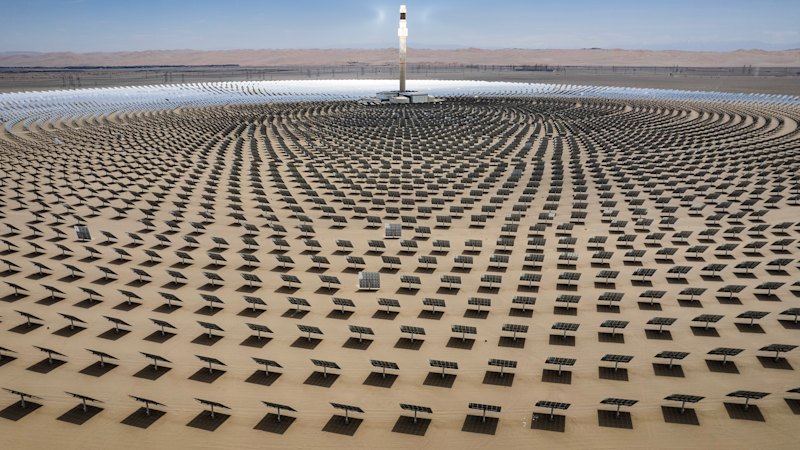
Meanwhile, emissions from China, the world’s biggest greenhouse gas polluter, have now been flat or falling for 18 months, according to analysis by Lauri Myllyvirta, lead analyst at the Centre for Research on Energy and Clean Air. The early peak is due to the massive and rapid deployment of solar and wind power, which grew by 46 per cent and 11 per cent, respectively, in the third quarter of this year, as well as a surge in electric vehicles sales.
Loading
The drop in emissions is particularly significant because China’s energy demand continues to grow, meaning that renewables have not only been meeting all new demand, but have also begun to displace fossil fuels.
Chinese President Xi Jinping announced a new 2035 emissions target in September to reduce carbon pollution by 7 to 10 per cent from an undefined peak, though China has a history of outperforming its targets.
Earlier this month, the United Nations Environment Programme published its annual Emissions Gap Report, warning that the world was likely to breach 1.5 degrees and that without immediate, aggressive action Earth would be on track for a global average temperature rise of 2.3 to 2.8 degrees above pre-industrial levels over this century.
It calculated the Trump administration’s withdrawal from the Paris Agreement, which goes into effect in January 2026, would add another 0.1 degrees to this range.
Launching the United Nations COP climate talks, which are taking place in Brazil, UN Secretary General Antonio Guterres said last week that world economics had shifted in favour of renewables.
“In 2024, investors poured $US2 trillion into clean energy – $US800 billion more than fossil fuels,” he said.
“Clean energy is winning on price, performance and potential – offering the solutions to transform our economies and protect our populations.”
Start the day with a summary of the day’s most important and interesting stories, analysis and insights. Sign up for our Morning Edition newsletter.