
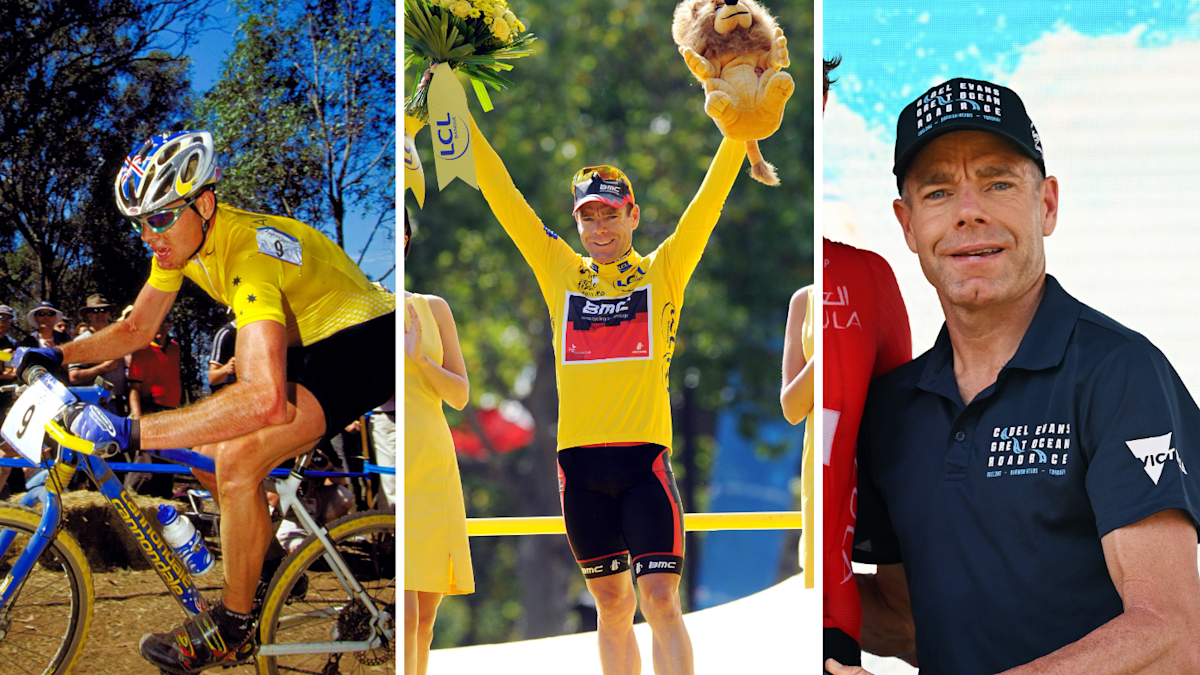
In 2011, there became a new way to refer to cycling in Australia – BC and AC.
On the eve of Cadel Evans‘ victory in the Tour de France, respected sports journalist Kieran Pender wrote, “in a moment, [Evans’] yellow jersey triumph demarcated Australian cycling for ever.”
“Before Cadel and After Cadel.”
READ MORE: Hazlewood ruled out of first Test in huge Ashes blow
READ MORE: ‘Extremely poor’ Socceroos left scrambling in second straight loss
READ MORE: England paceman cleared after Ashes injury scare
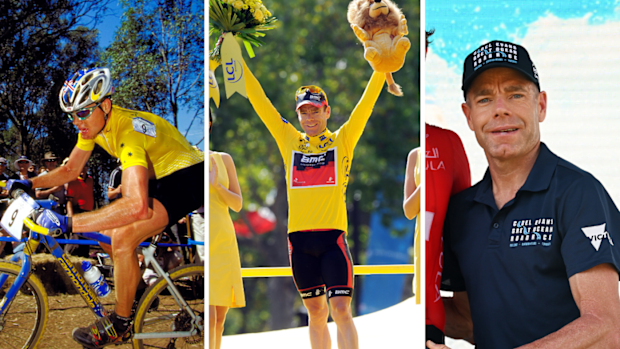
Cadel Evans through the years. Getty
His historic ride into the Champs-Elysees was not just a victory; it became iconic Australian sporting history, so significant it was immortalised in the shape of a Lego figurine.
But not everything was smooth sailing in the Australian’s career.
Evans came of age in a peloton that rode beneath the dark shadow of doping.
He was a rookie sharing the Tour de France field with Lance Armstrong and struggled through a timeline of scandals that rocked the sporting world.
He believes that cycling had to “clean itself up” as a sport and is confident that today’s athletes are more rigorously checked.
“Many years ago, it certainly did [taint the sport],” Evans admitted to Wide World of Sport.
“One thing that I think cycling had … because it was normally a public arena, all these things became very public.
“The sport was really forced to clean itself up and it’s really been since these late ’90s, early 2000s, since all these issues have been in our sport.
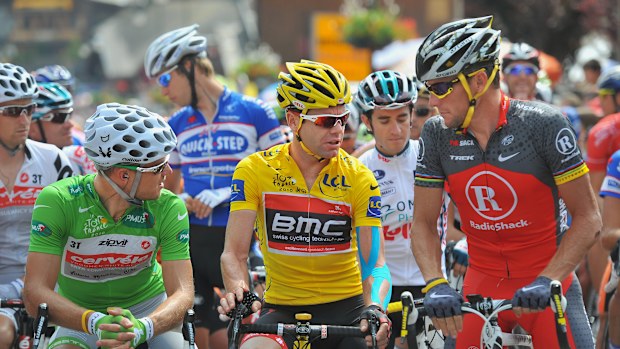
Lance Armstrong and Cadel Evans catch before the stage. Getty
“It’s been a bit of a leader of any sport in the world in terms of the drug testing protocols and cleaning up its own sport.”
Today, the Union Cycliste Internationale (UCI) collects nearly 600 in-competition samples during the Tour’s three week campaign and has worked hard to scrub the persistent suspicion of doping.
“I’m proud of the sport for that, where today the drug testing that the riders go through and have been going through for the last 10-15 years is just incredible,” Evans said.
“And people can also say, ‘Oh, there are doubts in the sport,’ but also it’s not just the drug testing, it’s the intelligence gathering and the investigations and so on that have also brought down people who haven’t abided by the rules in the past.
“So I feel faith in the sport and great confidence that it’s really as clean as any sport could possibly be.”
The early years
Evans started his illustrious cycling career in the mountains, rather than the road.
He grew up out the back of Armidale, New South Wales, by altitude the highest city in Australia, with his mother.
In the Sydney 2000 Olympics, he came seventh in the men’s cross country mountain biking in Fairfield after a slew of injuries had impacted his preparation.
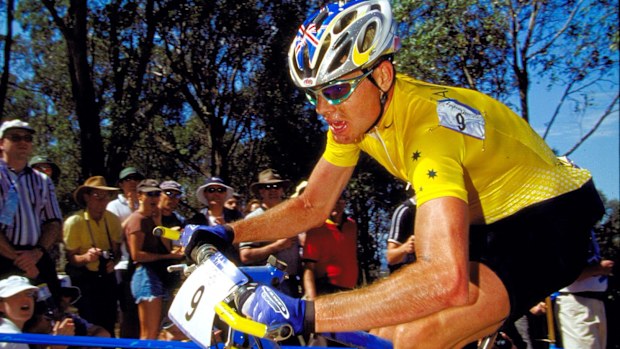
Cadel Evans of Australia in action during the Men’s Cross Country Mountain Biking. Getty
The pressure cooker situation of a home Olympics for a then 23-year-old Evans was difficult for him.
He made the switch to road racing in 2001 and never looked back, but it was the vast open landscape of mountain biking that honed Evans’ skills in his career.
Evans looks back at the early days of his career with fondness.
“I came to the sport through mountain biking, so to speak, and I was one of the first riders to switch,” he admitted.
“I’m really grateful to mountain biking for getting me into the sport.
“It really taught me how to prepare for the Tour de France later in my career when the sport was changing and evolving.
“I was already well prepared for it. I was prepared today and well drilled in what was required and that really put me in a good position.
“Especially in 2009, 2010, 2011 – the best years of my career.
“While everyone was sort of catching up with the challenges that had gone on with the sport.”
He was meticulous with his set ups which made him a front runner in the pack before anyone decided it was time to tinker with their bikes for millisecond gains.
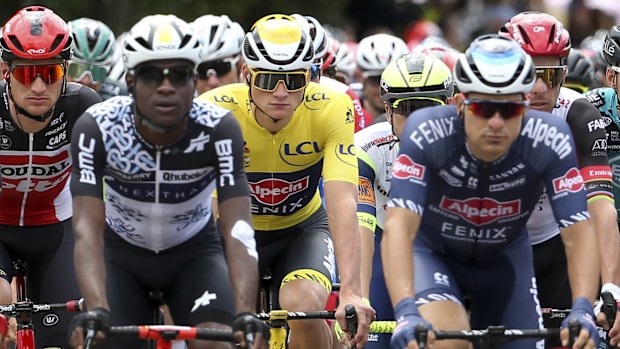
Every rider in the Tour now is locked in on top performance. Getty
Now, every team and rider is coming into each stage with that amount of dedication to high performance.
“Sports evolve like everything in the world, but basically the dedication and sacrifice that the riders make is much greater now,” Evans observed.
“I mean, maybe in 2011, when there was the Tour, maybe there was 10 or 20 people who did absolutely everything possible in terms of preparation, material and so on.
“Now, you know, for 10 or 15 riders, it’s just absolutely amazing, just the depth of how well-prepared the riders are.”
Evans agonisingly finished just shy of victory in 2007 and 2008, coming home in second to Alberto Contador and Carlos Sastre respectively.
Those years earned the Aussie the frustrating media nickname, ‘Nearly Man’ and soon, it started to infiltrate into his normal life.
“I had to consciously not let myself be conditioned by that mentality because one thing that was kind of bizarre, it wasn’t just the media and things, but I would go to the supermarket or something the hairdresser, and they’d say the same thing,” he said.
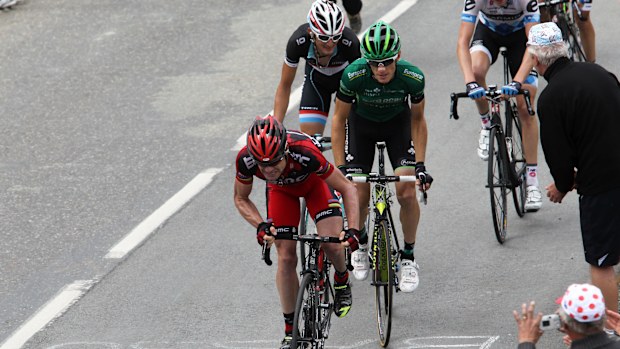
Cadel Evans, Pierre Rolland and Frank Schleck during Stage 19 of the Tour de France. Getty
“It kept me with it. So I just had to keep reminding myself that I have to believe in myself and keep doing what I’m doing.”
Taking it home in 2011
For Evans, he finally found a way to overcome this mentality and won the Tour in 2011, becoming one of the oldest cyclists ever to clinch Tour de France victory. He was 34 years old.
“And my thing was, in 2007 and 2008 I came really close, but I had to be very strategic because I didn’t have a team to take the lead early,” he said.
“And on the last day, I just used a little something or someone that could be formidable or formidable in the best time trial.
“So when I went in in 2011, I was a bit more conditioned to this having been before, and so you had to deal with it.”
It all came down to a final time trial in Grenoble, with Evans facing a 51-second deficit.
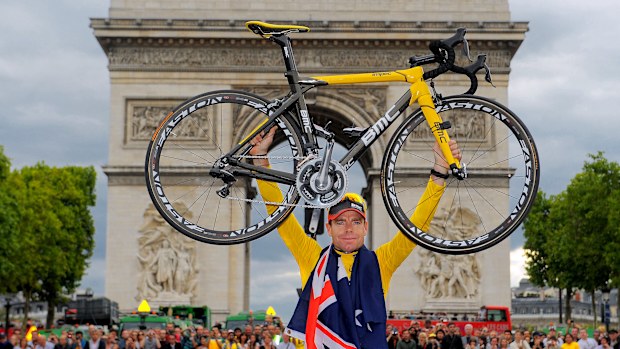
Cadel Evans in 2011 after Stage 21. Corbis via Getty Images
He already knew he had rival Andy Schleck in the time trial, the Luxembourgian was “scared” of Evans and his mentality.
“Slightly high-pressure situation when you just fought that one,” he laughed.
“But I’d been in the same situation twice before in 2007, 2008.
“The difference this time around was mentally, I was pretty sure I had Andy Schleck mentally because he was really scared of me in the time trial.
“We’d really done everything. My time trial mentality, which was different from my progressive mentality.
“It became very calculating and gave me a lot of confidence knowing that we’d done everything as best we could.”
Schleck and his younger brother Frank shared the eventual podium with Evans and the three now regularly see each other for the People’s Ride in France.
“I was actually shared the podium with two brothers, which was kind of unusual. Andy and Frank Schleck, coming from Luxembourg…bizarre because they were teammates but they were also brothers,” Evans said.
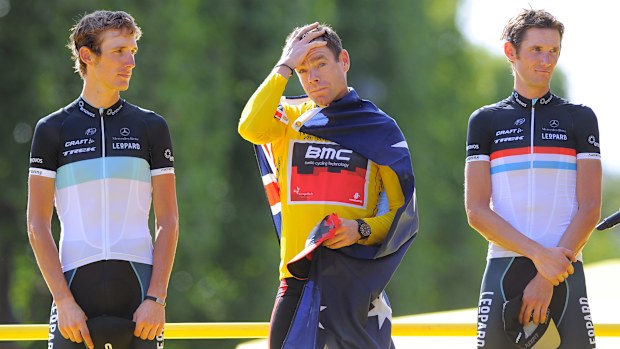
Andy and Frank Schleck shared the podium with Cadel Evans in 2011. Corbis via Getty Images
“[Was it] sibling rivalry or companionship? As an only child, I never knew.
“But I see them at the Tour today when I go and do the Mummu Tours.
“We catch up and we eat together. And coming up this year and participating in People’s Ride so that we can meet back together again.
“We were brothers in 2011, but we’re great friends now.”
Australia’s relationship with le Tour
When Evans was in his pomp, the Tour de France was once part of the Australian sport zeitgeist, with sports fans often dedicating late nights and early mornings to watching the iconic race unfold.
It has undoubtedly fallen off over the last decade, and Evans believes it may be due to the sport’s current lack of high profile Australian riders who are capable of transcending the sport and becoming more mainstream.
“Oscar Piastri and Formula One, to use as an example [of national fans],” Evans pointed out.
“I don’t know in the brochure, but probably some young riders…[will] change the dialogue for the Tour de France and something in the future for Australia.
“I’m sure in Slovenia they’re all talking about it [the Tour],” he laughs.
“Because he’s [four-time Tour de France winner Tadej Pogacar] probably going to win another one.
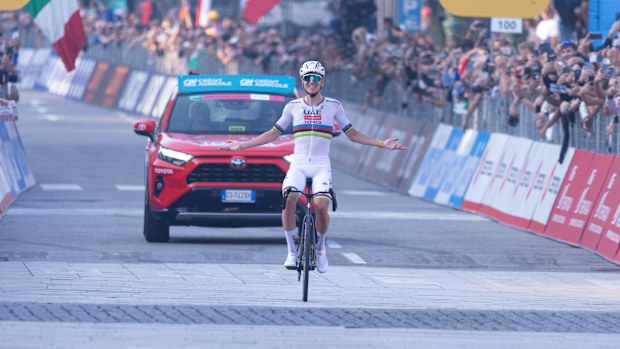
Tadej Pogacar wins Il Lombardia 2025 for the fifth time. NurPhoto via Getty Images
“It’s funny watching the evolution of nations and the popularity of the sport around the world, because obviously there’s a guy named [Lance] Armstrong from America who was standing on the podium many times in Paris.
“But whether that came after [Marco] Pantani in the late ’90s or Jan Ullrich from Germany in the late ’90s.
“Then we had Bradley Wiggins [and] Chris Froome which brought in this huge popularity and following from the UK.
“So someone really changes the popularity of the sport by their efforts and results in the Tour de France.
“I’m so lucky to be enjoying this sport as much as they were. I’d love to see someone help that movement grow again [in Australia].”
Looking ahead to next year’s Tour, Evans said you’d have to be silly not to back 27-year-old Pogacar to win again, and to continue dominating for several years to come.
Pogacar currently has four Tours to his name in 2020, 2021, 2024 and 2025.
The Slovenian is in with a chance to match the record for the most Tour victories overall if he comes away with a fifth win after Armstrong’s record of seven victories was scrubbed from the history books when his years of doping came to light.
This record is currently shared between four riders: Jacques Anquetil (1957, 1961-1964), Eddy Merckx (1969-1972, 1974), Bernard Hinault (1978, 1979, 1981, 1982, 1985) and Miguel Indurain (1991-1995).
Pogacar also recently won the Tour of Lombardy for a fifth consecutive time in 2025.
“To not back Pogacar, I think, wouldn’t be a wise move,” he added.
“He has absolutely everything. He avoids crashes. He has the strongest team. He’s the best climber. He’s the best time trialer.
“He’s consistent, not just through the Tour, but throughout the whole season.
“He’s … Yeah, I can’t … I can’t explain it.
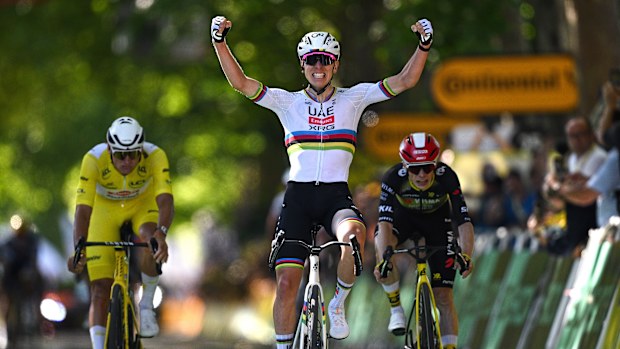
Tadej Pogacar celebrates at finish line as stage winner ahead of Mathieu Van Der Poel and Jonas Vingegaard. Getty
“He seems to be increasing the gap between himself and [Jonas] Vingegaard, who looks to be second again. I’m sorry, but [Mathieu] van der Poel for third.
“They are the best in the world right now. And they’ve just proven again and again that they’re head and shoulders above everyone else in our sport.”
The 2026 edition of the Tour de France will begin on July 4 next year.
It will start in Barcelona for the first two stages and move into France at the end of day three, the first time in its history to do so.
“It’s gone back in some ways in terms of, there’s a team time trial again, which hasn’t been for a long time, which is fantastic for us as spectators.”
“And the fact that it’s on the opening day makes it really, really interesting.
“I see it from a sporting point of view, but also as a spectator, it’s one of the most spectacular stages to watch.
“And being in Barcelona…Barcelona alone is a fantastic place to be and it’s sort of fantastic because [it’s] is very unique.”
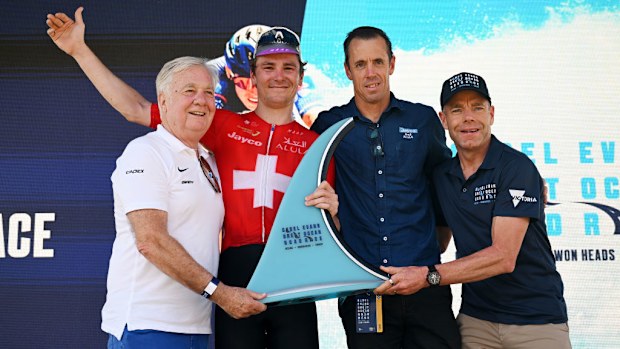
Cadel Evans poses at podium during the 9th Cadel Evans Great Ocean Road Race 2025. Getty
Evans now lives back in Australia and is the host of the Cadel Evans Great Ocean Road Race, which annually sees 3,000 participants race through Geelong and down the iconic Victorian coastline.