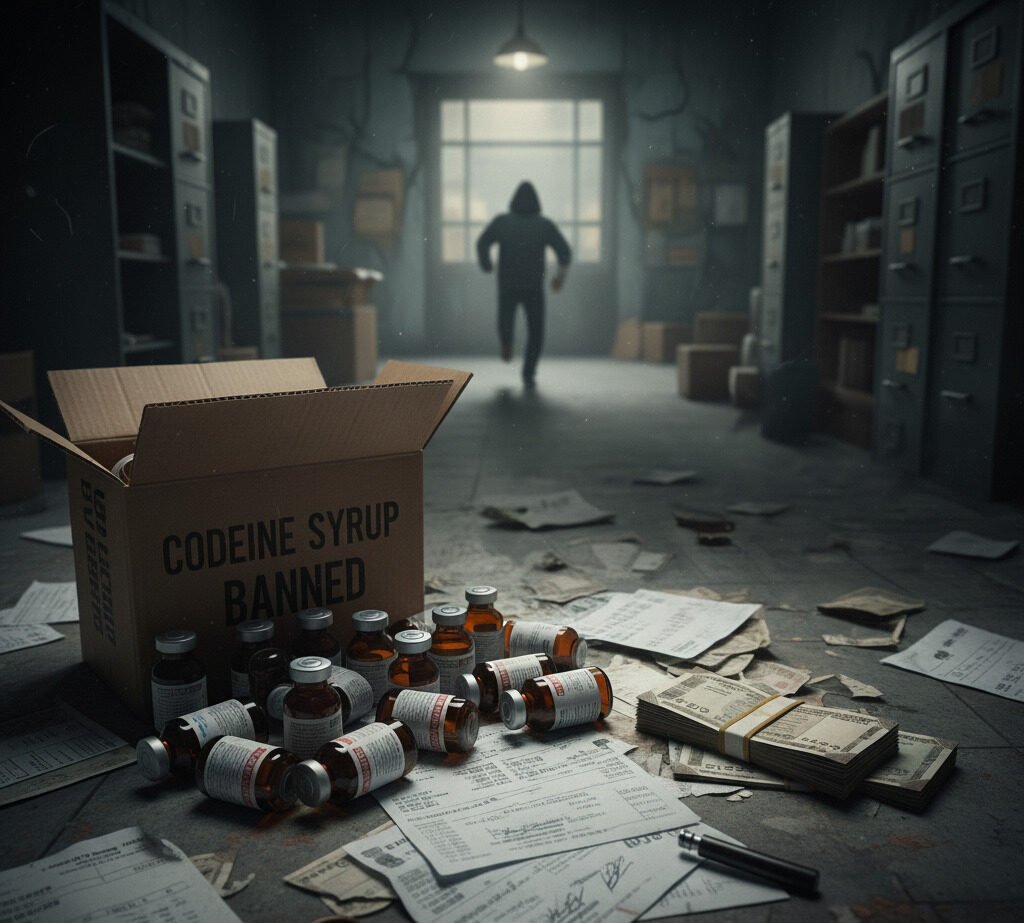
8.9 million vials of codeine-based syrup traded through fake firms; 28 drug dealers in Varanasi booked, kingpin Shubham Jaiswal absconding.
Uttar Pradesh’s Food Safety and Drug Administration (FSDA) has unearthed one of the largest illegal cough syrup networks operating across multiple states, exposing a trade worth nearly ₹100 crore. The crackdown—conducted between November 12 and 14 by a special inspection team—revealed that 8.9 million vials of banned codeine-based cough syrup were bought and sold using forged invoices, shell firms and benami drug licences. Following the investigation, police registered cases against 28 drug dealers from Varanasi along with the alleged mastermind, Shubham Jaiswal, who is currently absconding.
A Multi-State Network Built on Fake Billing and Closed Firms
According to FSDA officials, the racket was run primarily through Shaily Traders, a firm shown on paper as operating from Ranchi, Jharkhand, but actually controlled by a Varanasi-based family. The firm allegedly purchased large quantities of restricted syrups from Abbott Healthcare between 2023 and 2025 and then distributed them to fake or non-operational medical firms across Uttar Pradesh and neighbouring states.
During spot inspections, most of the medical outlets listed as recipients of the stock were found to be either locked or non-existent. This confirmed that the trade was being routed through paper firms set up solely to facilitate illegal distribution of narcotic-grade cough syrups.
The investigation further revealed that Shubham Jaiswal—who headed the operations—was simultaneously linked to two different companies, Shaily Traders (Ranchi) and New Vriddhi Pharma (Varanasi), during the same period. Such dual employment violates licensing norms and indicated deliberate manipulation for illicit trade.
Shell Firms Created Exclusively for Codeine Syrup Supply
The FSDA team, led by Commissioner Roshan Jacob, discovered that several firms were set up with the sole purpose of purchasing and circulating codeine-based syrups. Nine firms—including Srishti Pharma, GD Enterprises, Shivam Pharma, Harsh Pharma, DSA Pharma, Mahakal Medical Store and others—were found shut at the time of inspection.
Interestingly, DSA Pharma and Mahakal Medical Store were registered at the same address, raising questions about the authenticity of ownership documents. In yet another instance, a proprietor of one firm issued “experience certificates” to the owner of another firm, helping them obtain a licence merely to procure narcotic-category medicines.
Jewellery Shop Worker Shown as Medical Store Owner
One of the most striking findings came from the investigation into Shri Balaji Medical. The firm had allegedly purchased a large stock of syrups from New PL Pharma, which itself claimed to have sold 2.16 lakh vials. However, when officers traced the registered owner, they found a jewellery shop worker who had no connection with the pharmaceutical business. This confirmed the use of forged identities, fake bills and benami entities to move narcotic syrups across districts.
Similarly, GD Enterprises purchased 2.14 lakh vials from Shaily Traders but failed to produce any sale records. Officials believe the syrups were diverted to networks dealing in addictive substances.
28 Drug Dealers Booked; Police Launch Search Operation
The FIR names 28 individuals from areas including Chowk, Sapt Sagar Market, Sigra, Ausanganj, Lanka, Pandeypur, Mahmoorganj, Maldahia, Adampur, Jaitpura and BHU zone. Teams from the Kashi police zone have been deployed to trace and arrest all accused.
DCP (Kashi Zone) stated that associates of the prime accused will also be questioned to understand the financial trail and identify interstate links. Meanwhile, the Ghaziabad police are preparing to issue a lookout notice against Shubham Jaiswal, who reportedly fled the country earlier.
A Case That Exposes Systemic Loopholes
The ₹100-crore cough syrup racket has put a spotlight on long-standing gaps in the drug distribution system—particularly related to licensing, monitoring of sales and verification of wholesalers. The scale of the operation indicates a well-organised supply chain designed to push narcotic-grade syrups into illegal markets by exploiting regulatory weaknesses.
With FSDA and police now probing deeper, officials believe more links of the network may emerge in the coming days. The case has once again underscored the urgent need for stronger audit mechanisms and real-time tracking within the pharmaceutical supply chain to prevent misuse of controlled substances.