
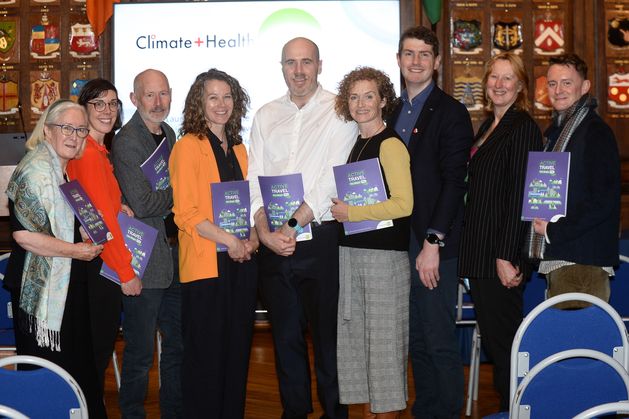
The Irish Climate and Health Alliance has launched its new report, Active Travel: The Magic Pill.
It’s a reference to the” single medication that could reduce the risk of heart disease, stroke, diabetes, and certain cancers – while also improving mental health, boosting sleep, and cutting carbon emissions.”
The Alliance, a broad coalition of professional health bodies, NGOs with a focus on health and climate, and academic institutions shares a common goal in advocating for urgent government action in addressing climate change and its direct impact on public health.
The “Magic Pill” report follows on the CHA position paper on sustainable diets, “Fixing Food Together”, launched in 2023. The new report provides evidence that sedentary lives and enforced car dependency have disastrous consequences for physical and mental health, for communities and environment.
It states that despite policies supporting active travel and success stories such as Safe Routes to School; Bus Connects, Connecting Ireland and a €350 m a year annual investment in active travel, 69% of all trips are still taken by car (even though almost 30% of trips are of 2 km or less,) only one in two hundred and fifty teenage girls cycle to school, one in four primary school children cannot run properly and only 46% of people over 15 have sufficient physical activity levels.
Meanwhile, cardiovascular disease, diabetes and respiratory illnesses exact a toll on individuals and on our health service. And 4 years into the “Vision Zero” Road Safety Strategy deaths and injuries of vulnerable road users continue to increase.
Joan Swift, Chairperson of Sligo Cycling Campaign, a local group of the Irish Cycling Campaign represented the Irish Cycling Campaign on the working group which produced the report.
Ms Swift said, “The report points out that telling people to move more, is not enough when the design of our towns, cities and transport infrastructure conspires against that.”
At the launch event, Dr Diarmuid O’Shea, President of the Royal College of Physicians referred to one simple barrier to mobility. the timing, of the green man at pedestrian crossings often means that pedestrians must scurry across in fear the traffic will start to move before they reach the opposite kerb.
Dr O’Shea also called on the providers of medical training to prepare doctors not just to treat disease but to understand and influence the broader societal determinants of health.
The report calls on healthcare professionals to lead by example in choosing sustainable mobility where possible, but it also calls on them to be leaders in advocating for safe sustainable transport.
Ms Swift said: “While primarily focussed on cycling, Sligo Cycling Campaign members support and use all modes of sustainable transport. We look forward to liaising with local health bodies such as Healthy Sligo, HSE Public Health, HSE Environmental Health, Sligo University Hospital, ATU Faculty of Science and Health the LCDC, the Regional Health Forum and Sligo County Council to discuss how best to progress the recommendations contained in this report at local level.”