
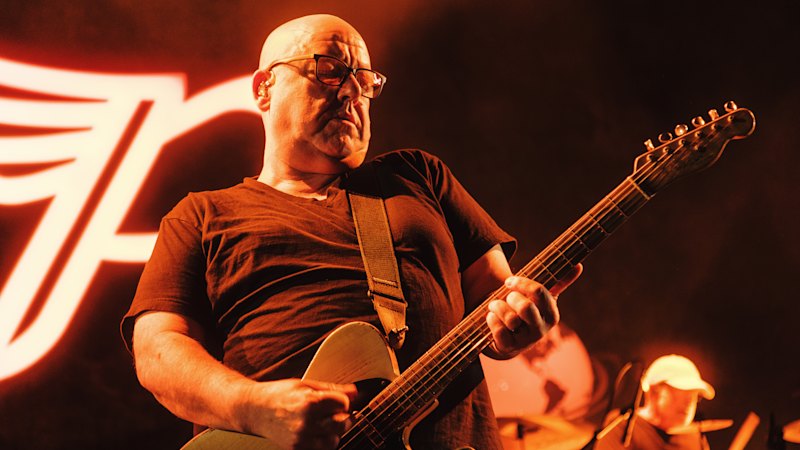
Santiago’s guitar work is as good as ever, searing, surfy, scintillating, and on Velouria, Allison, Is She Weird and Dig For Fire, the band sounds as good as they ever did.
The energy kicks up a notch when they trip into the Trompe set, with barely a pause to note the transition. This is a punkier set of songs, fast and furious, and the crowd becomes more energised as the set wears on.
Loading
The influence of Pixies, who recorded just four studio albums in their first wave of mutilation before breaking up in 1993 (and another five since reforming in 2004), has been well noted, with Nirvana and Weezer among the many to have paid homage. But on this night, with this set list, the backward lineage was apparent too: a cover of Jesus and Mary Chain’s Head On, the aforementioned Surftones track (and a general infusion of surf-guitar sounds throughout), and, in the final bracket of non-album tracks, Neil Young’s Winterlong.
It was a welcome reminder that although it sometimes felt like they’d arrived from nowhere – or, maybe, from outer space – the Pixies were indeed born of this world. They’re strange, jarring, at times unfathomable, but on this form they remain as vital as ever.
Reviewed by Karl Quinn
DANCE
Brigid ★★★
Dancehouse, until November 22
The room fills with haze while the dancers lie prone, hiding their faces. It’s an opening scene that recalls those old images of Celtic romance: an orange twilight glow, frothing vapours and ancient figures half-buried in the earth.
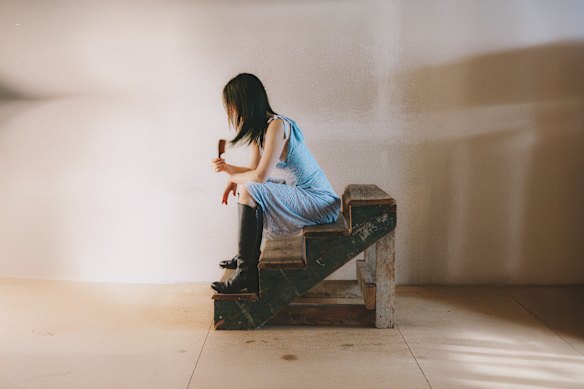
Brigid is an evocation of the pagan Irish goddess of the same nameCredit: Agustín Farías
Brigid, created by Alice Heyward and Oisín Monaghan, is an evocation of the pagan Irish goddess of the same name, one of the folk divinities of that legendary age before recorded history – the imagined time of the Tuatha Dé Danann.
We actually know very little about this daughter of the Dagda. Her story has been partly obscured by the later Saint Brigid of Kildare, the famous abbess and miracle-worker, the so-called Mary of the Gael who turned dirty bathwater into beer.
In looking back to the older Brigid, Heyward and Monaghan seem to take her obscurity as a cue. This is a work full of uncertainties and strange vacancies amid the rattling, racketing old-style jigging that fills the space.
Loading
The three performers – Heyward, Monaghan and Oonagh Slater – slowly raise themselves. You feel the heaviness of it, the work of dragging something old and earth-loving back into motion. They fall and fall again, landing with real weight.
The dancing arrives gradually. At first, they fall into step together: a fleeting suggestion, perhaps, of the goddess’s triple aspect. Then they separate, moving with apparent freedom across the long, windy gap between lights set at either end of the studio.
Monaghan’s boots slap the boards like antique flat irons. Or maybe hammers. Is this a vision of Brigid in her role as patroness of blacksmiths? The loud percussive steps follow closely the work of sound designer Gregor Kompar, who also performs live.
Heyward is lighter, almost airy, her rhythms more intimate, reminding us that Brigid brought fire and poetry. Her energy rises into something half-fevered, movement flickering and bright. Slater is more conversational, brisk but more regular.
There are several clearly marked sections, including a moment where the dancers retreat to the corners and wail. This is a nod to the story of her lament for her son, but it comes off as almost comic, suggesting mingled grief and joy.
Ritual is often a translation from the numinous to the legible; this work reverses the process, trying to conjure a lost divinity from choreography and remembered gestures. It’s an attempt, which, if nothing else, has its moments of peculiarity and beauty.
Reviewed by Andrew Fuhrmann
The Booklist is a weekly newsletter for book lovers from Jason Steger. Get it delivered every Friday.