
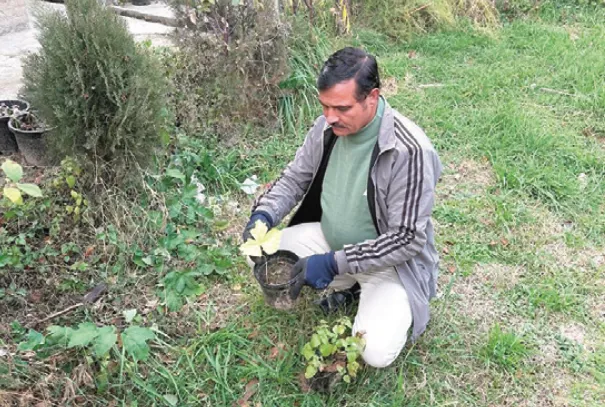
Achabal,( Anantnag), Nov 18: In the sprawling apple-lined fields of Achabal in south Kashmir’s Anantnag district, a retired teacher walks through a patch of land filled not with fruit trees but with rows of medicinal plants swaying in the autumn breeze.
Manzoor Javaid, 60 a recently retired environmental science lecturer who also worked as State Nodal Officer for the School Herbal Garden Scheme, has spent more than two decades transforming two Kanals of land into a thriving herbal garden that now hosts over 150 species.
“We have collected seeds from various regions, focusing on plants with proven medicinal value,” Javaid said as he brushed his hand over drying leaves. “Only a few species are active this season, but by spring the entire garden will be in full bloom and expanded further.”
Widely known as the “Herbal Man of Kashmir,” Javaid has built a collection that includes plants with anti-inflammatory, analgesic, antipyretic, antidepressant and anti-cancer potential. Among them is Taxus wallichiana, a rare Himalayan tree used globally for anti-cancer compounds. “This plant is globally recognized, and conserving it is crucial,” he said.
His garden also features Taraxacum officinale (dandelion), valued for liver health; Valeriana wallichiana, a natural sedative; and Bistorta affinis, traditionally used for bleeding and ulcerative colitis. Between the medicinal rows grow aromatic plants- lavender, rosemary, lemon balm, oregano and Elsholtzia ciliata, known locally as Eila Gassa.
Even exotic vegetables – Chinese cabbage, Swiss chard and wild garlic have taken root here. “I also prepare herbal teas from these plants and serve them to visitors,” Javaid said, pointing to a shaded corner where dried herbs hung in bunches. To take the work beyond cultivation, Javaid recently launched SJT Biotech Innovations Pvt. Ltd. “The company’s main mandate is conservation, value addition and developing herbal formulations,” he said. But commercial products will only follow scientific scrutiny. “We will first go for full-scale scientific validation and standardization,” he said. “Only after that will we prepare formulations for the market.” Javaid said the company is already in touch with major research institutes in Jammu and Kashmir and outside the region, and is preparing to sign memorandums of understanding (MOU).
To meet future demand, he plans to expand the garden by six more Kanals. He believes herbal cultivation could emerge as Jammu and Kashmir’s next major economic sector after fruit and tourism. “Farmers and youth can take this up as a career as growers, entrepreneurs or through value addition,” he said. “With the right support, herbal cultivation can reshape our rural economy.”
Students regularly visit the garden, turning it into an outdoor classroom for learning about Himalayan herbs. Javaid now advocates for introducing herbal science as a vocational course. “Just like tourism or automotive trades, we need herbal trades in schools,” he said. “It can even boost tourism . Imagine herbal tourism as a new attraction.”
Though many plants still await formal validation, Javaid continues documenting and expanding his collection. A longtime collaborator of the State Medicinal Plant Board, he treats the garden as both a repository and a lifelong mission. In a region known for its apples, his fragrant green patch stands out – not only for the rare species it preserves but for the possibilities it promises: a future where healing grows from the soil of Kashmir.