
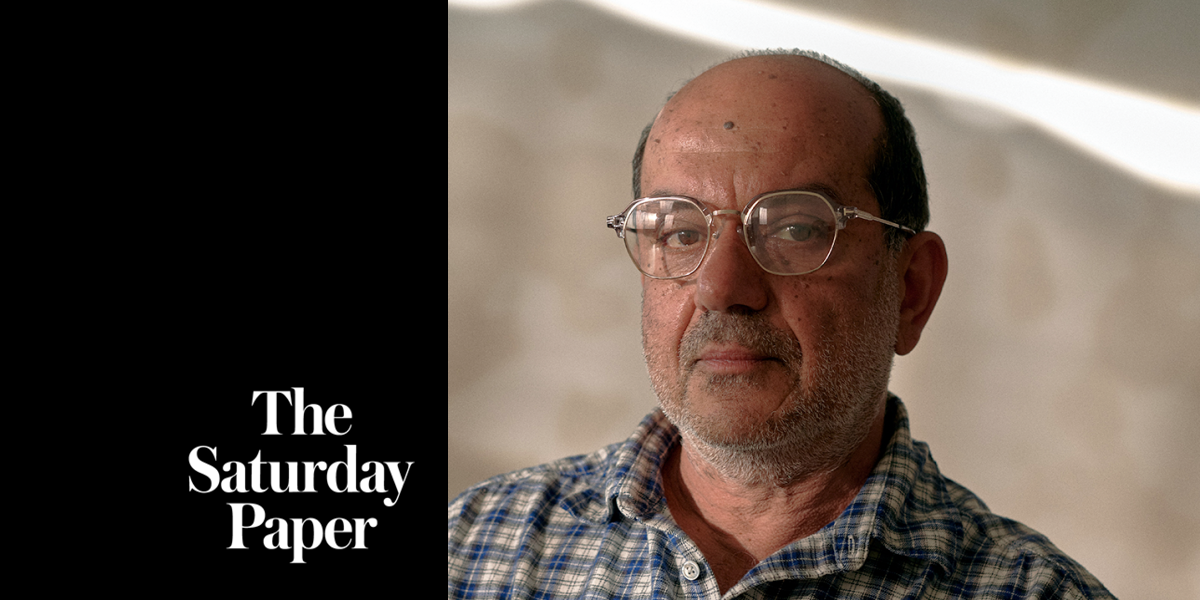
Hany Armanious creates confounding and enigmatic sculptural forms and artefacts. He brings into being mysterious works that unlock the energy, sensation and perversity embedded within inanimate objects, everyday things and the world around us.
Born in Ismailia, Egypt, in 1962, Armanious immigrated to Australia with his family at the age of six – a cultural and linguistic dislocation he has described as an overwhelming sensory experience. “I was not ready for the colour!” he explained in an interview last year. “Cairo is predominantly grey and dusty, and there’s not a lot of trees or greenery, so what was most striking was the bright green of so many trees, the really bright red of the terracotta roofs on the houses and just how bright the light was; it really was like stepping into another world. It was like being on drugs…”
This early experience of intense visual and cultural transformation and his enduring fascination with perception continue to animate Armanious’s exploration of the uncanny and sensory dimensions of everyday life. It reverberates in the unconventional course of his artistic trajectory. A central figure in the emerging “grunge” tendency of the early 1990s, Armanious was a key participant in now fabled exhibitions such as Rad Scunge and Monster Field, in the same year his work was included in the curated Aperto section of the 1993 Venice Biennale. In 1998, he received the prestigious Moët & Chandon Award for Untitled Snake Oil, an elegant, mercurial installation of hot-melt pigmented resin and glassware that evoked alchemical processes of material and formal transformation. A decade or so later, he would return to Venice as Australia’s representative in 2011, presenting meticulously cast sculptural objects – at once archaic and modern, formal and informal, concrete and uncanny – that reimagined everyday materials as relics of uncertain origin and function.
Now head of sculpture at Sydney’s National Art School, Armanious was the subject of a major survey inaugurating the refurbished Henry Moore Institute in Leeds, in 2024 – a critically acclaimed tour de force that has returned to Australia, opening this week in an expanded form at Buxton Contemporary, University of Melbourne.
Moore was a British modernist sculptor whose works circulated throughout the anglophone world in the 20th century as pervasively as modernism itself. “He was the only sculptor I was aware of as a teenager at school,” Armanious recalls. The invitation to reopen the Henry Moore Institute was auspicious – an occasion that might also be read as a return of the repressed, a colonial recasting returned to the source of empire – but also a potentially intimidating context – an artist who cautions that “sculpture is something I’ve never been consciously interested in” exhibiting at one of the world’s foremost centres for sculpture.
If classical sculpture invokes questions of form, volume, mass and materiality, Armanious extends these concerns into existential dimensions, both playful and philosophical. His sculptures are not content merely to occupy space: they think, and they invite us to think. They are sceptical and self-reflexive about their own making, their role as objects and their participation in systems of cultural value and belief. With both lightness and gravity, Armanious’s sculptures meditate on being itself: on the status of objects and, by implication, on human experience.
Armanious is known for his mastery of extraordinary processes of material transformation, turning commonplace objects into exalted artefacts that are at once haptic and symbolic, illusory and real. He has long exploited the fluid, inchoate properties of fugitive materials – hot-melt plastics, lead, clay, wax and peppercorns, and more recently resins and glass – to encourage aberrant and chance formations according to laws of nature and materiality, and endow his sculptures with an organic life of their own.
Since representing Australia in Venice, he has refined a complex range of experimental casting and assemblage techniques. These form the basis of Hany Armanious: Stone Soup, curated by Henry Moore Institute director Laurence Sillars in collaboration with Charlotte Day and Samantha Comte at Buxton Contemporary. Like a form of “three-dimensional printmaking”, Armanious’s casting of pigmented polyurethane resin has seen him go to almost absurd lengths to replicate everyday objects with impossible verisimilitude and luminosity – freezing time and matter while preserving a sense of ordinariness, humility and presence in the here and now.
Appearances, of course, can be deceiving. Functioning as paradoxical replicas or facsimiles, Armanious’s sculptures occupy a space between what they are and what they appear to be. A sculpture may read as a ready-made or an assemblage yet be entirely handmade – painstakingly, even obsessively, produced over time. A cast object might seem more “real” than its source, a riddle of material truth versus perceptual belief.
This oscillation keeps the viewer alert: sculpture becomes as much a cognitive experience as a physical one, drawing us into questions of seeing and believing. We cannot assume; we must investigate. This is one of the philosophical undercurrents running through Armanious’s practice: how do we know what we think we know – about an object, about the world, about ourselves?
While his practice is sculptural in form, his early training as a painter continues to shape his engagement with aesthetic and philosophical questions of appearance, illusion and reality. Flat Earth (2017), for instance, is a sculptural object that appears suspended like a painting turned to the wall: a muddy cake of cement pressed like a bog into the reverse side of a stretched canvas. Its constituent parts – canvas, stretcher and medium – are foundational to the very definition of painting.
The work recalls Gustave Courbet’s L’Origine du monde (The Origin of the World, 1866) – once deemed obscene and now held in the Musée d’Orsay – a painting that pushed realism to its limits and exposed the inherently erotic nature of representation itself. Flat Earth commands our attention as a primal, three-dimensional thing in the world, its material mysteries left for us to divine.
Functioning as paradoxical replicas or facsimiles, Armanious’s sculptures occupy a space between what they are and what they appear to be.
If Flat Earth dramatises the dynamics of the gaze, his Sneeze Paintings (2010) extend that inquiry by translating sensation itself into sculptural form. Cast in polyurethane resin rather than painted on canvas, these paradoxical objects capture the ephemerality and the momentary loss of control of a sneeze, giving form to in-between sensations of anticipation, tickle and release, and the quiet melancholy that follows its fleeting intensity.
While rooted in everyday forms, Armanious’s work maintains a playful dialogue with the sculptural canon: Brancusi’s essentialism, Duchamp’s ready-made, Picasso’s hybridity, Giacometti’s existential precariousness, Bourgeois’s teasing eroticism. Arte povera’s humble poetics meet the grandeur of ancient Egyptian ritual objects. These reference points surface as loose, informal riffs rather than solemn homages. They raise questions about perception, meaning and mortality: the condition of being alive, the nature of relationships and our entanglement with more-than-human others.
Armanious’s work also traces deeper lines of cultural inheritance and remembrance. In series such as his suites of Moths and Sphinxes, he revisits traditions of still life and assemblage as meditations on mortality and transformation in contemporary memento mori that blur the threshold between the animate and the inert. “Moths are guardians of the underworld,” the artist notes. “They’re strangely ugly and inscrutable, and incredibly energetic, with a weird anatomy.” It’s an observation that might equally describe the artist’s work itself.
In the artist’s hands, these nocturnal creatures are caught, frozen, statue-like, seemingly conscious of their symbolic role as custodians of mystery and agents of change. Likewise, the various Sphinx sculptures invoke both cultural ancestry and formal sculptural problems: hybrid figures poised between human and animal, body and base, Egypt and Australia. In both series, the impulse to collect, memorialise and reconfigure persists – not as nostalgia but as a vital dialogue with ancestry, belief and the sculptural language of life and afterlife.
A certain playfulness prevails as the artist moves effortlessly from an existential theatre of the absurd to contemporary slapstick, from alchemy to fetish, animism to voodoo. His sculptures oscillate between the sacred and the tragicomic, investing the banal with ritual charge and the ludic with metaphysical weight. In this delicate tension – between laughter and reverence, wonder and futility, object and illusion – Armanious locates a space of enchantment, where the everyday becomes strange again and the act of making turns towards mystery. His sculptures feel discovered rather than made: they embody cultural memory, with time running through them like sand.
In the gallery, Armanious’s installations unfold as intricate mises en scène in which sculptural objects, images and surfaces conspire to transform the space into a field of perceptual play. Sculptures rest directly on the floor or lean against the walls, in most cases without plinths. The works become continuous with the space of the viewer, reasserting sculpture’s relationship to the body and to everyday life. The scenography extends across the walls, where printed trompe l’oeil images of stains, peeling plaster and screw holes implicate the architecture itself in the unfolding drama of the work. The gallery becomes both stage and subject, destabilising our sense of what is real and what is illusory while prompting a more attentive mode of looking. The effect is at once disorienting and playful, a gentle unmooring that opens new perceptual experience and possibility.
An additional, more meditative register emerges through works such as Water Lilies (2018), a monumental pigment print on linen spanning six metres, that depicts a studio wall repeatedly painted over to form a palimpsest of erasure and accumulation. Washed in soft lilacs, purples and pinks, it radiates a haze that shimmers like light across water – a panoramic fetishisation of the ordinary, doubling the familiar textures of the spaces we inhabit yet rarely notice.
As American curator Anne Ellegood has written, Armanious honours “the primordial urge to attempt to understand the mysteries of the world through the making of objects”. His art invites the same impulse in the viewer, so that close looking becomes an act of attention with ethical weight, an insistence that what surrounds us, however humble, deserves scrutiny, curiosity and care. In a culture of speed, surface attention and algorithmic artifice, Armanious slows perception down. He makes objects that resist quick consumption and reward sustained reflection.
Titles such as Plato’s Cave, We Astrologers and Empathy Chart operate as philosophical prompts, provoking speculation and contradiction – belief versus knowledge, illusion versus enlightenment – and remind us of the inevitable incompleteness of understanding. Like the riddle of the sphinx, Armanious’s conundrums are not meant to be solved but to be lived with. He stands as an existential sculptor of the everyday, memorialising its absurdities while insisting they be taken seriously.
Technically dexterous, materially experimental and intellectually agile, Armanious’s work remains deliberately elusive. Even at its most demanding it retains a deceptive informality, as if the artist has casually nudged things into being. Small gestures assume epic scope: ordinary objects are recast with new aura, charged with esoteric meaning and elevated into quiet monumentality. Nothing is overdetermined and surprise remains possible. “My work gives equal value to everything,” Armanious says, which is also to say that everything deserves to be looked at and nothing should be taken for granted.
This article was first published in the print edition of The Saturday Paper on
November 22, 2025 as “Ordinary mysteries”.
For almost a decade, The Saturday Paper has published Australia’s leading writers and thinkers.
We have pursued stories that are ignored elsewhere, covering them with sensitivity and depth.
We have done this on refugee policy, on government integrity, on robo-debt, on aged care,
on climate change, on the pandemic.
All our journalism is fiercely independent. It relies on the support of readers.
By subscribing to The Saturday Paper, you are ensuring that we can continue to produce essential,
issue-defining coverage, to dig out stories that take time, to doggedly hold to account
politicians and the political class.
There are very few titles that have the freedom and the space to produce journalism like this.
In a country with a concentration of media ownership unlike anything else in the world,
it is vitally important. Your subscription helps make it possible.
Send this article to a friend for free.
Share this subscriber exclusive article with a friend or family member using share credits.

Used 1 of … credits
use share credits to share this article with friend or family.
You’ve shared all of your credits for this month. They will refresh on December 1. If you would like to share more, you can buy a gift subscription for a friend.
SHARE WITH A FRIEND
? CREDITS REMAIN
SHARE WITH A SUBSCRIBER
UNLIMITED
Loading…