
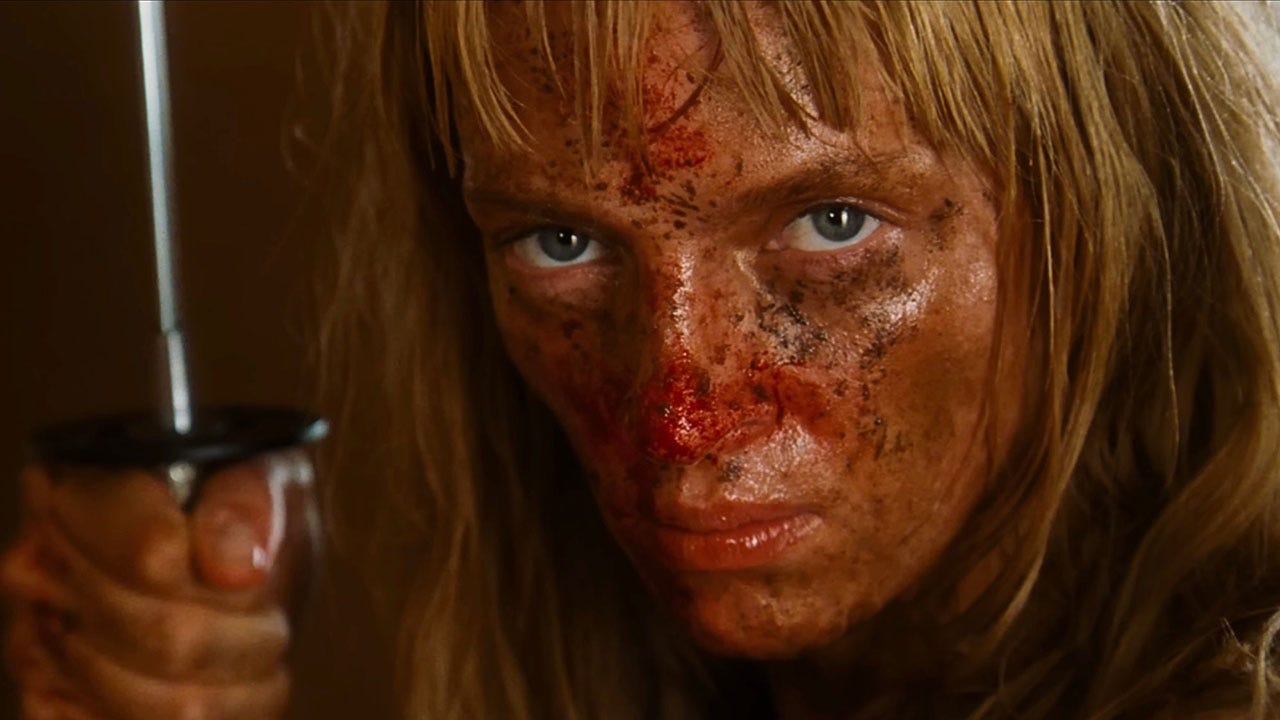
This article contains spoilers for the entire Kill Bill saga in all its variations.
Kill Bill: Vol.1 (2003) and Kill Bill: Vol. 2 (2004) are modern action classics. Writer/director Quentin Tarantino originally conceived the two films as a single 10-chapter epic, but executive producer Harvey Weinstein suggested splitting Kill Bill in half to make it more marketable, and Tarantino complied, rationalizing that a 4-hour-plus pulp epic might be too “pretentious.” To many Tarantino fans and film nerds, however, this concession was a missed opportunity at greatness. For over two decades, the original, unedited Kill Bill has never seen a wide, mainstream release for a general audience… until now.
Ranking the Movies of Quentin Tarantino
On December 5, 2025, Kill Bill: The Whole Bloody Affair will debut in theaters. It restores the Kill Bill project to a single uncut film as Tarantino originally intended, and it adds about seven and a half minutes of never-before-seen animated footage. Tarantino hasn’t officially announced what this new footage is, but based on trailers and past interviews with Tarantino, we think we know.
Here is everything we know about Kill Bill: The Whole Bloody Affair, including the newly extended running time, the unseen anime sequence, and the extra scenes and edits that you’re also likely to see.
Why You Need to See Kill Bill: The Whole Bloody Affair in Theaters

Watching the two volumes sequentially will not have the same emotional effect, because when Tarantino separated Kill Bill into two volumes, he recut and filmed additional footage and audio as a workaround so that the two halves could stand alone.
The Whole Bloody Affair rolls back those eleventh-hour changes. It repurposes scenes, reorders them, or deletes them entirely to create a more coherent narrative, and it adds details – new scenes, extended scenes, alternate takes, and uncensored bits of violence – to the overarching events of the story. So while it’s still the Kill Bill you know and love, the film will hit harder and build to its climax better than you remembered.
The History of the Whole Bloody Affair
Although this is the first time that TWBA is receiving a wide release, Tarantino has occasionally screened an earlier version of the combined edit for a limited audience. He first debuted TWBA at Cannes in 2006, screened that Cannes print at the New Beverly Cinema in LA (which he owns) in March-April 2011, and on other occasions since then. In the summer of 2025, he screened the Cannes print, complete with French subtitles, at the Vista Theater in LA (which he also owns).
Positive reviews and reactions from those screenings have circulated online for years, so we know most of the changes that we’ll be seeing this December.
Big Changes

Plotwise, two TWBA changes have a heavy impact on the story. The first change is that in the Cannes cut, the audience doesn’t learn the Big Twist – that The Bride’s daughter is still alive – until the very end of the movie. We find out at the same time the Bride finds out. When Tarantino split the films in 2003, Tarantino moved this twist to the end of Vol. 1 so that the first film would have a cliffhanger leading into Vol. 2. By restoring the twist to the very end of TWBA, Tarantino creates a more shocking, emotionally impactful payoff.
As for the second change: Remember the head-on car footage that opened Vol. 2, where the Bride is monologuing directly at the camera in black and white? In the Cannes print, that sequence is missing entirely; Chapter 5 ends, there’s an intermission, and Chapter 6 picks up immediately afterward. This makes sense because Kill Bill is no longer two separate films, and thus, the black-and-white recap is no longer necessary.
Interestingly, the most recent TWBA trailer contains a clip of this car scene, which implies that it’s still the movie. In the original screenplay, Tarantino planned this sequence for the beginning of the film, after the Bride’s shooting and before the title sequence. Could Tarantino have moved this scene to the beginning of TWBA instead of cutting it completely? I guess we’ll see.
More Gore

The most prominent change that Americans will notice in TWBA is that the House of Blue Leaves fight sequence, which was once in black and white, is now in color. So in TWBA, you’ll see The Bride slicing through the Crazy 88 in all its gory red glory, the way Japanese audiences originally watched it.
The reason why Tarantino made this sequence black and white in America was to better appeal to American audiences. It’s a common misconception that Tarantino changed the sequence to dodge the MPAA’s NC-17 rating; instead, he did it as a preemptive move in response to American sensitivities, because he felt the American press would focus on the red blood to the exclusion of everything else, whereas audiences abroad would not.
Everything Else We Know
The following changes were apparent in the Cannes cut, and they will likely carry over to the final TWBA cut in December 2025. This is an incomplete list of the major differences; it doesn’t account for all the changes that are likely on the way, given the extended running time of the new cut (more on that later):
The opening black title screen with the ‘Klingon proverb,’ “Revenge is a dish best served cold,” has been replaced with a dedication to Japanese director Kinji Fukasaku (Battle Royale).The O-Ren anime sequence is more graphic and shows more of Boss Matsumoto’s disembowelment.The House of Blue Leaves sequence contains some alternate takes that show more dismemberment and graphic moves, including a finger throat punch. You’ll also see additional footage of the young Yakuza boy losing his mask, which sets up the spanking at the end of the sequence.Sofie Fatale loses both her arms on-screen, whereas the second dismemberment is only implied in the original Vol. 1 cut.The Unseen Anime Sequence

Here’s the part that Tarantino devotees are waiting for. Distributor Lionsgate announced that TWBA will include a seven-and-a-half-minute anime sequence that’s never been seen before; the Cannes cut, which up until now has been the definitive version of Kill Bill, did not include this new sequence either. So we’ll all be seeing it for the first time on December 5.
There’s lots of online speculation as to what this sequence could be, but based on prior interviews, we pretty much know. In fact, Tarantino himself alluded to it at San Diego Comic-Con in 2014, discussing his creative partnership with Production I.G. (the Japanese anime studio that did the original O-Ren sequence):
“Originally back when Kill Bill was going to be one movie, I wrote an even longer anime sequence. In the movie, you see [O-Ren] kill Boss Matsumoto. But then there was that long-haired guy? The big, big, big sequence was her fighting that guy.”

That guy, known to fans as Pretty Riki, was speculated by some people to be Bill back in 2003; this confirms, officially, that Pretty Riki and Bill are different people. As for the sequence itself, Production I.G. never made it for Vol.1 because it couldn’t deliver the animation on such a tight schedule. But over a decade later, the animators changed their minds:
“Later, when Production I.G. heard that we were talking about doing Kill Bill: The Whole Bloody Affair? They still had the script. So without even being commissioned to do it, they just did it. They just did it and they go, “We’re just going to do it and we’ll pay for it ourselves, and it’s going to be so great that you’re going to have to use it.”
In the trailer, we see a shot of Pretty Riki bleeding in an elevator and one of a young O-Ren dropping a grenade, so it’s safe to say that the new seven-and-a-half-minute anime footage is probably that sequence. During the same Comic-Con interview, Tarantino said we’d see the sequence in 2015, but that never happened. Better late than never!
The Whole Bloody Runtime

The Cannes cut clocked in at 248 minutes (4 hours, 8 minutes). Kill Bill: The Whole Bloody Affair weighs in at a whopping 281 minutes (4 hours and 41 minutes), which includes a 10-15 minute intermission. Something isn’t adding up if you do the math, which is great news.
We’re not sure if the Cannes cut running time includes the intermission, but let’s say for argument’s sake that it does; that means the new TWBA is 33 minutes longer. If you subtract that seven-and-a-half-minute anime sequence, we’re left with 25 and a half minutes unaccounted for. Is there a completely new and as-yet unannounced scene or chapter?
If the Cannes cut running time doesn’t include the intermission (the most likely explanation), then its running time would be 263 minutes (4 hours, 23 minutes), making TWBA 18 minutes longer. Take out the anime sequence and we’re left with 10 and a half minutes.
Intriguing, isn’t it? What else does the new TWBA cut contain to account for the discrepancy in the running time? We’ll all know for sure on December 5 when Kill Bill: The Whole Bloody Affair hits theaters. And definitely see it in theaters! Tarantino is on record numerous times as saying that he wants to keep TWBA a cinematic experience. Since he now owns the movie outright, this is not an “I’ll catch it on streaming some other time” kind of deal; there’s a good chance you’ll have to wait a while before you can see it (in theaters) again!