
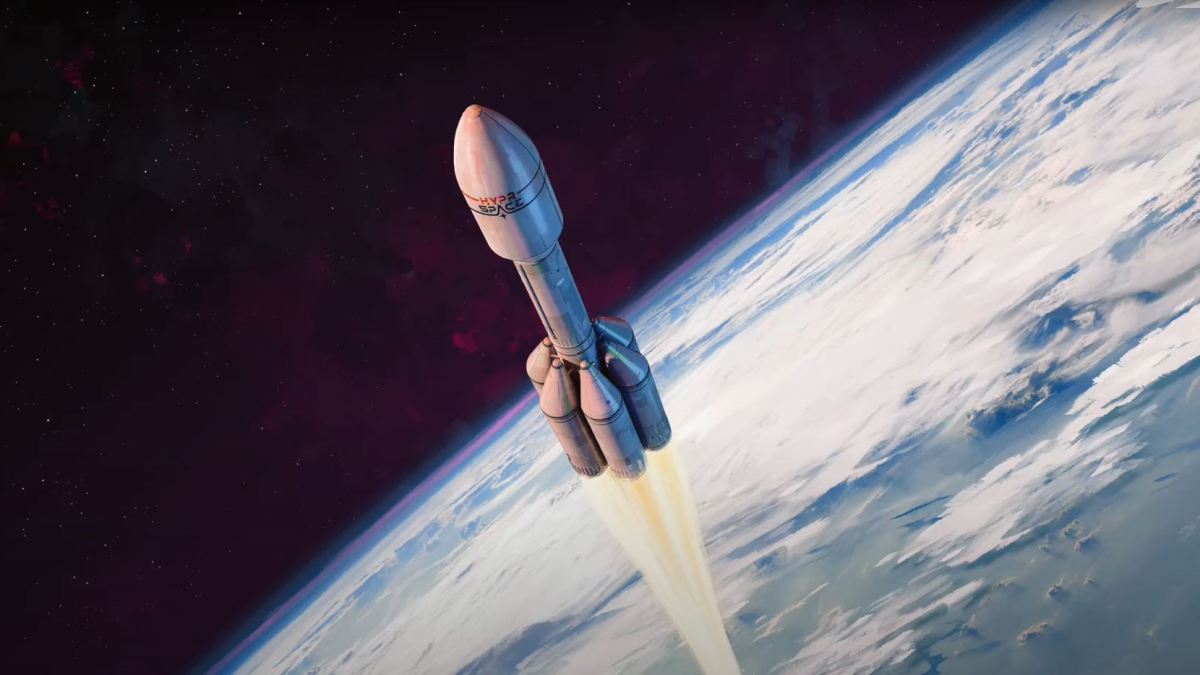
Ever since October 1958, when Wernher von Braun suggested renaming the Juno V rocket the Saturn, Nasa has excelled at naming things. They have sent an Apollo, Orion and Titan all hurtling into the heavens.
Some names have their foundations in mythology and astrology, some in legend and folklore. Others are more straightforward, a simple description of the mission — see the Space Shuttle and the International Space Station.
However, it did not take a rocket scientist to guess that the French would do things differently in the space race. Blasting off at some point next year, joining SpaceX’s Falcon and Starship, China’s Long March and Britain’s Orbex rocket, will be the effort backed by President Macron: Baguette One.
The small reusable launcher is being developed by HyPrSpace, a start-up based in the Bordeaux area in the southwest promising a cheap, environmentally friendly satellite transportation service.
Baguette One is a suborbital launcher powered by what the firm describes as “revolutionary hybrid propulsion technology” and due for a test take-off from a French military base. The aim is to follow up with Orbital Baguette One (or OB-1, in homage to the Star Wars character Obi-Wan Kenobi), HyPrSpace’s microlauncher.
This is planned to carry a load of up to 250kg into orbit. Sylvain Bataillard, the co-founder, said the names had been chosen because the company wanted to be “serious but not sinister”.
Television presenters struggled to keep a straight face when they discussed the project on TF1, the country’s biggest channel, this week — illustrating the report with an AI-generated image of a baguette on a launchpad. But it is being taken seriously by Macron’s government.
The president is determined to ensure that France retains a foothold in space, and the company has received €35 million in subsidies. It is one of four space start-ups chosen to share a further €400 million if initial tests prove successful.

The market for commercial satellite launches is dominated by Elon Musk’s SpaceX
MIGUEL RODRIGUEZ CARRILLO/GETTY IMAGES
The defence ministry is also lending a hand, with bases in southwest France and Provence made available for the first test. It will be the first rocket launch in metropolitan France, the others all having lifted off from the European spaceport in French Guiana.
The Novaspace consultancy has predicted 26,104 satellites will be launched by 2032, and HyPrSpace is among dozens of businesses around the world trying to penetrate the market. Despite boasting the world’s first commercial launch service provider in the form of France’s ArianeGroup and a long history of lift-offs from the Guianese spaceport, Europe is lagging well behind.
SpaceX accounted for more than half of all satellite launches last year, while Europe managed fewer than either India or China.
Isar Aerospace, a German start-up, tested Spectrum, the first rocket to be launched from western Europe, in March but it crashed after 30 seconds. ArianeGroup is hoping to do better with a microlauncher developed by the start-up it created, MaiaSpace. As for Orbital Baguette One, it is touted by Bataillard as a “taxi” for satellites.

The Spectrum rocket from the German firm Isar Aerospace crashed 30 seconds after its launch in March
ISAR AEROSPACE/PHOTO WINGMEN MEDIA/ AP

ISAR AEROSPACE/PHOTO WINGMEN MEDIA/AP
He said most microlaunchers charged about €40,000 per kg to take satellites into orbit but that his would cost half that. Heavy lift rockets were cheaper still, but clients were unable to choose the lift-off date, he said. With microlaunchers, they can.
Baguette One, conceived by “space bakers”, according to the company’s website, relies upon liquid and solid propellants, some of which can be made from recycled plastic. The engine is pressurised by helium and the combustion chamber has no turbo-pump, unlike most rockets. The company says this enables costs to be reduced.