
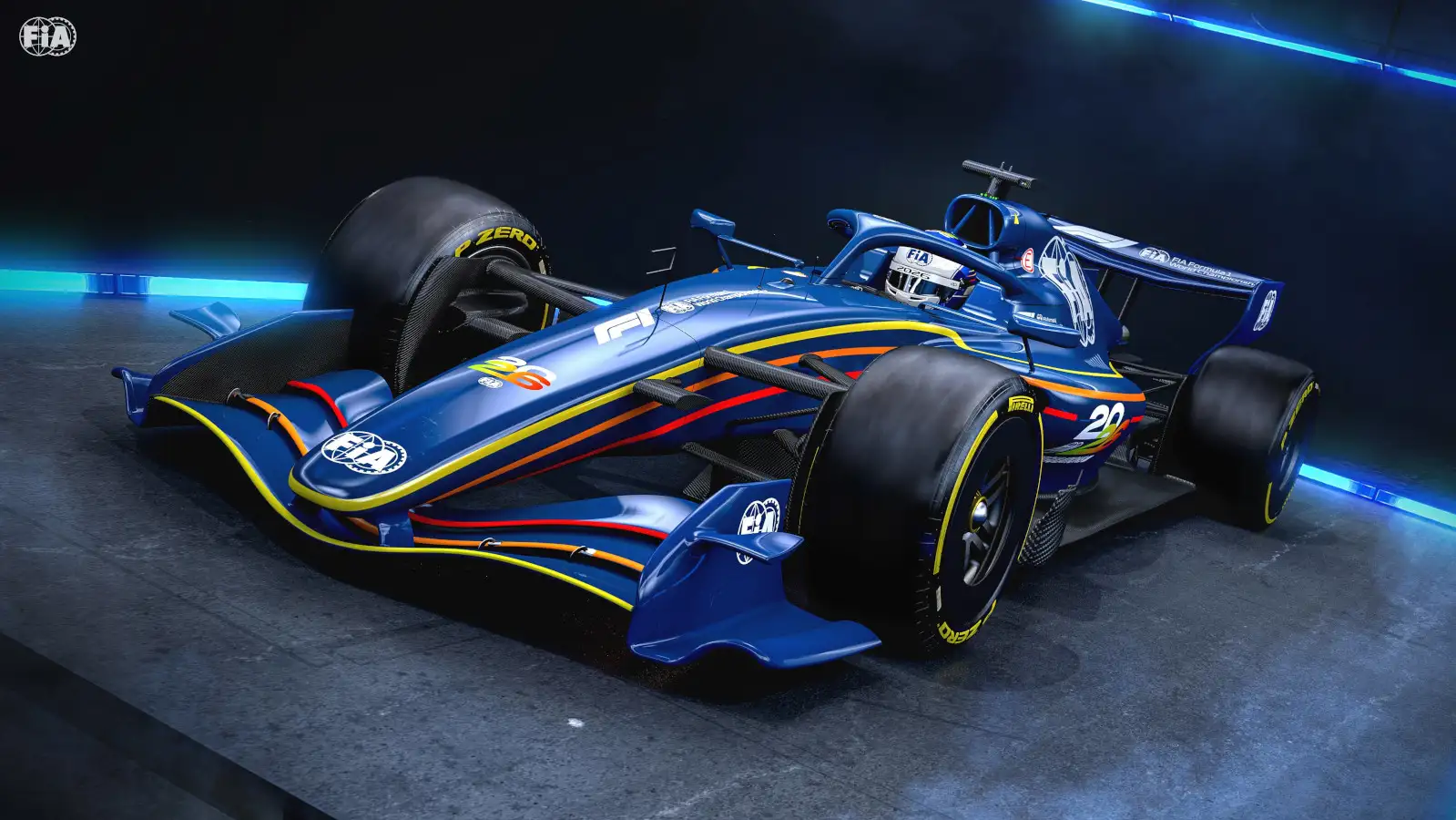
Any concerns that F1 will be significantly slower under the new regulations have been firmly shut down by the FIA’s Nikolas Tombazis.
F1 moves to vastly different power unit and chassis regulations next year, which have triggered unfounded fears of cars being much slower once they hit the track.
Nikolas Tombazis shuts down slowdown fears
It’s just two months until the long-awaited regulations overhaul becomes reality, with the first test of the F1 2026 cars scheduled in Barcelona in late January.
A new-generation hybrid power unit will see F1 increase its electrical power output to a near 50/50 split with the internal combustion engine.
The expected characteristics for these power units mean cars should barrel out of corners, with energy management systems ensuring a natural delivery of power down the straights to prevent the much-feared phenomena of drivers needing to back off or brake down the straights in order to regenerate electrical energy.
On the aero front, cars will utilise active aerodynamics with innovative ‘X-Mode’ and ‘Y-Mode’ configurations designed to maximise downforce through the corners, while balancing that out with reducing drag down the straights.
It’s a complex formula and not every driver has spoken favourably about the driving experience after their first forays in their team simulators, although it must be pointed out that such simulators have been constantly evolving as more and more information is learned and disseminated.
On Wednesday, Isack Hadjar suggested that the performance of the 2026 model in the sim is closer to F2 than the current F1 cars, with the feeder series cars over 10 seconds a lap slower at most venues than their F1 contemporaries.
But Nikolas Tombazis, the FIA’s single-seater director, has poured cold water on the suggestion of next year’s F1 cars being significantly slower than the current generation.
“I think comments about Formula 2 pace are way off the mark,” he said in the FIA press conference in Las Vegas on Thursday.
“We are talking about lap times, overall, which are in the region of one or two seconds off where we are now, depending on the track, depending on the conditions.”
Tombazis explained that, given teams’ natural development in finding more performance through a rules cycle, it makes sense that next year’s cars will be somewhat slower than at present.
“Obviously, at the start of a cycle, it would be silly to be faster than the previous cycle,” he said.
“It would cost us nothing from a regulations point of view, it would be very easy to make the cars go faster. But one has to gradually claw back what is gained by natural development.
“So you can’t start the cycle going faster than the previous one. Then, you know, in 20 years from now, you can imagine what would happen..!
“So I think it’s natural that the cars are a bit slower, but I don’t think we are anywhere near the ‘it’s not a Formula 1’ discussion in any way or shape.”
Speaking in a recent interview with PlanetF1.com, Tombazis spoke about the same topic, saying that negativity from drivers could be down to them stepping out of cars at the limit of the current regulations, into a simulated version of an early iteration of new regulations.
“It is natural that, if a driver gets out of one car and goes into a slightly slower car, he’s not going to say, ‘Wow, I’m really happy here’, in terms of comparison,” he said.
“While we’re getting closer to the season, running on the simulator with the cars close to the performance that they could have is quite recent. This process of refining the regulations is something that is still ongoing.
“So, the drivers sometimes have driven a particular condition, identified an issue in a particular way, which has now been resolved. So I think, on that basis, their comments are right in terms of factually right, but probably a bit premature, because you don’t take into consideration the final product.”
More on the F1 2026 regulations
👉 Explained: The 2026 engine regulations set to seriously shake up Formula 1
👉 F1 2026: Confirmed teams and power unit suppliers for F1’s huge regulation changes
Red Bull’s chief engineer, Paul Monaghan, was alongside Tombazis in the FIA press conference, and he explained that performance levels are likely to differ depending on the characteristics of any given circuit.
“We have what we might term energy-rich circuits and energy-poor circuits,” he said.
“So it’s easier to fill the energy store on some tracks. And then the lap time is a little bit slower.
“Some of the poorer ones, we’re struggling a little bit at the moment — we’re a bit more than that off.
“But one of the great difficulties at the moment is trying to actually establish how much grip we’re going to have. We can have an aero map, and it says we’ll make this level of downforce — is it actually reality?
“Once we have the final tyres from Pirelli, maybe they’re a little bit better, a little bit worse. And it has quite a knock-on effect on your overall lap time. So, yes, they’ll be a little bit slower. I don’t think we’ll be Formula 2-paced. I hope not. So that’s where we would be. ”
What is acknowledged by all is that the F1 2026 regulations are going to be more complex for the teams in terms of understanding optimisation, and drivers in adjusting their styles to match, as well as the cognitive demands of a more involved process behind the wheel.
Aston Martin’s sporting director, Andy Stevenson, has said he would expect the cars to be a little slower, but there’s palpable excitement about getting started with the new regulations and starting to hone their performance.
“I think they’re going to be really interesting,” he said.
“There’s a lot of work for us all to do, and there’s a lot for us to learn, which is why these pre-season tests are so important, because we’ve started work on simulations and things, but there’s nothing like getting to the track and actually making it work.
“So it’s going to be very busy. I think it’s one of those things that we’re going to get used to very, very quickly.
“We’re talking about the cars maybe being a bit slower than they are now, but what we mustn’t forget is what we’re introducing. We’re introducing a new form of hybrid, which is really exciting, and we’re powering the combustion part of that power unit with sustainable fuels.
“I mean, it’s fantastic news. So I think we should be celebrating that and looking forward to what we can bring and how much faster we can make the cars once we get used to them.”
Read Next: F1 2026 aero mastermind set for surprise team return after FIA departure