
November 19, 2025: Preliminary Necropsy Results
Veterinarians and other experts conduct a necropsy on the stranded humpback whale near Yachats, Oregon. Credit: Oregon State University Marine Mammal Institute/Craig Hayslip
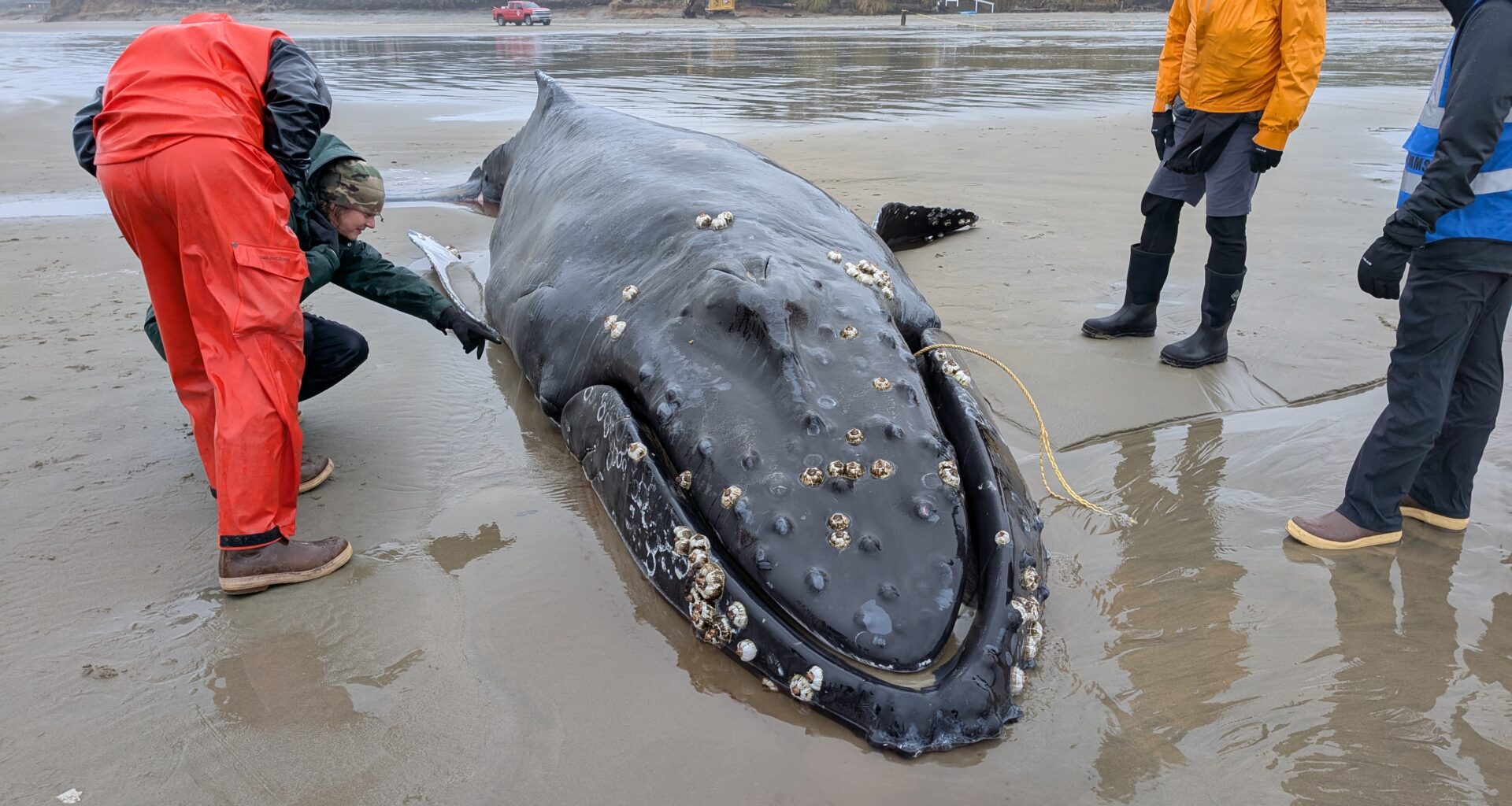
A large team from multiple organizations convened on Tuesday, November 18 to conduct a necropsy on the young humpback whale that stranded over the weekend.
The necropsy revealed the whale to be a male measuring 26 feet. The team collected many samples, which will undergo analysis at the Oregon State University Veterinary Diagnostic Lab. They noted some lesions. The whale had no stomach contents, and was in fair body condition at the time of necropsy.
The team is grateful to a local contractor that provided lighting and a small excavator. They are also thankful to the local community and bystanders for understanding the logistical and complex challenges that come with large whales onshore.
Oregon State University will release more details of the necropsy and the sample analysis as they become available.
On November 17, veterinarians from the West Coast Marine Mammal Stranding Network euthanized a young humpback whale stranded north of Yachats, Oregon, after an unsuccessful attempt to free it. The whale was entangled in gear when it first stranded on November 15. NOAA Fisheries attributed the gear to the 2023–2024 Oregon commercial Dungeness crab fishery.
Trained teams from the West Coast Marine Mammal Stranding Network responded from Washington, Oregon and California to help a young humpback whale stranded on the Oregon Coast. They employed an innovative method using block and tackle in an urgent effort to free the whale, but were ultimately unable to return the animal to the water. Credit: Oregon State University/Leigh Torres
Teams of trained responders from Portland and Seattle arrived November 16 and assessed the overall condition of the whale. They set up a rope and pulley system to try to free it from the beach at high tide the following morning. However, the attempt was unsuccessful.
While the whale remained alive, experts determined that euthanasia was the most humane option for this case. The prolonged period of time onshore had left the whale weak and unlikely to survive. Veterinarians euthanized the whale late afternoon on November 17. Responders will conduct a necropsy to assess the animal’s overall health and help determine why it stranded.
Why Attempts to Return Large Whales to the Ocean May Be Unsuccessful
A whale’s body is adapted to the buoyancy of water. Its own body weight causes immense pressure once it is stranded, which can lead to respiratory and circulatory collapse. Refloating stranded large whales is challenging, and there are limited options. Simply pulling a large whale back into the ocean is considered inhumane—it can dislocate the tail, cause paralysis, or even break the spinal cord. The rope and pulley system the Network members attempted is still difficult and not always successful. Another option, dredging a channel for a whale, has historically resulted in the whale drowning.
How to Help a Stranded Marine Mammal
Many people want to help stranded animals, but only trained responders should approach them. Even if a stranded animal is injured, attempting to touch or move them can be dangerous for you and the animal. We appreciate the many concerned onlookers who remained a safe distance from the whale, giving response teams room to work.
Responders conduct necropsies and collect samples to better understand the cause of death, which contributes to scientific research and future conservation efforts. Each stranding provides valuable data about the health of whale populations and the threats they face. To report a stranded or injured marine mammal, call (866) 767-6114.
We thank our partners in this effort:
Pacific Marine Mammal CenterSeaLife Response, Rehabilitation, & ResearchCascadia Research CollectiveOregon State ParksOregon State Fish and Wildlife DepartmentOregon Coast AquariumOregon State PoliceOregon State University’s Marine Mammal Institute