
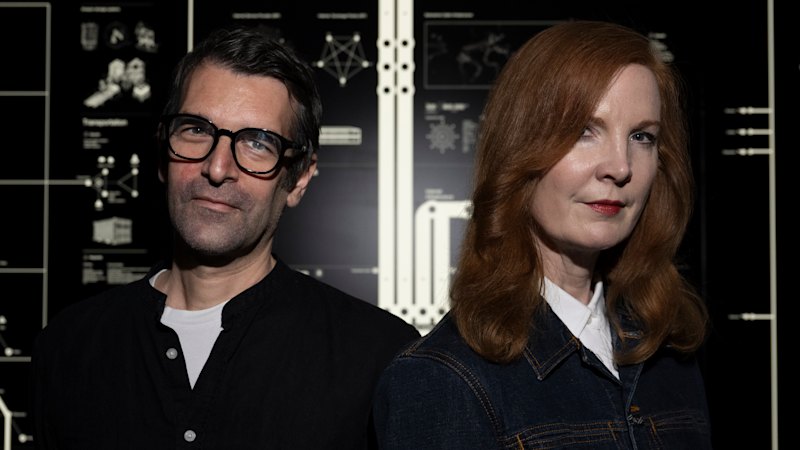
That work was to consume two years of tracking down patents, trying to understand how and where data is stored, how much energy that consumes and much more.
“I spent time in mines, going into Amazon fulfilment factories, going into all of the places where AI is getting built, seeing semiconductor manufacturing and going into all of these components in the supply chain,” says Crawford.
Crawford and Joler’s intensive, painstaking work, aims to start an informed conversation about artificial intelligence, which is rolling out at such a breakneck pace that it can appear a fait accompli.
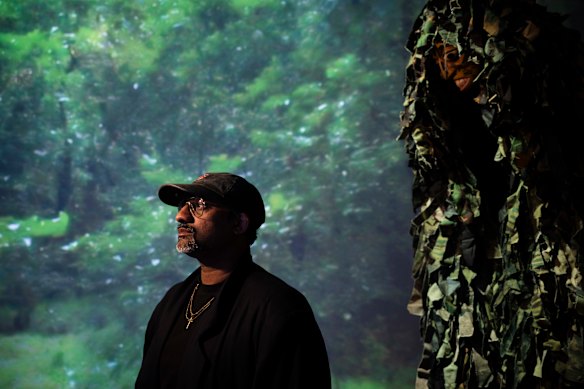
Christopher Kulendran Thomas with his work The Finesse. Credit: Janie Barrett
“[There needs to be] a democratic conversation for people to have some agency in the big decisions that are happening both at an infrastructural level, such as thinking about the data centres and the amount of energy and water being used, all the way through to the cognitive layer, like our education, which is being radically transformed,” says Crawford.
“Creative industries are also being radically transformed. Is that what we wanted? Is that something that you asked for? Did you ask to have AI writing your songs and painting your pictures rather than [just] doing your laundry and paying your taxes? There’s a set of questions around how we as a society play a bigger role in understanding and participating, because otherwise AI is going to be something that is done to us. Rather than something that we participate in.”
Crawford and Joler’s work is part of Data Dreams: Art and AI, a show opening at the Museum of Contemporary Art this weekend.
It joins eight other works, each with a different take on what artificial intelligence might mean. They include The Finesse, an intriguing immersive video installation from Christopher Kulendran Thomas, a British-born artist of Tamil descent.
Growing up in London in the 1980s after his family moved there to escape the civil war in Sri Lanka, Thomas heard only fragments from his parents about the Tamil Tigers’ liberation movement.
“I’ve since come to find that history incredibly interesting,” he says. “This work is a way for me to sort of hallucinate the missing links in what I heard growing up and to fill in some of those gaps.”
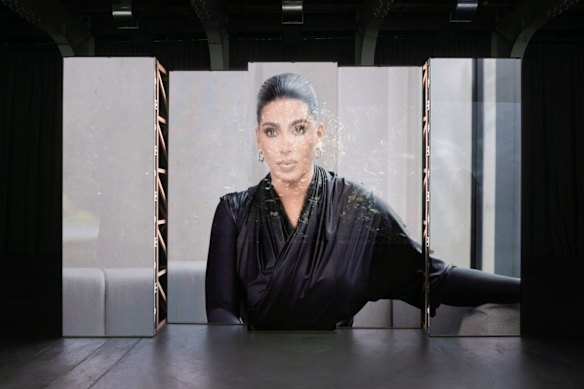
Sections of The Finesse are narrated by ‘an avatar bearing a striking resemblance to a well-known media personality’. Credit:
In part, the work employs artificial intelligence to imagine a universe in which the Tamil Tigers won their struggle.
“These alternate realities are like sci-fi in that they are a way of glimpsing this kind of other possible worlds,” says Thomas.
Loading
Sections of the work are “auto-edited” by AI algorithms based on footage scraped live off social media and narrated by an image of Kim Kardashian, or, as Thomas refers to it, “an avatar bearing a striking resemblance to a well-known media personality”.
“I never know what she’s going to say but usually the most interesting or insightful things in the work are nothing that I’ve written but it’s stuff being generated fresh every time.
“There are all kinds of ambiguities about what you’re looking at, which is part of the fun of watching it.”
Data Dreams: Art and AI is at the MCA until April 27.
In need of some good news? The Greater Good newsletter delivers stories to your inbox to brighten your outlook. Sign up here.