
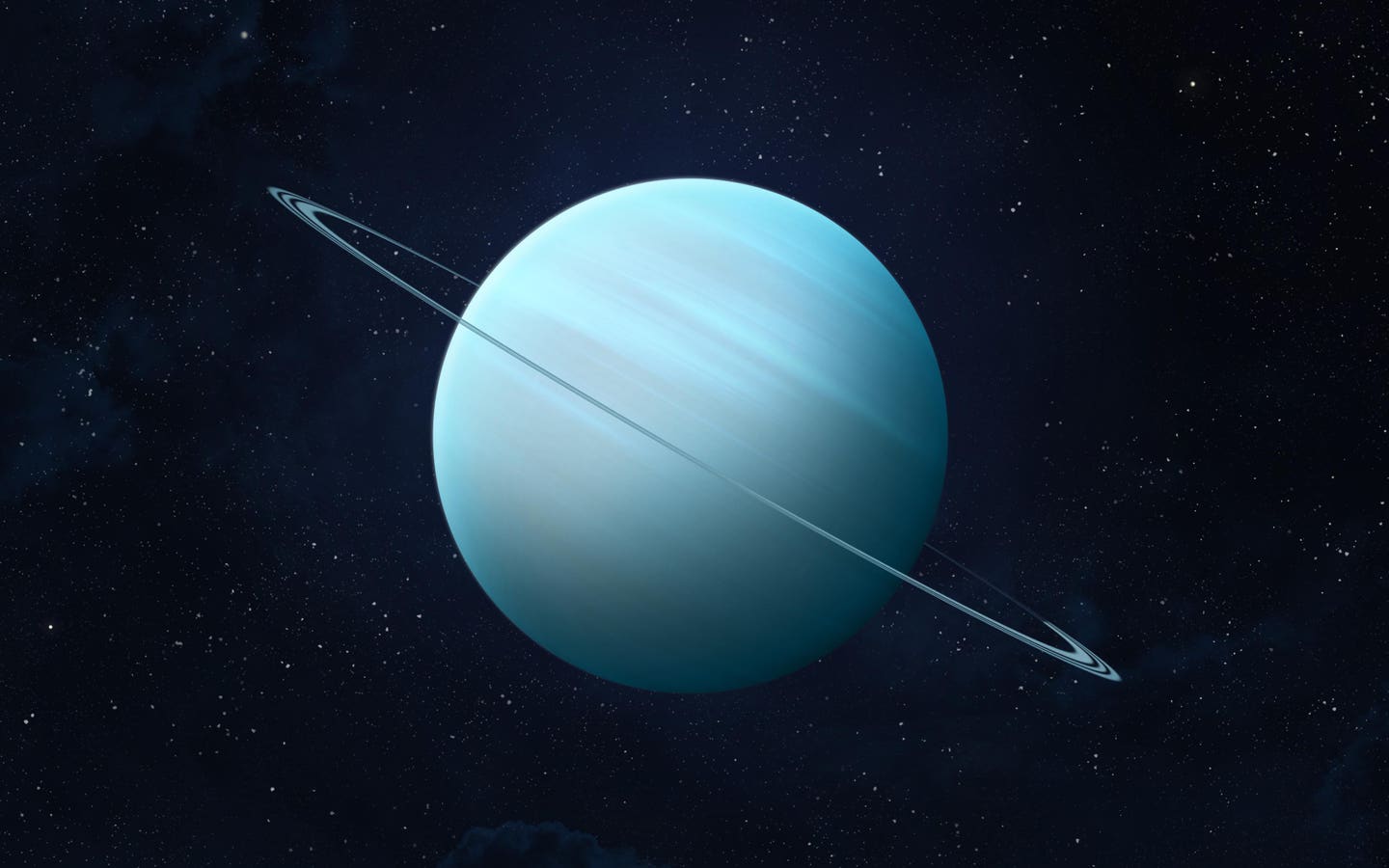
With Earth directly between Uranus and the Sun, the seventh planet has reached opposition, making it visible all night long.
getty
It’s the third-largest planet in the solar system, but Uranus is one of the most overlooked by skywatchers. Nearly 1.8 billion miles (2.9 billion kilometers) from Earth, it’s faint, slow-moving and rarely a target for casual stargazers. Even most experienced stargazers haven’t ever seen it — but it is possible. This week, it’s easier than ever.
Unlike closer, brighter planets like Venus, Jupiter and Saturn, Uranus typically requires binoculars or a telescope to spot — and even then it’s little more than a tiny, pale-blue disk. It wasn’t officially discovered until 1781, when astronomer William Herschel found it in a 6-inch telescope.
However, this week Uranus reaches its annual opposition, and for a short window, it becomes far easier to find — possibly with the naked eye.
Look east after sunset for Uranus below the Pleiades.
StellariumWhen And Where To Look
This weekend, Earth slid between Uranus and the sun, placing the planet directly opposite the sun in our sky. Astronomers call this a planet’s opposition, which brings Uranus to its brightest and closest point of the year. It also rises in the east at sunset, climbs high through the night, and sets at dawn.
For skywatchers, this marks the best opportunity to see the seventh planet all year. Practically speaking, opposition isn’t one night, but a week on either side.
The planet sits in the constellation Taurus, approximately four degrees southeast of the bright open star cluster known as the Pleiades (also known as the Seven Sisters and M45). During November and December, from the Northern Hemisphere, you can see the Pleiades in the east as soon as it gets dark. Find the stars 13 Taurus and 14 Taurus and use them as guides to locate Uranus.
Look east after sunset for Uranus below the Pleiades, using the stars 13 Taurus and 14 Taurus as guides.
StellariumWhat You’ll See
Uranus is not bright, but at magnitude +5.7, it’s technically a naked-eye object under very clear and dark skies — though don’t expect to see more than a faint dot. Through binoculars, it will resemble a dim star. If you do have a small telescope, it will reveal it as a blue-green disk, though only a 6-inch telescope provides an impressive view (and maybe of some of its 27 moons, all named after literary characters from Shakespeare and Pope).
Observing Tips
To find Uranus with the naked eye is challenging — a very dark sky and patience are everything. Try a Dark Sky Place or find somewhere dark on a light pollution map, dress up warmly and use a lawn chair for comfort. If you have a pair of binoculars, you’ll have a much better chance of glimpsing it (any pair of fine, but 10×50 or specialist 15×70 will make it easier).
Start by finding the Pleiades — rising due east and moving into the southeast night sky — then scan a few degrees beneath it. Don’t expect Uranus to twinkle; instead, look for a steady glow, which will make it stand out.
What’s Next In The Night Sky
Late November is a fabulous time to get re-acquainted with the night sky — and the moon and planets, in particular. After sunset this week, there will be a beautiful crescent moon visible in the western sky — look on Sunday. Nov. 23 through Wednesday, Nov. 26, for that. It will glow with subtle Earthshine — sunlight reflected from Earth lighting up the moon’s dark side. Swivel 180 degrees to face east, and you’ll see a very bright Jupiter rising into the sky. Later in the week, Mercury makes a rare naked-eye appearance near Venus in the pre-dawn eastern sky, peaking on Nov. 30.
The times and dates given apply to mid-northern latitudes. For the most accurate location-specific information, consult online planetariums like Stellarium.
Wishing you clear skies and wide eyes.